A New History of Photography: Chapter One
Without Fear or Favour

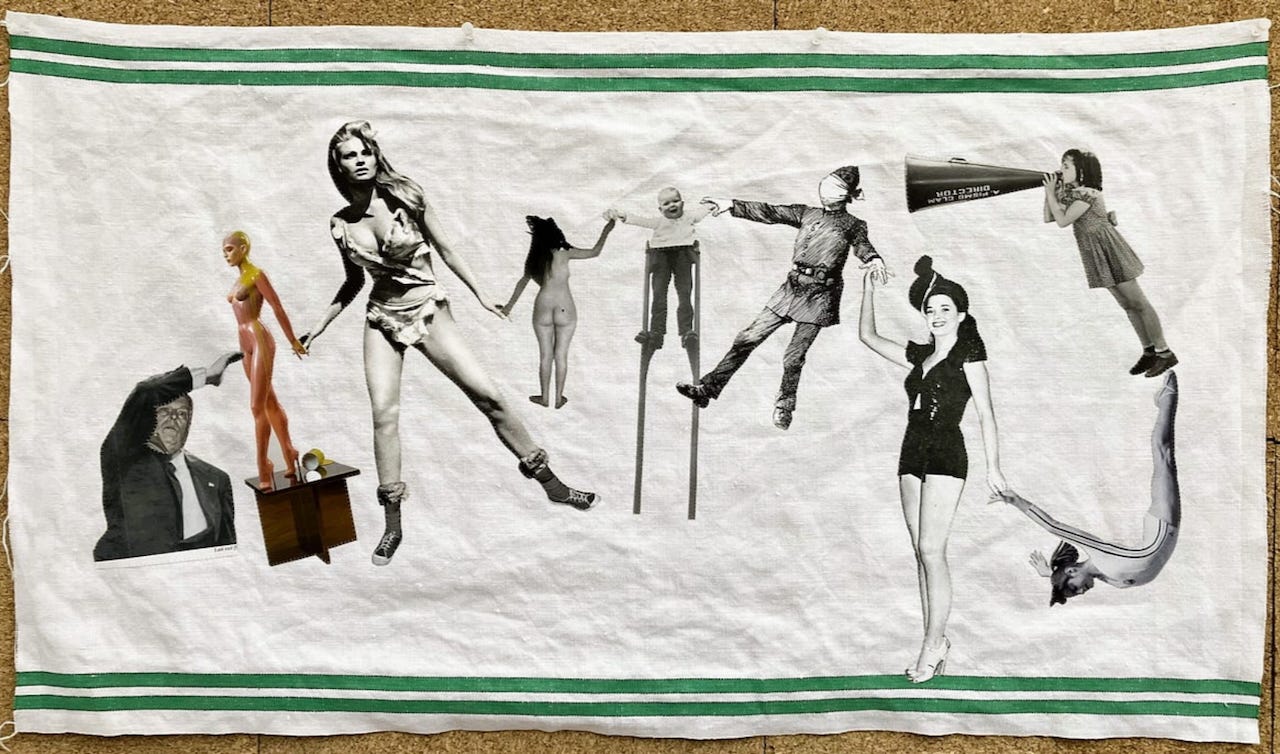
Alison Aye’s Without Fear Or Favour is a tea towel stitched with photographs cut from charity-shop books, arranged in a procession. It’s about misogyny and Epstein and the patriarchy and the institutions that produced all three. It is also, perhaps therefore, very funny. Gillray and Hogarth would have recognised the form. Satire that walks the line between tenderness and fury, modesty and force, research and piety. The satirist who can hold both ends of the line is the satirist who knows what is at stake for the people inside the picture, including the people being picked off. Alison does.
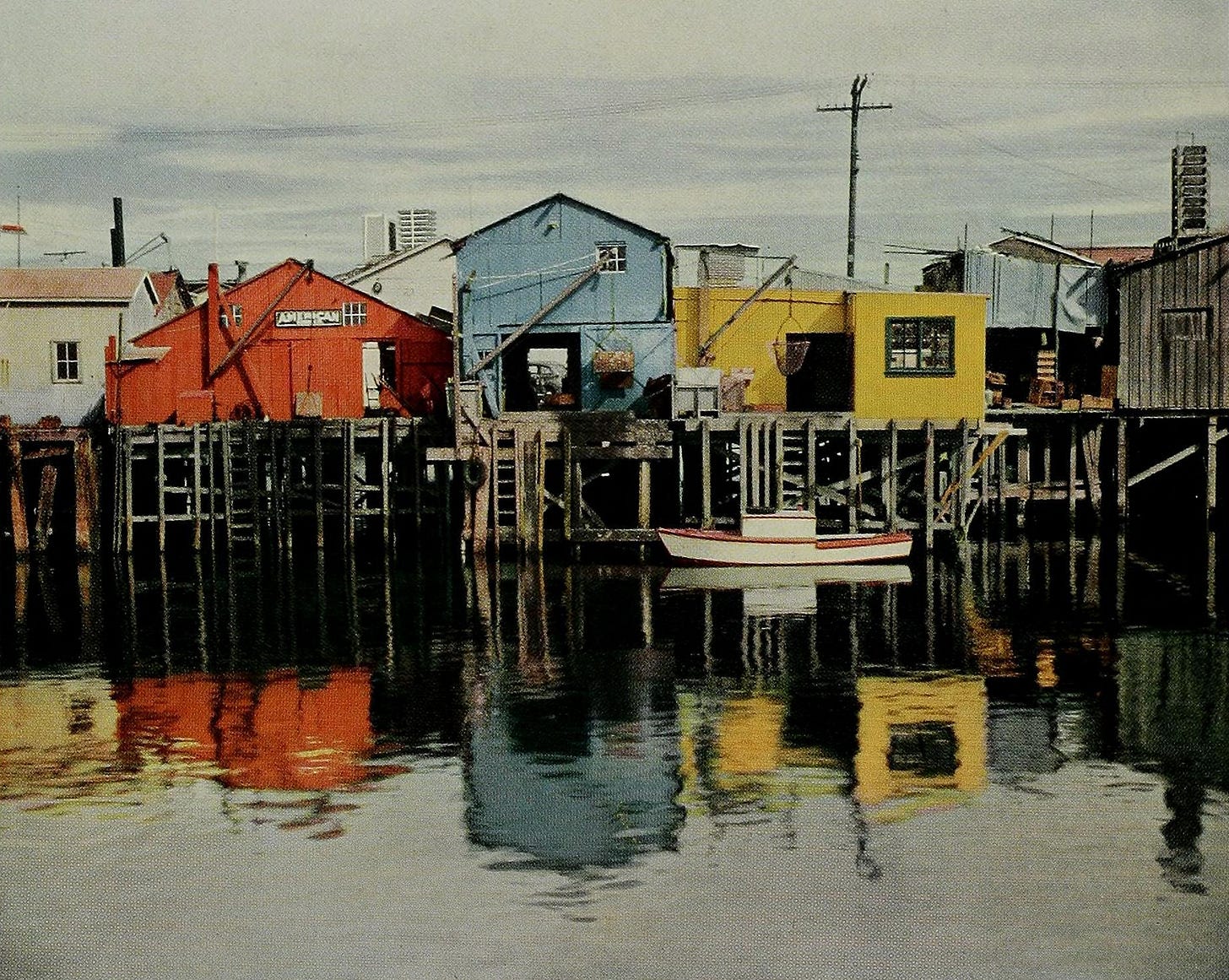
Beaumont Newhall’s History of Photography, 1949, opened with a colour frontispiece by Edward Weston. Waterfront, 1946, from a Kodachrome transparency. Red and blue and yellow sheds on piers, “AMERICAN” stencilled on the largest, the whole scene doubled in the reflection into something very close to a Mondrian. A working waterfront abstracted into composition. Photography’s bid, in new colour, for the seat modern painting had already taken.
This history opens with a tea towel made by a woman in South London cutting up a 1985 Octopus Books reprint of Great Movies that once belonged to B. V. Wells and cost £10.05. Its figures are not abstracted. They are still legibly what they were before she cut them out.
The procession
Alison calls her piece a “line of touch”. Nine collaged figures holding hands, left to right, in what begins to look like a protest march. It’s a motley bunch.
Nixon’s body wears Andrew’s face, the disgraced president carrying the disgraced prince. Allen Jones’s Action Painting, 2015, follows, a naked fibreglass woman in improbable stilettos and coated in dripping yellow paint, exhibited at the 2016 Royal Academy Summer Show by a Senior Royal Academician. This figure carries its own quiet charge. Alison spent years being rejected by the Summer Show, finally accepted in 2024 at her thirty-first attempt. She cut Jones’s sculpture from the 2016 catalogue, a book the Royal Academy sold in its shop.
Raquel Welch follows in her One Million Years B.C. fur bikini, walking on the feet of a women’s libber from the 1971 Miss World protest, sheepskin Afghan coat included. The pin-up walks on the feet of the women who came to wreck the competition that produced her. Baby Andrew at Balmoral, 1960, stands next on the stilts of an unnamed Kent hop-picker from 1927, the royal body on the working body. Tenniel’s 1888 Punch engraving gives us the policeman blindfolded while hunting the Ripper. Peggy Satterlee, sixteen when she accused Errol Flynn and was destroyed in court by his lawyer for her trouble. Nadia Comăneci, fourteen in Montreal, scoring perfect tens and told later to smile more. Evelyn Del Rio, the Latin Shirley Temple, dancing at the Cotton Club from the age of three. “Call me cynical,” Alison writes, “but I can’t see how she could’ve possibly escaped abuse of some kind or another.” The line ends on her.
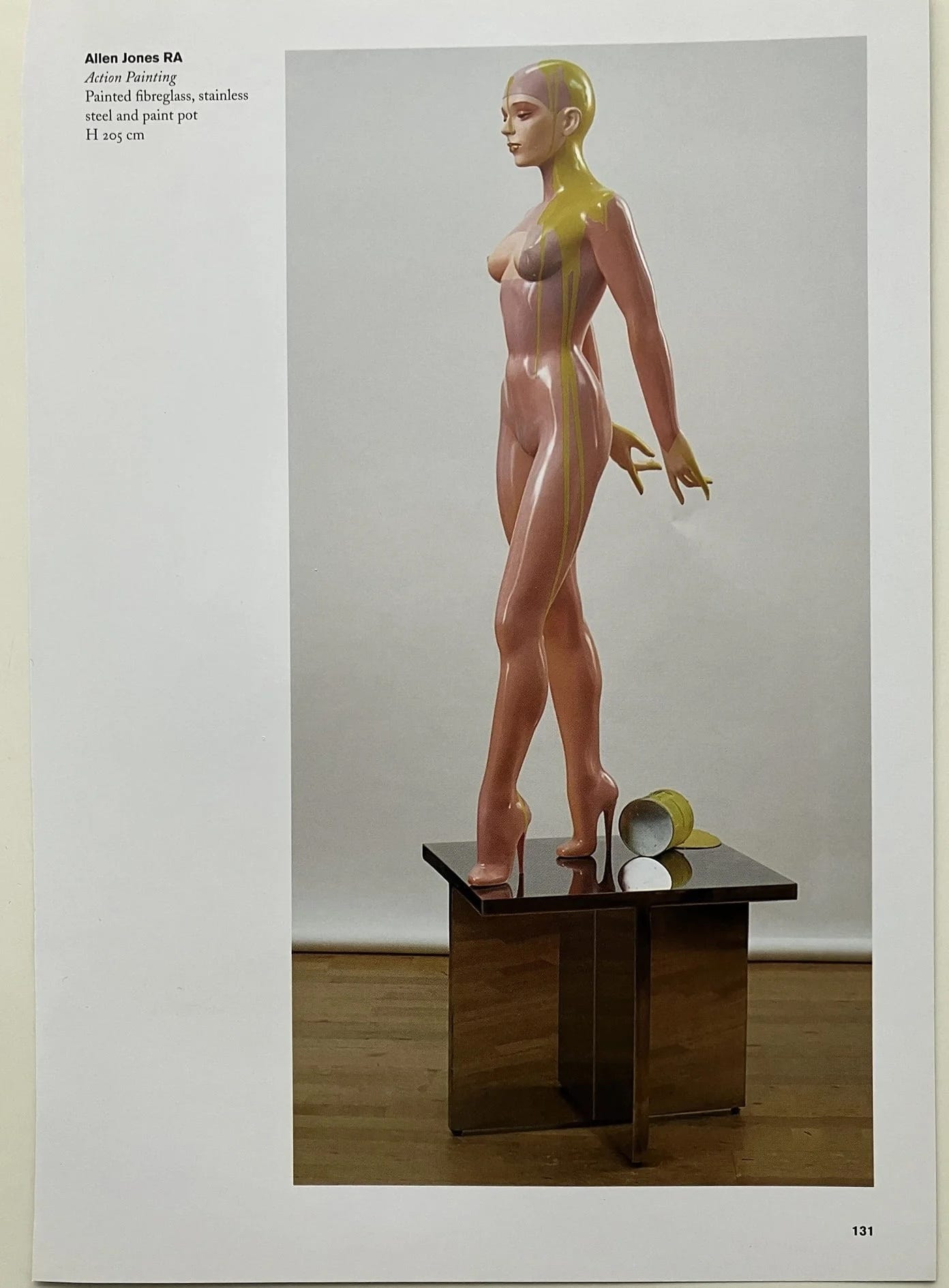
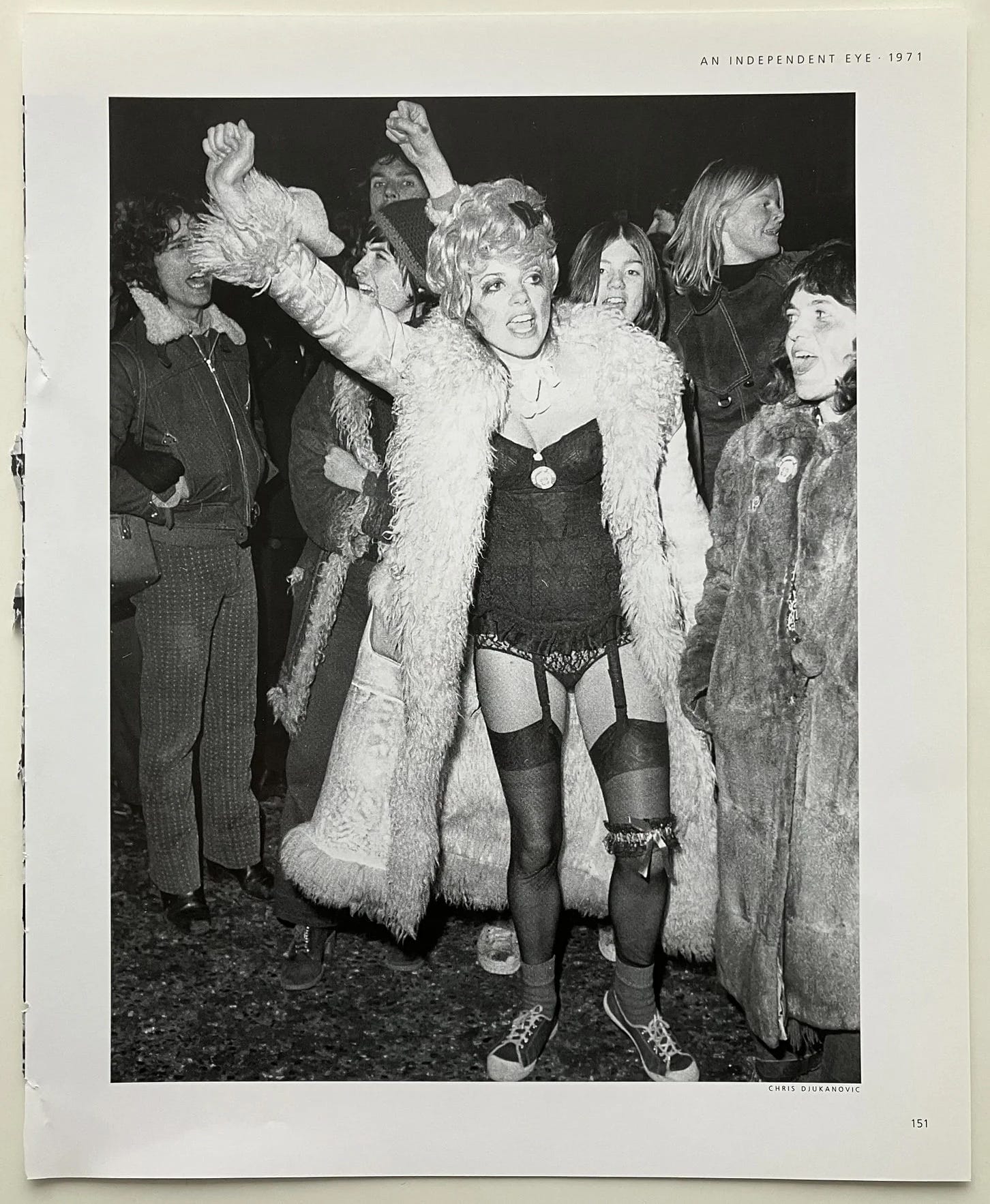
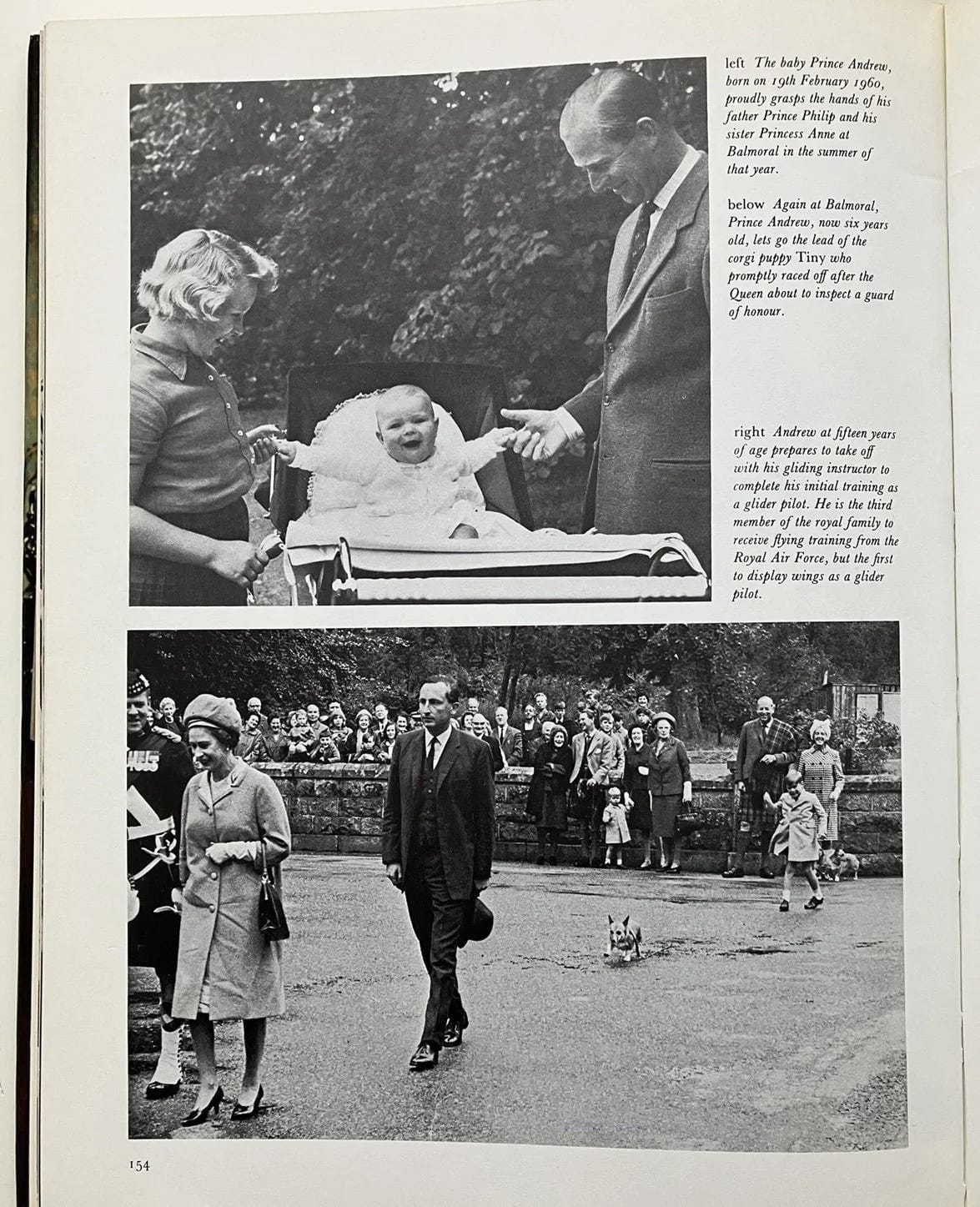
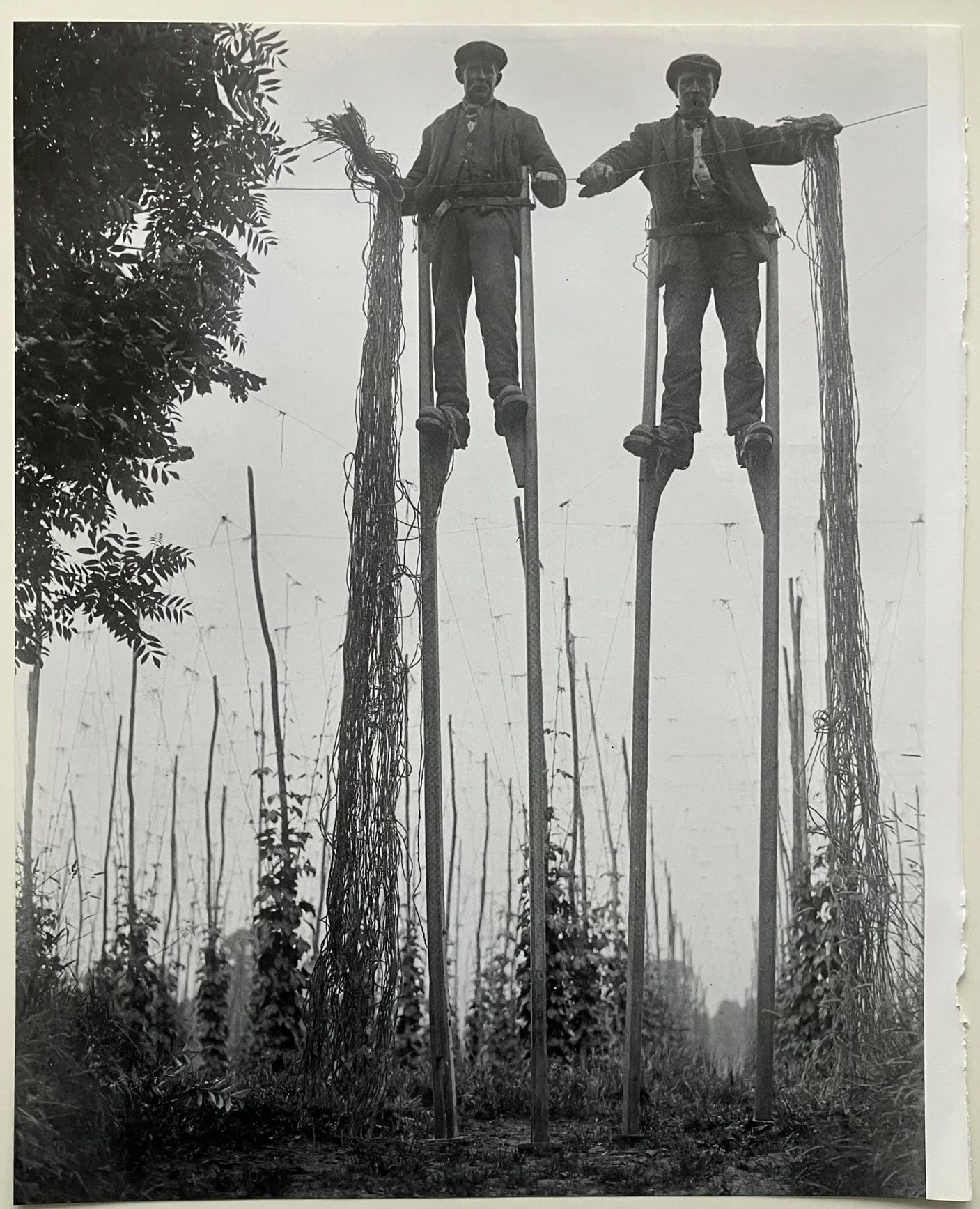
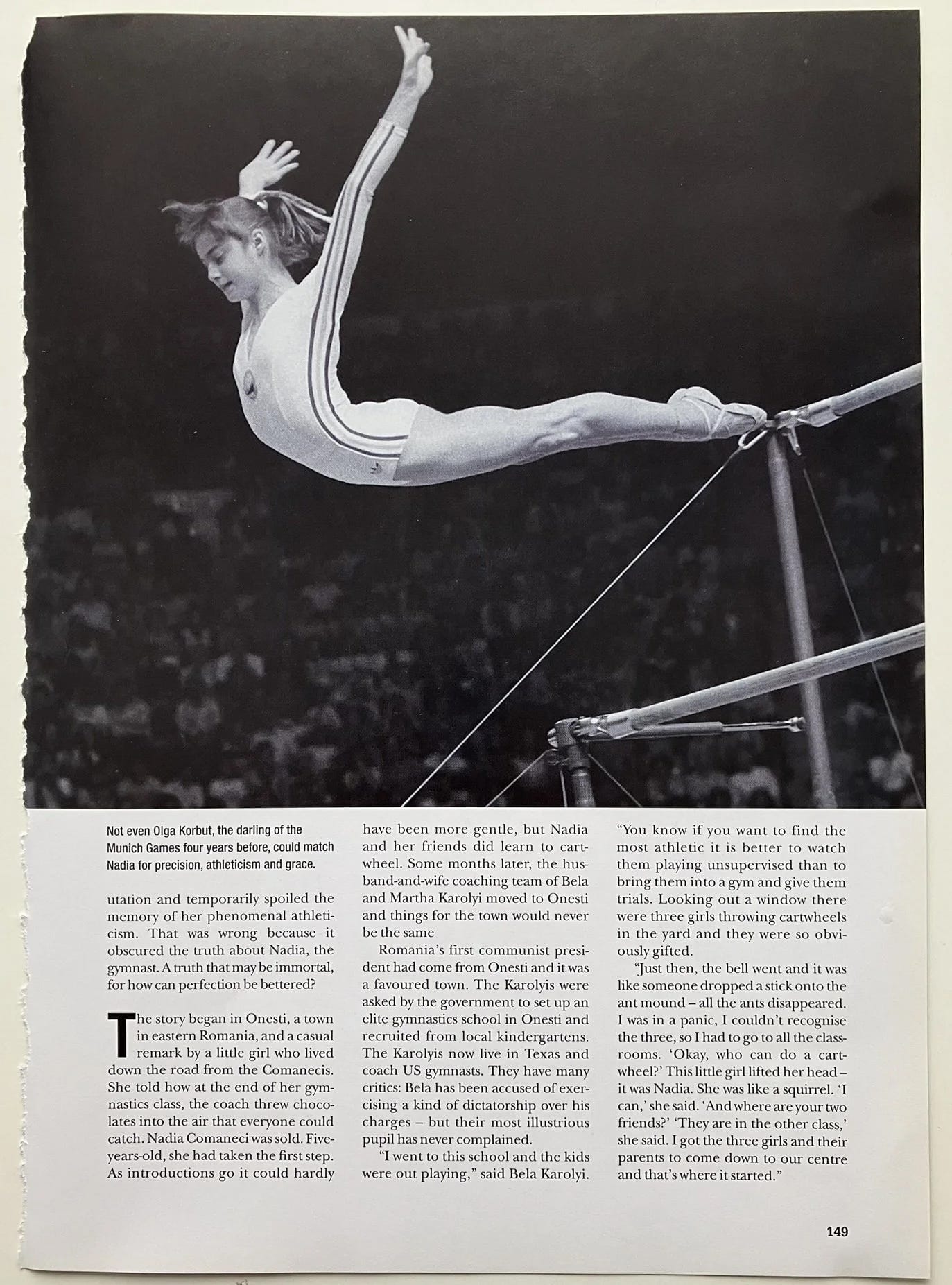
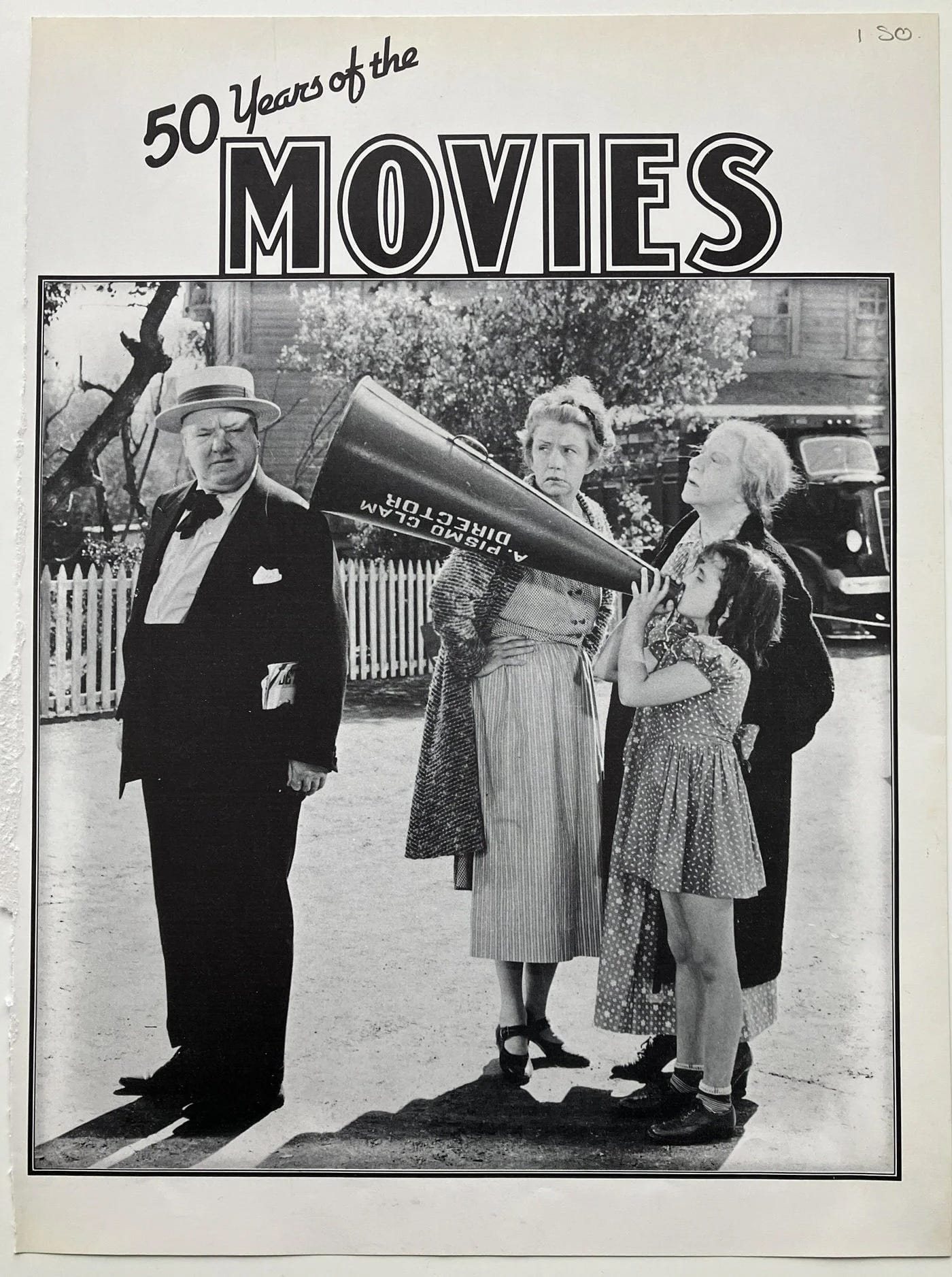
A selection of Aye's source material
The baby
Along with a recent Andrew from the letters page of the Metro, Alison has also chosen the baby at Balmoral. He belongs with the others. Del Rio was three, Satterlee sixteen, Comăneci fourteen. The Storyville sex worker’s age is unknown but likely not much older. Welch was “launched as a sex symbol” by her husband-press-agent before she could refuse the role. The line of touch is also a line of children pressed into service before they had consented to it. The baby Andrew fits here, uncomfortably. His adult choices were his, and Alison’s collage does not absolve them. Nixon’s body still stands under his face. But by giving us the child too, Alison refuses the easy satisfaction of the caricature. The difference between Andrew and the girls was privilege. He is supported by hop-picker’s legs, evidence of another working childhood. The institutions that produce figures like Andrew also produce their victims, and they produce them out of the same labour.
This is a harder reading of patriarchy than the easy satirical one. Nobody here was born bad. The system made them.
The centre
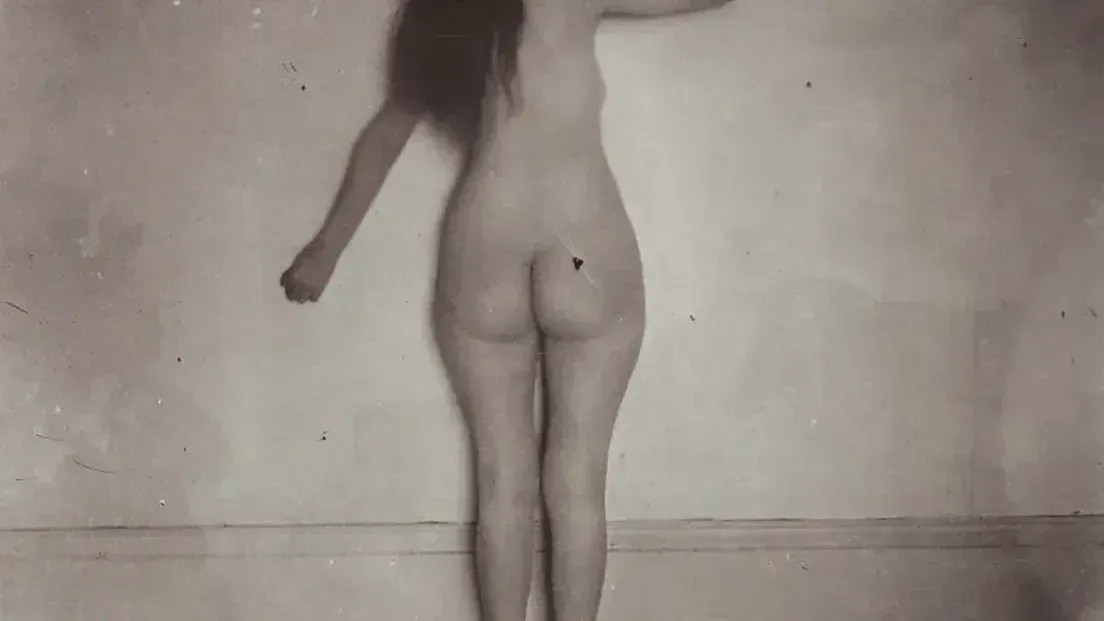
The figure at the centre of Alison’s line also deserves a longer look. E. J. Bellocq was a commercial photographer in New Orleans who, around 1912, photographed women working in Storyville, the city’s legalised red-light district. He died in 1949 and the plates sat unseen until 1958, when Lee Friedlander bought eighty-nine of them from an antique-book dealer. Friedlander made gold-toned prints and the images were exhibited at MoMA in 1970, catalogued by John Szarkowski. A Louis Malle film followed in 1978. Storyville entered photographic history, and Bellocq was assigned a place in the canon he had not sought and could no longer refuse.
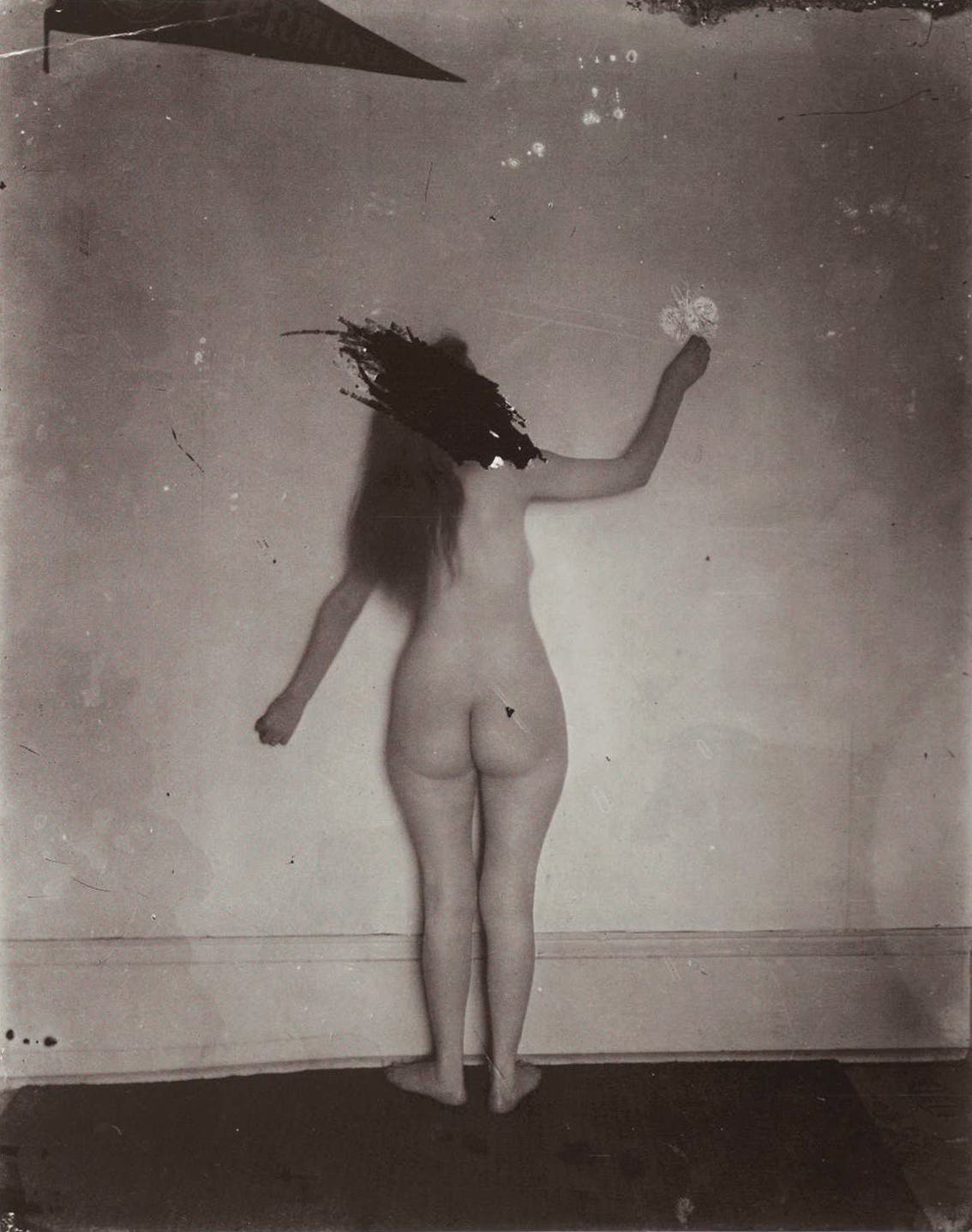
The woman stands in three-quarter rear view, her body turned partly into the light, one arm raised toward a butterfly she has drawn on the wall behind her in white chalk. There is a small dark heart on her left buttock, tattoo or drawn. Her face is scratched off the plate in thick strokes.
Look at the photograph for a minute.
Nobody is being extracted here. The pose is too alive, the composition too cooperative, the lightness too mutual. She has drawn the butterfly. She has arranged herself in relation to her drawing. Bellocq has chosen the angle, set the exposure and worked with what she offered him. This is a photograph two people made together. The surprising thing about the Storyville plates, which many people have noticed over the decades, is their tenderness. It is the record of a collaboration. Alison writes: “We’ll never know the full story, but I’m choosing to think he erased her face to protect her identity.” She chooses the kindest reading and admits she is choosing. It is probably the right one. The face-scratching, in this light, is of a piece with the collaboration rather than against it. Not an erasure of her but a continued protection of her, after the fact, by someone who had cared enough to help her make the picture and then cared enough to guard it.
The caption in Alison’s source calls the woman a “prostitute”. Alison calls her a sex worker. The quotation marks she puts around the book’s vocabulary do the quiet labour of refusing it.
The structure of recovery is integral to photography’s history. Berenice Abbott bought Eugène Atget’s negatives from his concierge in 1927, after his death, and spent decades making prints and securing his reputation. Friedlander bought Bellocq’s plates in 1958 and did the same. More controversially, perhaps, John Maloof rescued Vivian Maier from obscurity. In 1991 Friedlander would publish Nudes, containing pictures of his wife Maria that Justine Kurland would eventually cut up.
SCUMB Manifesto includes Nudes (Fisting), 2021, made by dicing Friedlander’s book into a shape-shifting cascade of abstracted limbs. The piece hangs in the V&A’s American Photographs exhibition now. The title’s violence is doing argumentative work. Kurland was Friedlander’s student. She has said in interviews that she loved his work. She cut it up anyway, because the nudes were where her love of the work stopped being tenable. The canon does not distinguish between the act of care and the act that later required a different kind of care. It absorbs both, circulates both and leaves the distinctions to be made by whoever comes next with a pair of scissors.
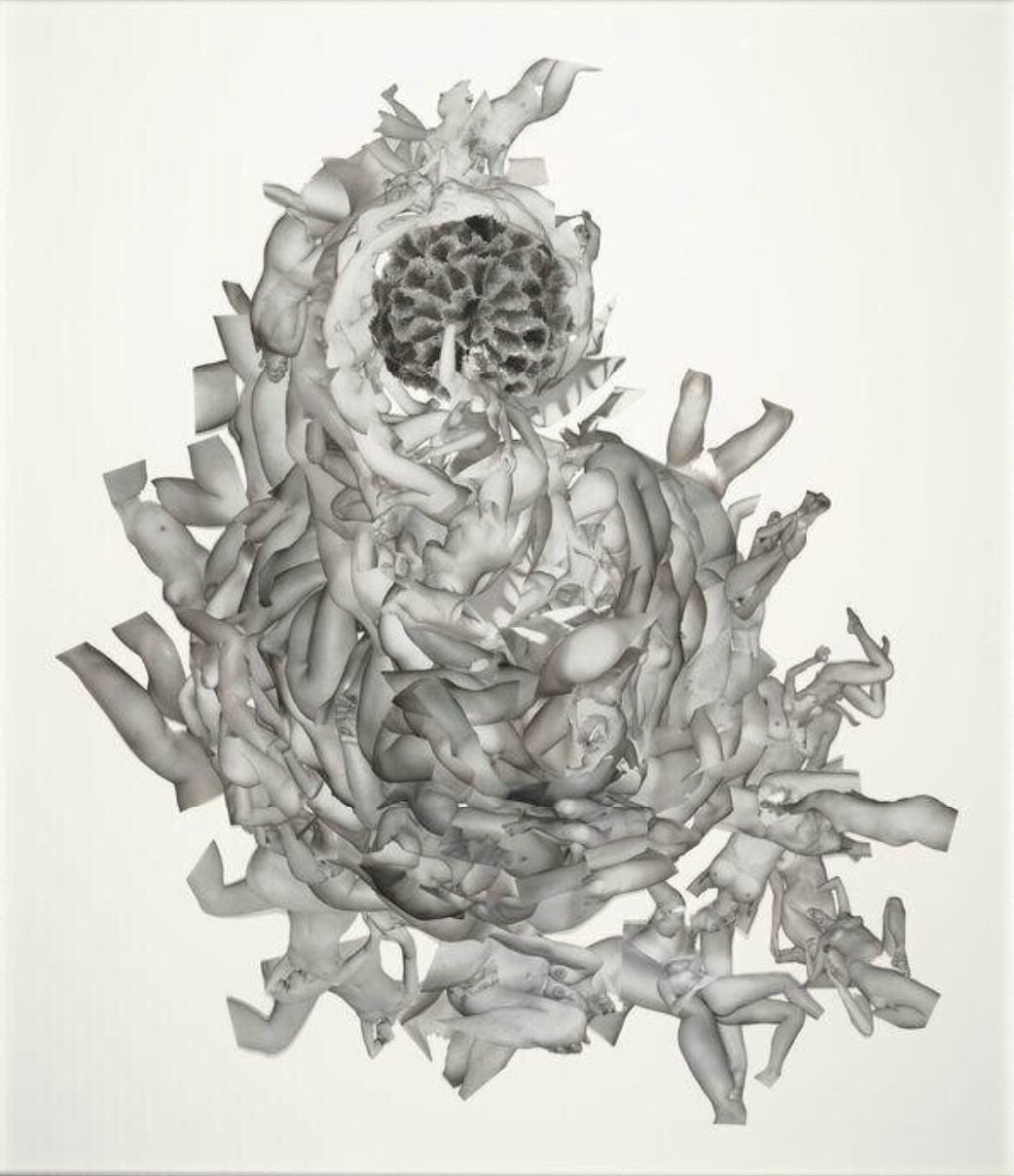
Alison places the Bellocq portrait at the centre of her line. Six figures layered on one plate. The sex worker who drew the butterfly. The photographer who helped her make the picture. The person (possibly the same photographer) who scratched the face. Friedlander who printed and circulated the image. Phaidon who published the 1997 book from which Alison cut it. Alison who stitched it to the tea towel. The collaboration at the first layer is the point of the placement. Alison has put the most cooperative image in the procession at its centre. The extractive figures march around a counter-example.
The register
What keeps the piece on its feet is the register it sustains. Tender and furious at once. Modest in scale and forceful in argument. Scrupulously researched without being pious about it. The hand-stitching is not decorative. It is the time she gives to the figures, the literal thread of her looking, which stands against the extractive speed of the image industry that used them. The tightrope is the form of the satire. Alison holds it by letting the rage at Andrew coexist with the tenderness toward the sex worker, the baby and the hop-picker. The adult Andrew is not let off. The baby is not turned into an excuse for him. Both are true at once, because both are what the class system produces.
Class and the image
Alison’s is a working-class art practice. Her biographical note tells us she is the daughter and granddaughter of seamstresses and coal miners. She could sew at an early age. She makes work that respects traditional craft and class struggle, and ignores “the misogynistic hierarchy of the art world, where needlework is often neglected.” But working-class here means more than the biographical fact. It names a tradition of radical critique that understands class, capital and the image industry as the same apparatus, and that attempts to expose the systemic violence the arrangement produces in everyone it touches.
Photography is not an innocent bystander in the procession. It is the medium through which most of these figures became products. Welch was launched as a sex symbol by publicity photograph. Del Rio was a headline dancer at the Cotton Club from age three by publicity photograph. Satterlee’s face survives because the scandal sold papers. The Storyville portrait became canonical because MoMA acquired it. The Balmoral photograph maintained the myth of the benign royal family. All of these images worked for somebody, and most of them worked for the same somebody, and that somebody was not the women in the frame.
This is what Berger was tracking in Ways of Seeing, 1972, when he argued that the oil painting flatters the patron, the advertisement flatters the shareholder and the woman inside both is the material through which the flattery is delivered. Alison is working in the line that runs from Höch’s photomontages of the 1930s through Berger to Kurland’s SCUMB. The line understands that the image industry does not stand outside the class system. It is one of the class system’s most efficient machines. The hop-picker in the Kent field, the child star at the Cotton Club, the Storyville sex worker and the fourteen-year-old gymnast are all workers inside the same economy. The men at the top do not escape the arrangement. They are corrupted by it in a different and more powerful register. Nixon and Andrew are not innocents given a regrettable outcome. They are the arrangement’s end products.
Alison’s procession is not a general indictment of men. It is against a particular formation of masculinity that class and capital keep producing, the one that delivers the abusers and the enablers and the men who stand by. Bellocq, at the centre of her line, is the evidence that other forms were and are possible. A man who worked alongside the women he photographed, whose collaborations survive on the plate as traces of the way power could have moved differently in that room. The procession marches around him because he is what the arrangement fails to produce often enough. The indictment is of the system, not the sex.
Alison’s refusal to credit photo agencies catches this precisely. Photo: Getty. Photo: Rex. Photo: PA. The company names are the last link in a chain that started with a woman’s body and a man’s commerce and got laundered through several layers of incorporation until the actual labour disappeared. When Alison demands the name of the person who pressed the shutter, she is reversing the laundering. She is putting the labour back in the frame. The photograph is work done by a person under conditions somebody else profited from. The same is true of the figure in the photograph. And the same is true of the tea towel Alison sewed at home, in the same tradition as the seamstress grandmother, inside an art world that files needlework as domestic and therefore negligible.
Modesty and scale
A word on scale. Kurland’s SCUMB Manifesto is magnificent and also, in a way that sits awkwardly with its own argument, huge. Its radicalism is somewhat domesticated by the company it keeps and the size at which it commands the wall. Alison’s work has not been absorbed in the same way. It took thirty-one attempts to make it into the Royal Academy Summer Show, and the RA is not the V&A. The wait tells you something about the institution’s tolerance for the kind of thing Alison does, and its long patience for the kind of thing Allen Jones does. Without Fear Or Favour measures 43 by 73 centimetres. It is a tea towel. You could fold it up.* You cannot monumentalise a tea towel without the joke collapsing.
Lineage
Photography, as the canon narrates itself, takes itself extremely seriously. The photographer as witness. The photographer as sensitive seer. Newhall’s tweed. The fine print. The monograph. The wall label. The solemnity has costs and one of them is that photography has mostly forgotten how to be funny in a way that bites. Elliott Erwitt carried the joke inside Magnum while his colleagues were winning awards for gravitas. Duane Michals wrote little stories by hand on his prints and, in This Photograph Is My Proof, 1967, mocked the idea that photographs prove anything at all. These are photographers consistently described as “minor” by people whose idea of major involves solemn men in Yosemite. Geoffrey Batchen, in Each Wild Idea, 2001, argued that the canon has systematically ignored vernacular photography because it complicates the indexical story. The vernacular tradition is also the satirical tradition, and both were buried for the same reason. They wouldn’t sit still for the seminar.
Coda
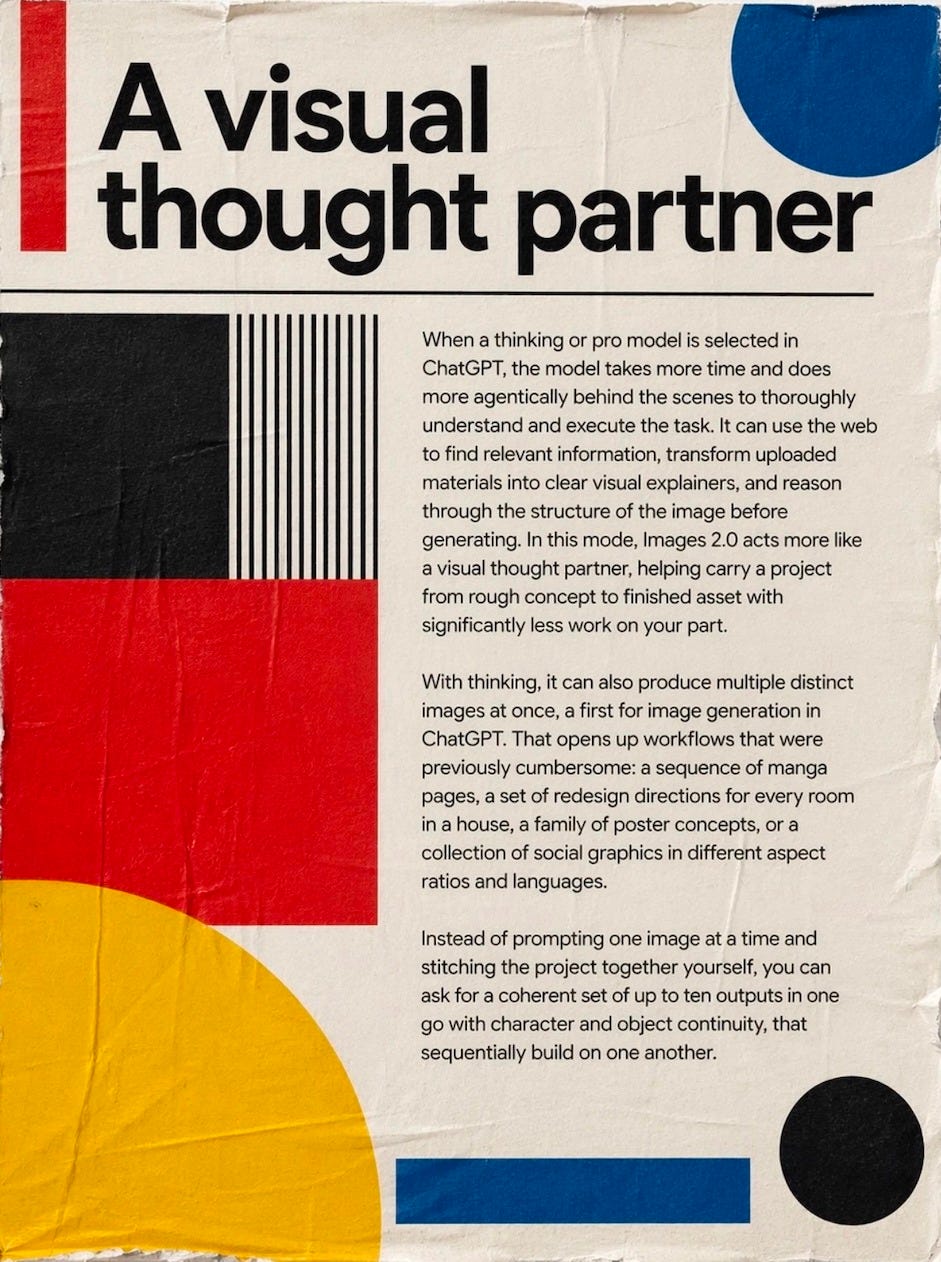
ChatGPT’s new image engine calls itself a “visual thought partner”.
Instead of prompting one image at a time and stitching the project together yourself, you can ask for a coherent set of up to ten outputs in one go …
The language and mid century styling (an uncanny echo of Weston’s waterfront Mondrian) is fascinating. “Stitching”. Alison’s thread is real.
Photography is what happens when images made by machines enter the hands of people who do things with them. The hands Alison honours are the ones that did the work and never got their name in the book.
Thanks for reading PhotoPedagogy! Subscribe for free to receive new posts.
These posts will always be free but, if you enjoy reading them, you can support my analogue photography habit, and that of my students, by contributing to the film fund. Thanks to those of you who have already done so. All donations of whatever size are very gratefully received.
* In Alison’s own words: “Just one thing - yes, it could be folded but I would be forced to kill the folder!”