Fragments, Interventions & Constraints
Notes on building a photo collage app and other vibe coding experiments.
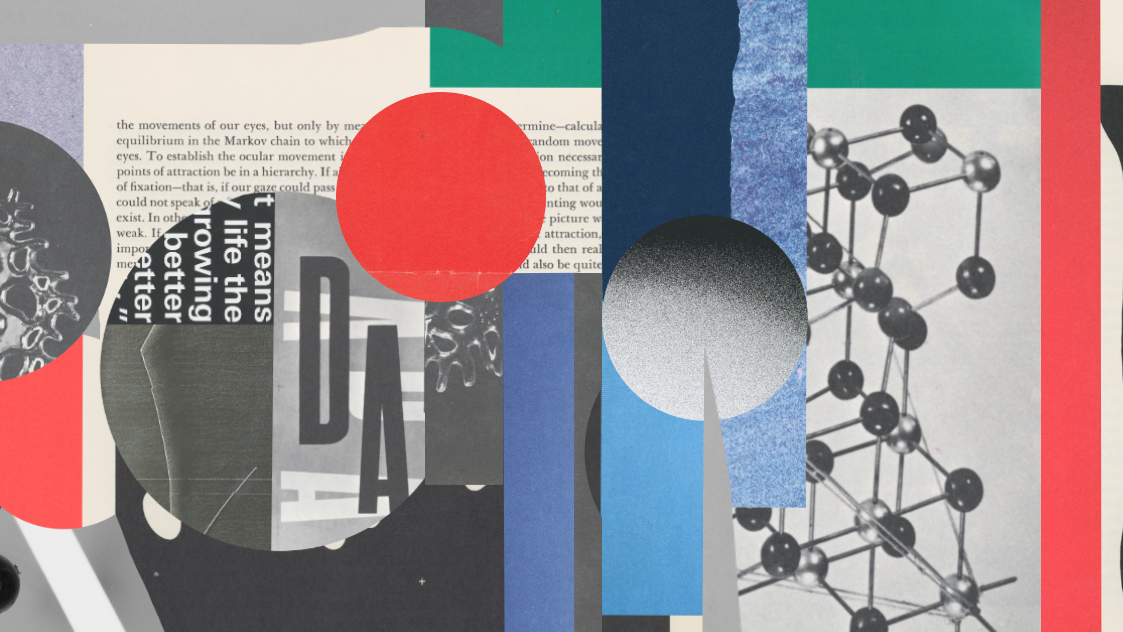
Collage is close to the most analogue thing a person can do with a photograph. You cut, you tear, you shuffle the pieces, you commit. There is something faintly perverse, then, about rebuilding all of that on a screen.
My defence is that starting is the hard part. For a lot of students the problem is rarely a lack of imagination. It’s the small mountain of friction in front of the first move: finding source material worth cutting up, the glue that dries too soon, the irreversible snip, the missing piece. A screen removes some barriers. Nothing has to be found and nothing you do is ever final. What the screen cannot give you is the tactile and the irreparable, the small thrill of having wrecked something for good. I’ve tried not to pretend it can. The Collage app is a way in. It was never going to replace the table covered in cuttings.
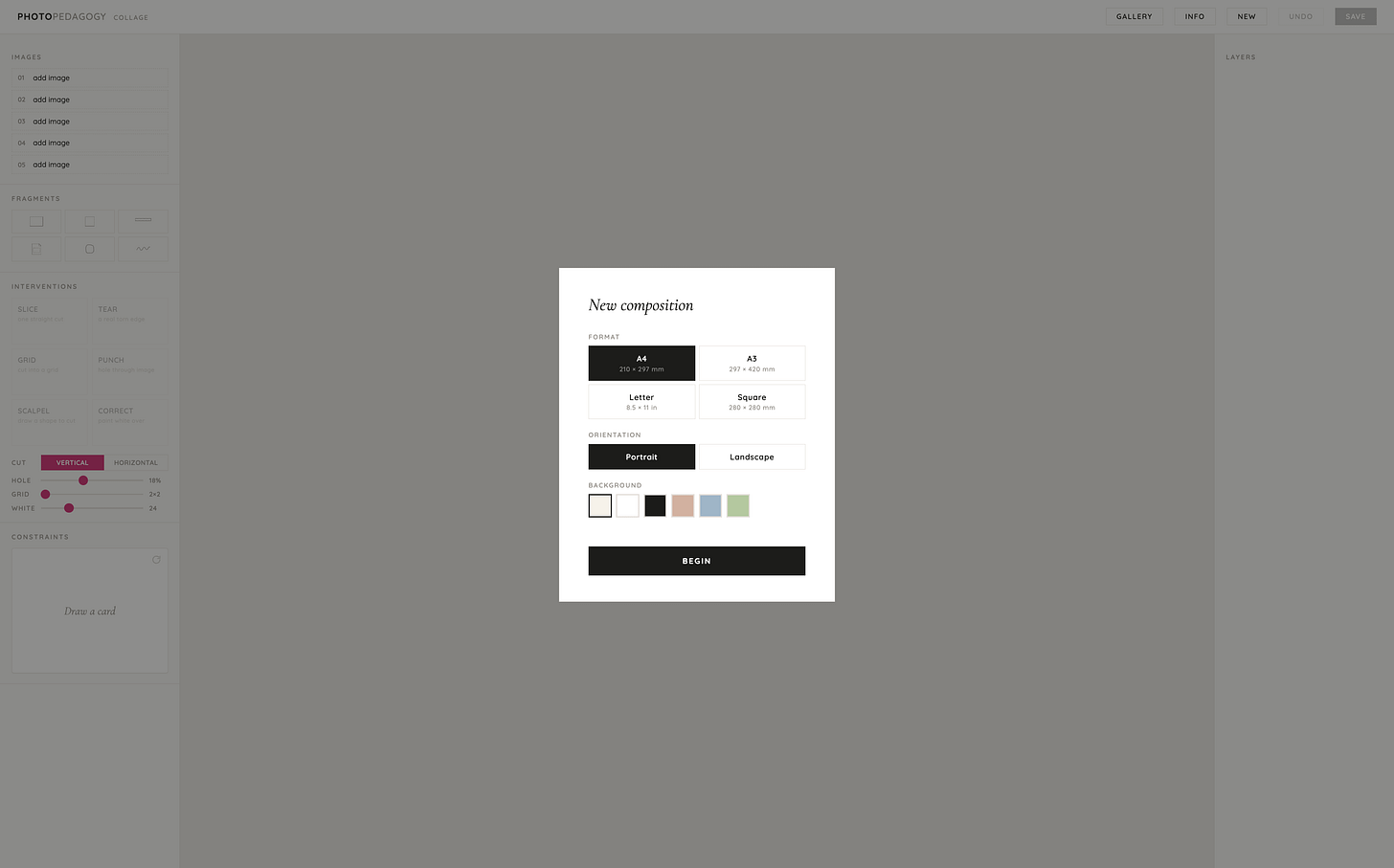
What it does offer is practice in a particular kind of seeing. The fragments are dealt out by chance, from a bag the student cannot look into and there is a deck of constraint cards that issues Oulipian instructions.
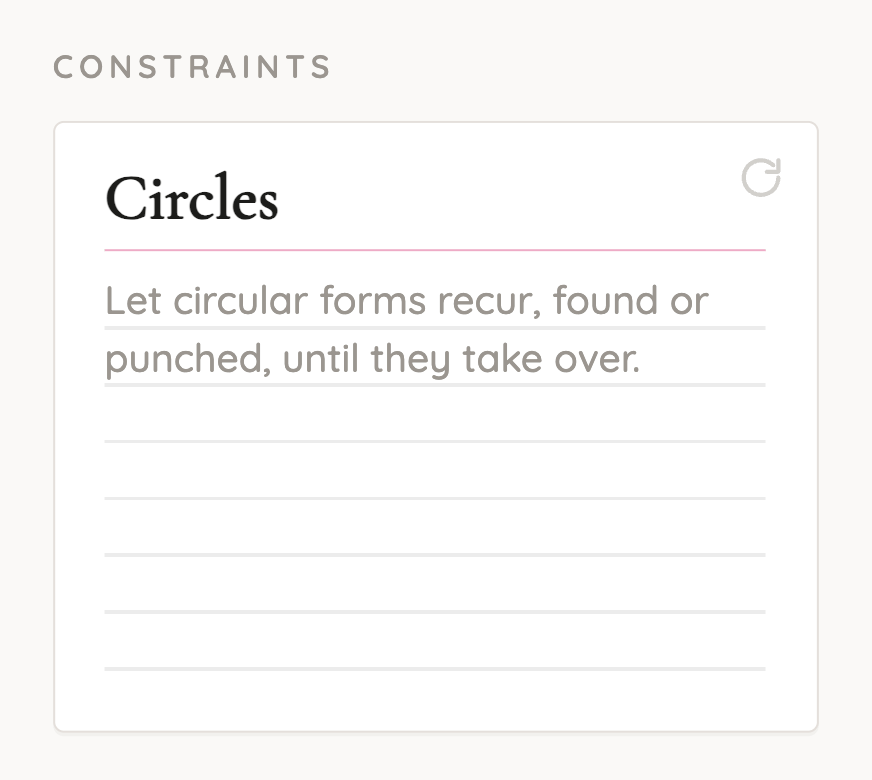
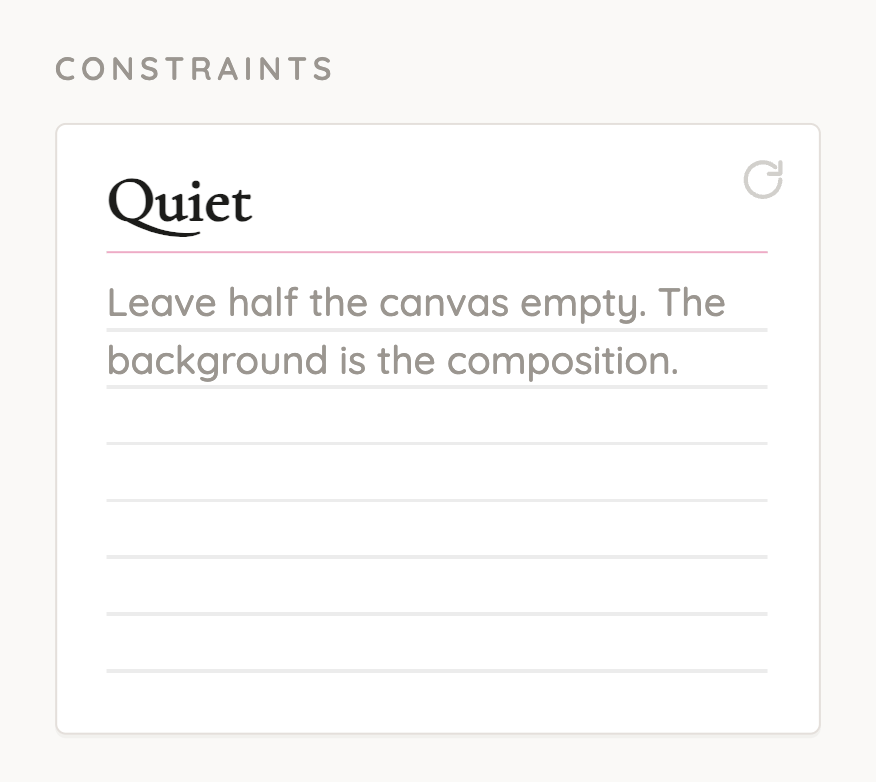
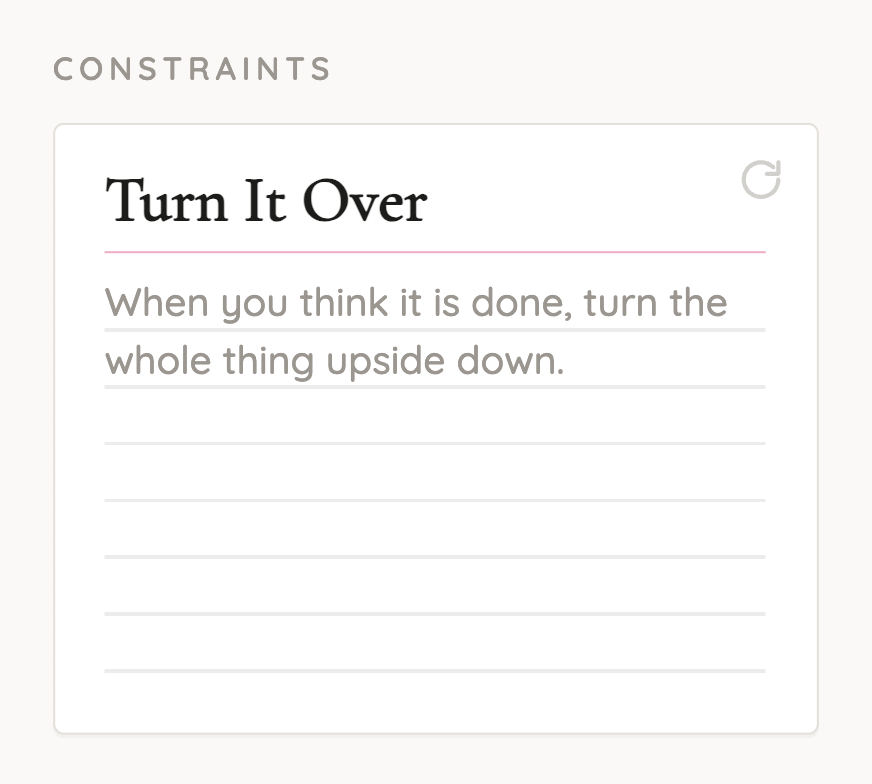
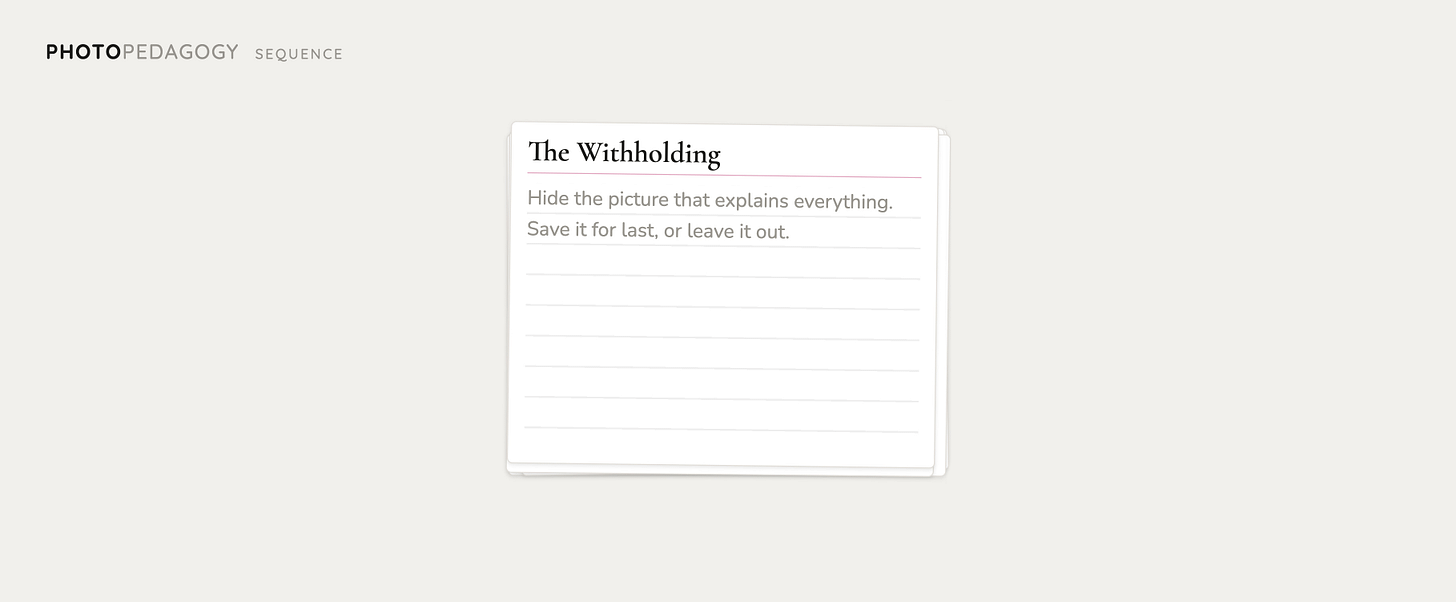
Constraints cards
Hopefully, chance is doing some pedagogical work here, guiding a student past their own taste and handing them a juxtaposition they then have to make sense of. Working out why two unlike things have suddenly started to rhyme is most of what photographic looking comes down to. The stakes are low, so they can play. They can tear a piece, punch a hole and keep the disc that falls out of it, rotate everything ninety degrees and begin again. Because nothing is final, they’re more willing to risk something interesting. At least, that’s the theory.
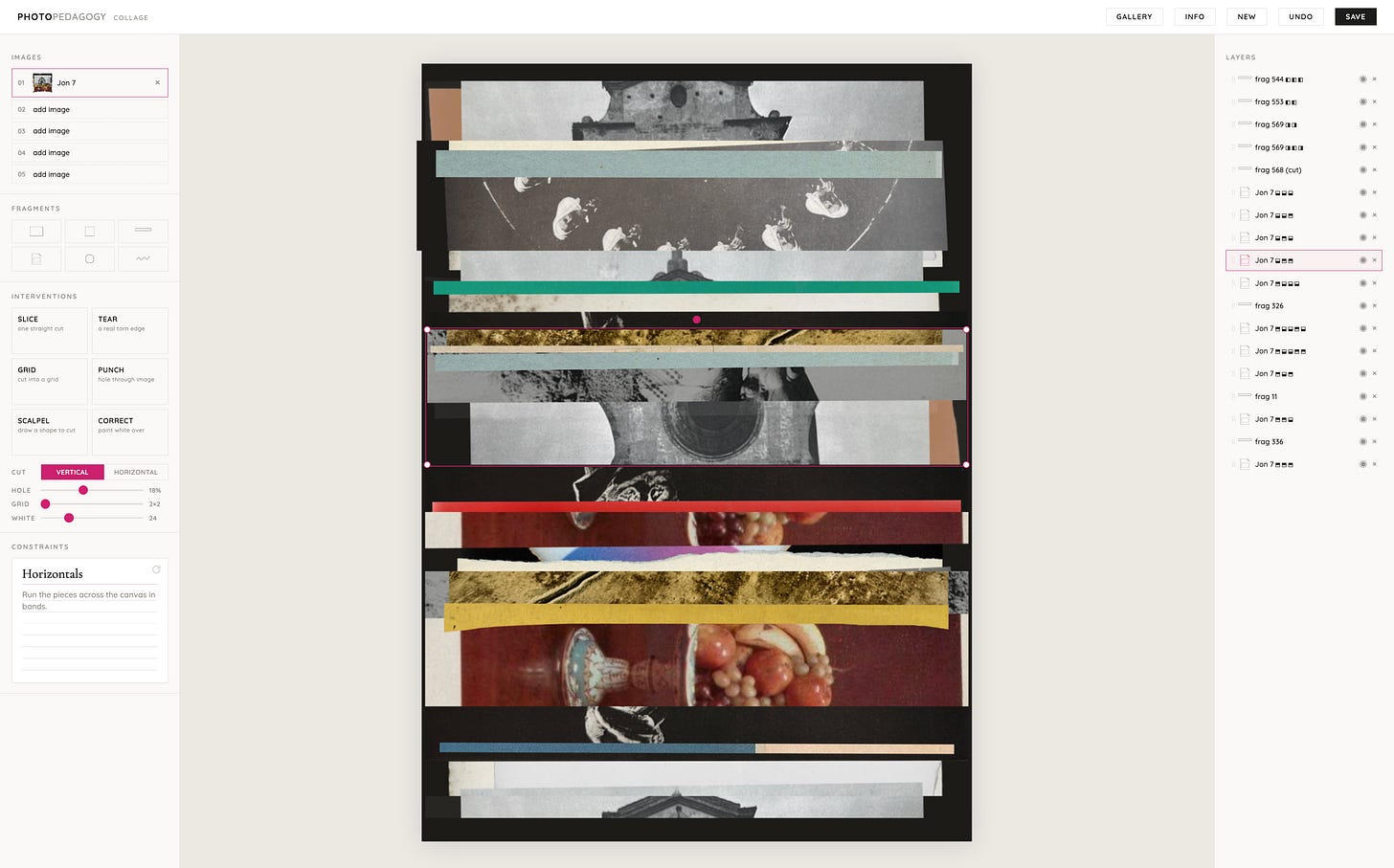
I built this with Guido, my AI photography guide. I still worry about what AI is doing to images. The standard fear, that generative models are flooding the world with synthetic pictures, cutting the photograph loose from the thing it was once a trace of, and quietly devaluing the labour and the looking that photography depends on, seems to me well founded. I have no wish to wave it away in order to look relaxed and contemporary.
That fear, though, is about one use of the technology, the making of images. What I’ve been doing is a bit different. Guido (Claude Anthropic Opus 4.8) wrote the code. It didn’t make a single image in the app. Every fragment in it is real, scanned from paper I own, old photographs and book covers, paint splodges, torn textures and stray bits of type. The creative act the tool supports is recombination, the oldest collage move there is, performed on indexical scraps that were each once a real mark on real paper. What the AI gave me was the thing I lacked, which was a way to turn a dormant idea into a working tool without first spending years learning to code. I suspect a great many good teaching resources die in that gap, between the inkling of an idea and the skill to make it. This one didn’t have to.
It’s worth saying how a photography teacher ends up building software at all, since I am not, by any stretch of the imagination, a coder. It began with Remix, a small experiment that appropriates the website’s own quotations and images together at random to ask what happens when pictures meet words. It owes a debt to Alan Huck and Jonas Feige’s The Mute Testimony, and to one of our threshold concepts, the idea that photographs rely on chance, more or less. Remix worked well enough to be encouraging, so I attempted something harder. Diptych deals out two images at a time, photographs of photographs from books in my library, shot fairly casually on a phone and shown without captions, the interest being what the pictures say to each other. Each one taught me a little more about what had come within reach for someone with ideas and no formal way of realising them, and Collage is where the appetite led. The fashionable name for the method, prompting a machine in ordinary language until something appears, is vibe coding.
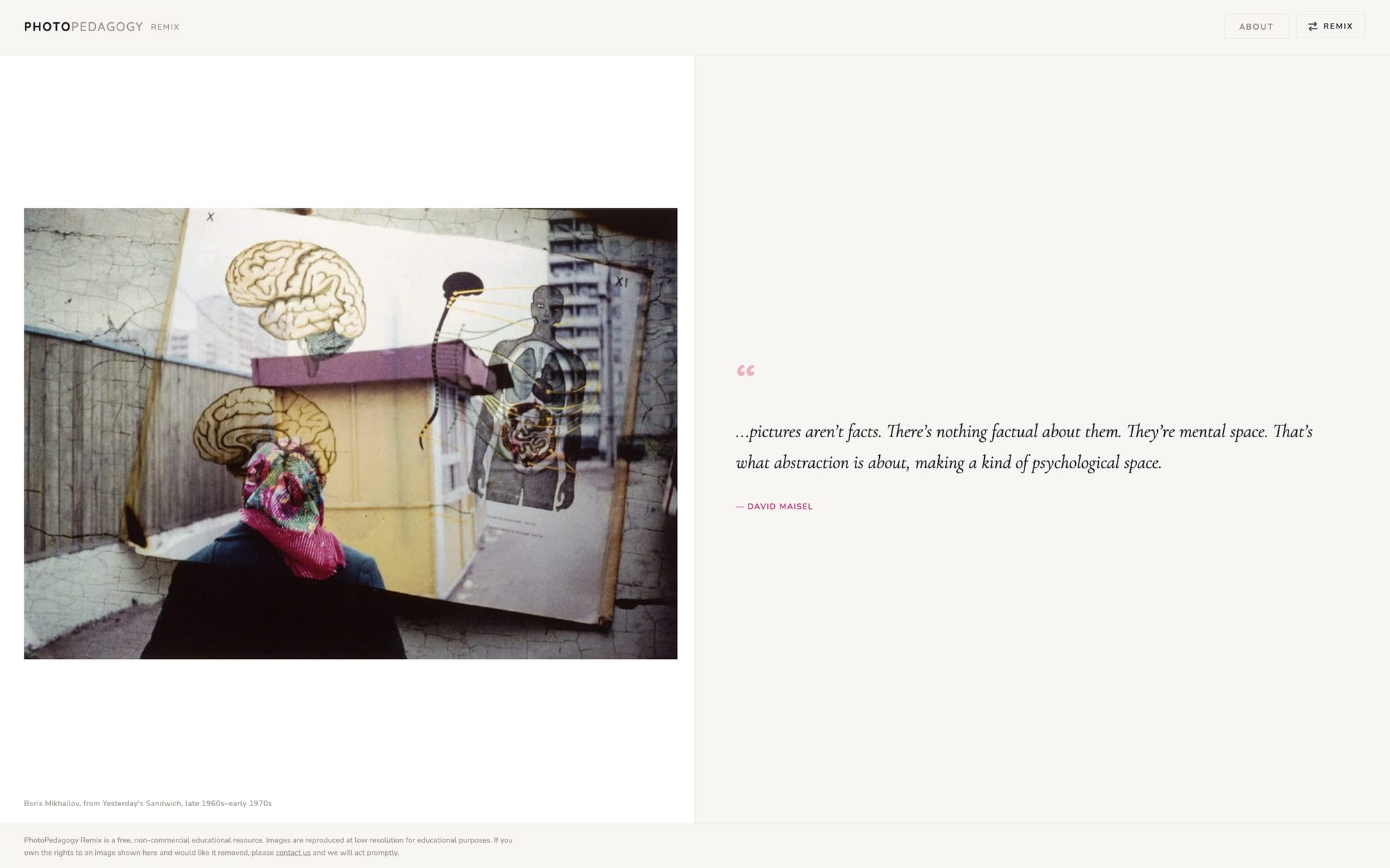
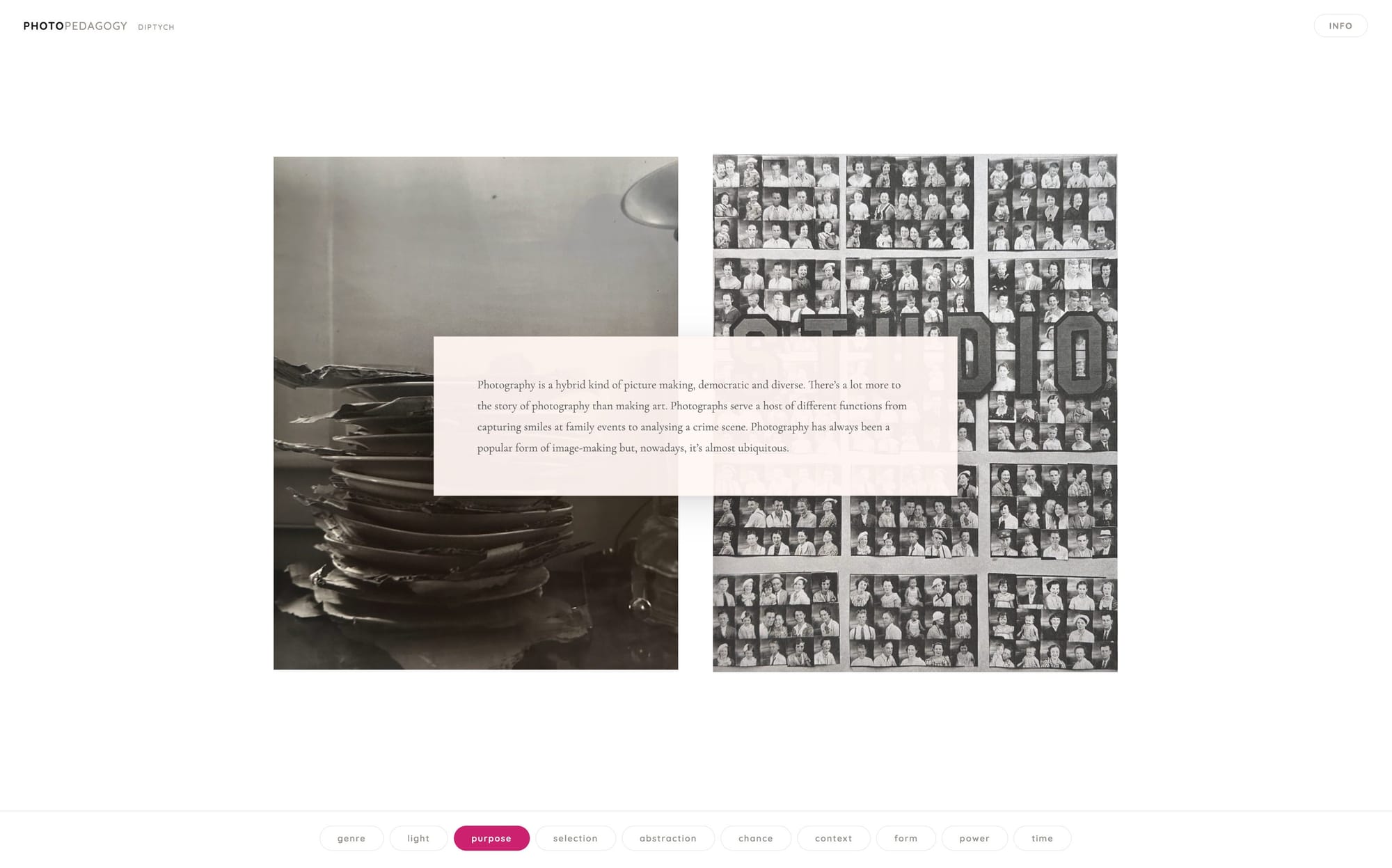
The Remix and Diptych apps
If the name makes it sound frictionless, it was not. The smooth version you sometimes read about is a fiction. We made plenty of mistakes and went down lots of rabbit holes, having to scramble our way back to the surface. On at least one memorable occasion Guido offered a tidy, confident explanation for a mistake rather than admit that ‘he’ didn’t know what had happened. I maintained editorial control and a suitable amount of scepticism. I consider myself the author of the app, if not the manufacturer. The taste and the judgement, the decisions about what the tool was for and what it ought to refuse to do, remained mine, and the moments of friction turned out to be among the most clarifying parts of the process. If there is a classroom lesson in any of that, it may be a useful one. The machine is a collaborator you must never entirely trust, which is a thoroughly healthy relationship to model for students who are about to grow up surrounded by them. And I don’t entirely trust my cameras either.
The app sits in a strange place. It is a digital simulation of an analogue act, assembled from digitised real things, producing new digital images, made with the help of a machine, and containing no generated imagery at all. It may be an interesting object to give to students who are trying to think about AI and the image, precisely because it refuses easy categorisation. It lets you talk about what an AI-generated picture is by holding up, right beside it, something that is digital and machine-assisted and yet still anchored, all the way down, to a real fragment that was once somewhere in the physical world. The indexical trace survives the scanning. That stubborn fact, that these pieces point back at something that was really there, is the whole of the difference, and a student can feel it long before anyone makes them define it.
Diptych says the quiet part out loud. Its pictures are copies of copies, photographs of photographs, cut loose from their origins in the way images travel now, restless and endlessly recombined. That is the precise condition the argument about AI images is really about. These tools drop a student straight into it, then keep one foot in the real, because every scrap in them began as something that once existed in the world.
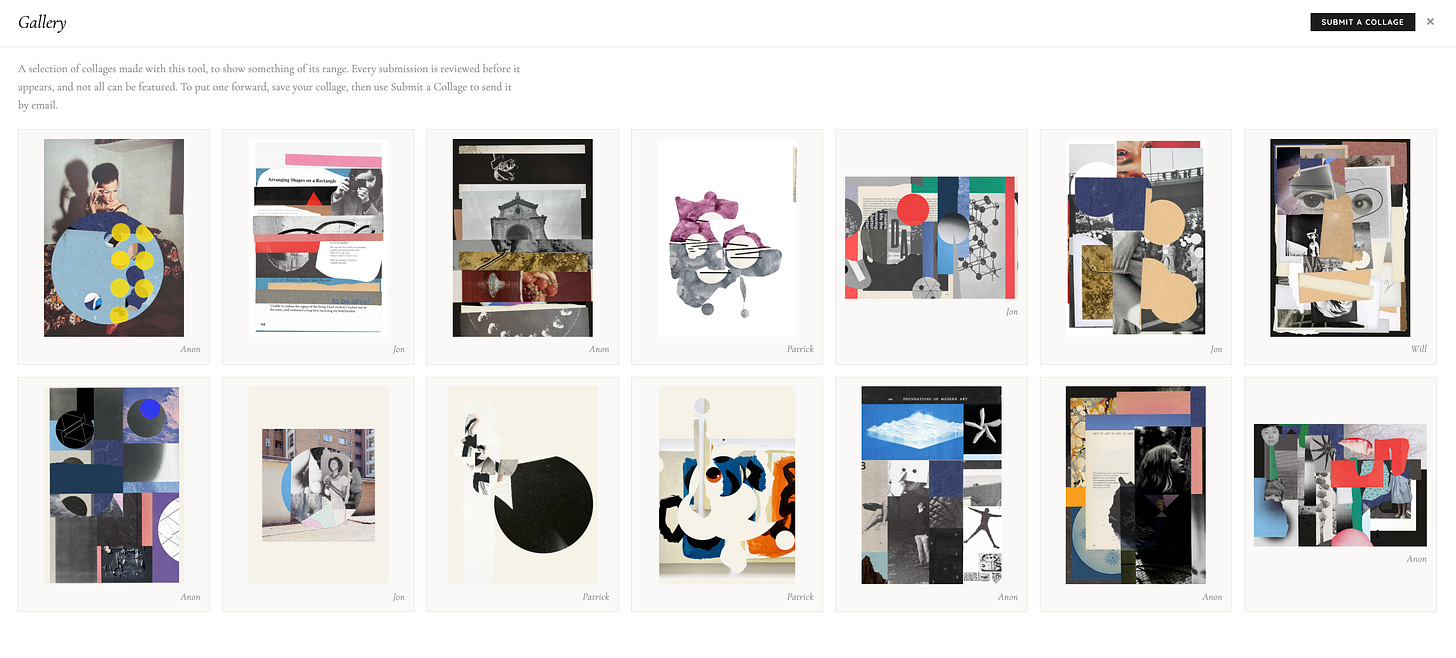
This grey area, between the analogue and the digital, the real and the virtual, is where photography education is going to be living for a while. We might as well make things in it, and think with our hands. Nothing you make in the app is ever final, which is also, more or less, my position on the larger question. Thanks to the early testers and for the contributions to the growing Gallery.
Have a go. Try to break it. Tell me what it is still missing.
Thanks for reading PhotoPedagogy! Subscribe for free to receive new posts.
These posts will always be free but, if you enjoy reading them, you can support my analogue photography habit, and that of my students, by contributing to the film fund. Thanks to those of you who have already done so. All donations of whatever size are very gratefully received.