From the Bookshelf
Lavinia Greenlaw — The Vast Extent: On Seeing And Not Seeing Further
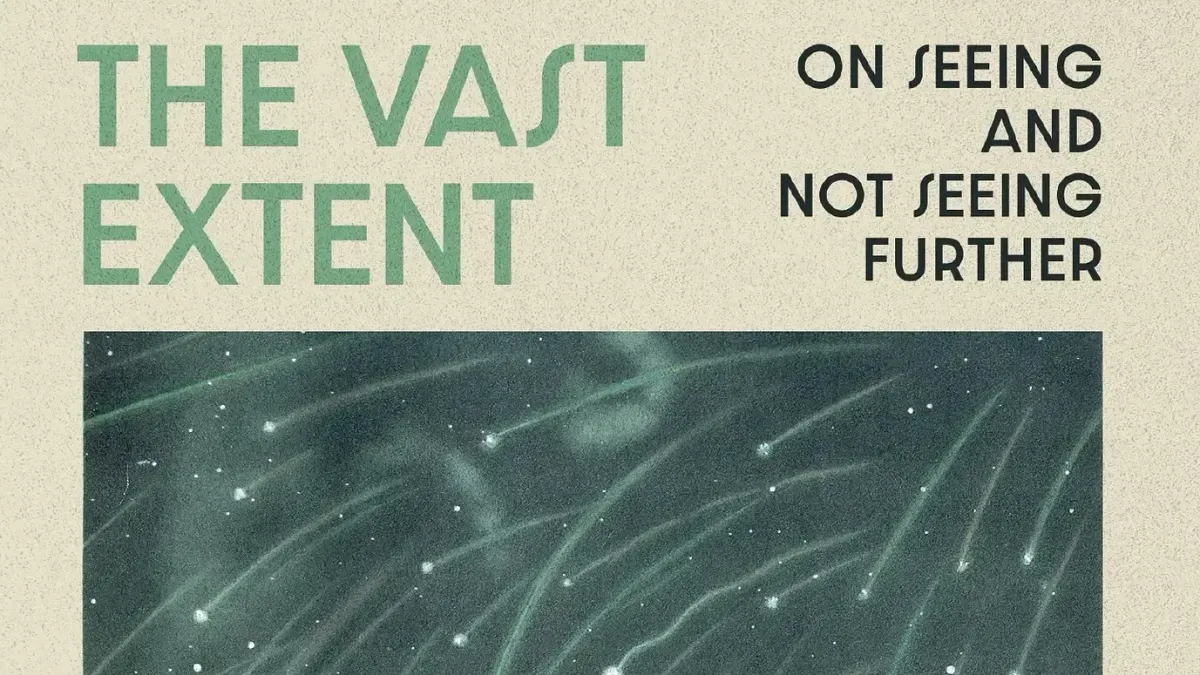
The title comes from Locke: "the comprehension of our understandings comes exceeding short of the vast extent of things." Not a promise to extend vision, then, but an admission that understanding will always fall short. If you can't grasp the whole, you might as well enjoy the parts.
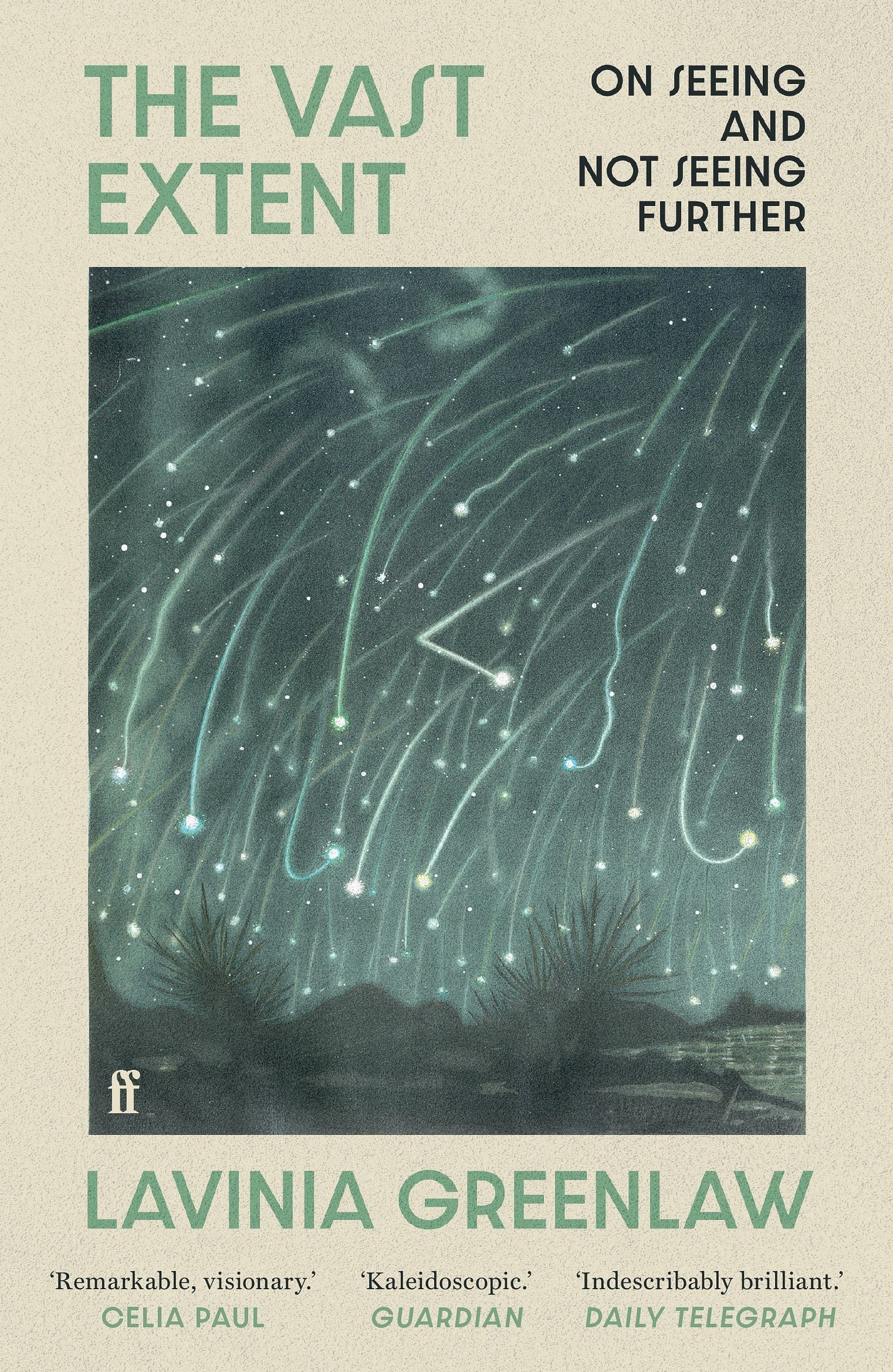
The book is structured as what Greenlaw calls “exploded essays” on the subject of vision. Each chapter carries a title made of three words in loose relation: “Caves, sleep, absence of light” or “Pattern, machinery, punctuation”.* The parts are held apart rather than fused, casting light on one another like the aspects of a poem. Or like photographs in a sequence. Things are placed beside each other and allowed to connect (or not) in the reader’s mind.
Greenlaw is a poet who grew up among scientists and doctors. She was the first artist-in-residence at the Science Museum. Her brother was an astrophysicist who "gently showed me that my 'seeing' was qualified by habits of perception of which I was unaware." He died recently, and the book is dedicated to him. Thirty years of thinking about vision, shaped by a lifelong conversation that can no longer continue. But the book doesn't feel elegiac. It feels curious, alert, sometimes mischievous, the spirit of that conversation still in motion.
The book contains lots of images, but photographs and photography are particularly present in two of may favourite chapters.
Undiscriminating wonder
“Boredom, repetition, fixatives” begins with Ruskin as a child, denied toys, staring at carpets. It moves to Mendelssohn, seasick on the way to Fingal’s Cave, then walking a railway tunnel in Liverpool because he was bored and wanted something to do. He persuaded a watchman to let him ride a car through the tunnel in the dark. “It was a bit rough on my stomach,” he wrote. Turner painted the same cave, veiled in smoke from a steamboat. The chapter moves through darkness and motion and nausea, gathering speed.
Then Fox Talbot’s latticed window appears, “the earliest extant photographic negative,” still looking “drenched in chemical solution.” Greenlaw’s father, meanwhile, spent his youth at Kodak, “mixing solutions and mopping up spilt mercury,” until boredom drove him to become a navy pilot. Photography stayed with him. She remembers his backyard darkroom, “watching images develop and then deciding the moment at which they would be transferred, slippery and dripping and still on the move, to the tray of fixative.”
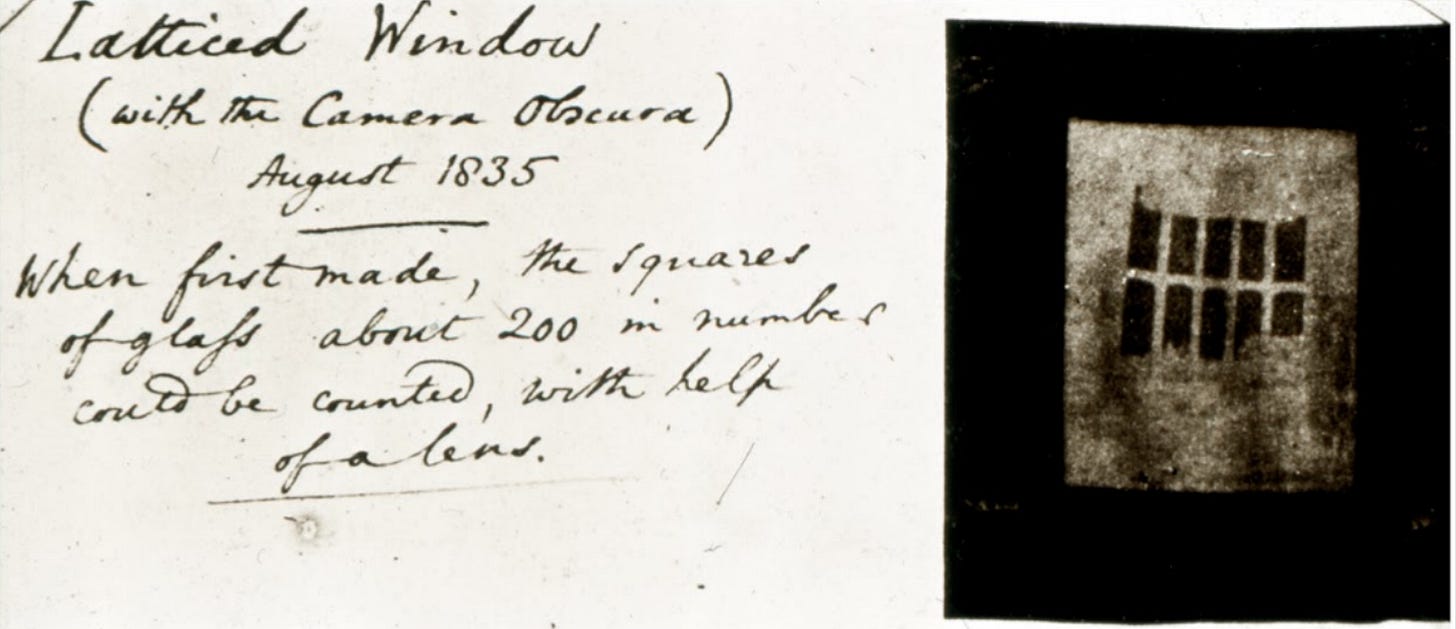
Fixing is the chapter’s hinge. Photography fixes the moment. Memory fixes experience. Both are unstable. And boredom, it turns out, is the precondition for attention. You have to be empty enough to notice.
There’s a conversation embedded in the chapter with the neuropsychiatrist Paul Fletcher. Greenlaw asks how we make sense of what we see. “By remembering what we’ve already seen,” he says. She asks how we know what we’re looking at is real. “I don’t think we do. I think we just rely on its reliability.” The exchange is brief, a little awkward. The poet wants something the scientist can’t quite give. They circle the same question from different directions.
Towards the end, her father has Alzheimer’s. He sits at a window watching a barber’s pole spin on a street corner. “It was something that never stopped moving and never changed.” Because he can no longer remember watching it, nothing is a repetition. He has lost the capacity for boredom. She writes: “In order to fix the moment, we depend on time passing.”
There’s grief here, but also wonder. The father enters “a state of undiscriminating wonder,” staring at cracks in windowpanes or stains on cloth “with rapt attention.” Everything is beautiful because nothing is remembered.
Sometimes, in order to see clearly, we have to place ourselves in a position of not seeing at all […] We have to ‘see nothing.’ Seeing without purpose is not the same as seeing without point. It is being open-eyed and open-minded, susceptible, alert, alive.
Granulated shapes
“The body, open, itself” opens with Rachel Whiteread’s House, then passes through the eighteenth-century surgeon John Hunter (who wanted to open anything that was closed to him), before arriving at John Berger and Jean Mohr’s A Fortunate Man.
Berger’s book documents a country doctor in 1960s rural England. Mohr’s photographs show the doctor examining, manipulating, listening through his fingers. Greenlaw writes: “He seems to be listening to what his fingers are telling him, receiving news via the medium of touch.” The doctor, Sassall, was wise and dedicated. At the end of the book, we discover he killed himself. Her own father also became a country doctor. “The good doctor who does not want to look at himself and so looks harder at others.”
Later in the chapter, she describes her own myopia. Her eyes began to fail at twelve. “My understanding of light begins in fractured auras and halos, leaky shifting colours, and granulated shapes that might or might not become clear.” She once ran for a bus that turned out to be a bus shelter. She flagged down a milk-float. “I’m never surprised to find out that something is not what it seems. I expect it.” There’s a lightness to her acceptance. Faulty vision became the ground of her thinking about perception. Every image is provisional. Why pretend otherwise?
Then Francesca Woodman. Greenlaw describes walking out of the woods one morning to see what looked like Woodman “standing in a meadow, holding up her birch sleeves.” Her mind went straight to the photograph, not stopping to notice she was looking at birch branches. This is how images work on us. They become the lens through which we see.
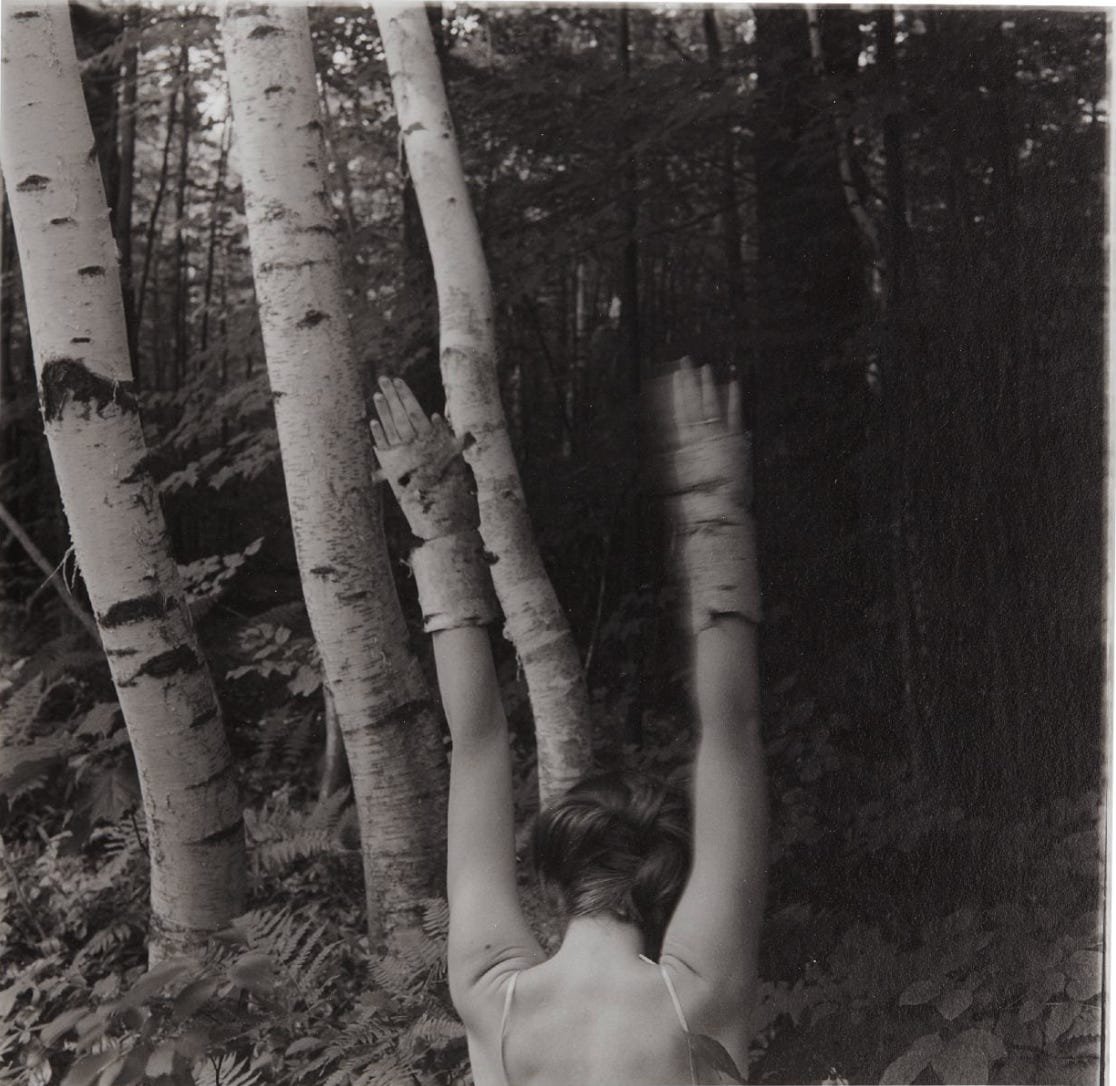
Woodman photographed herself disappearing into wallpaper, becoming wall, threading her body into domestic interiors. When sent on a residency in the woods, she was unimpressed: “Nature. What am I supposed to do with nature?” She needed edges, rooms, thresholds. The body against architecture.
The image remains
Fox Talbot’s latticed window and Woodman’s body wrapped in birch bark make a strange pairing. Both are about boundaries: the frame that lets light in, the skin that separates self from world. Fox Talbot believed photography could escape human investment, offering only “stronger lights thrown upon one part of the paper, and deeper shadows on another.” But we don’t see light and shadow. We see a window, a body, a tree. Everything is familiar. Every act of vision is a repetition.
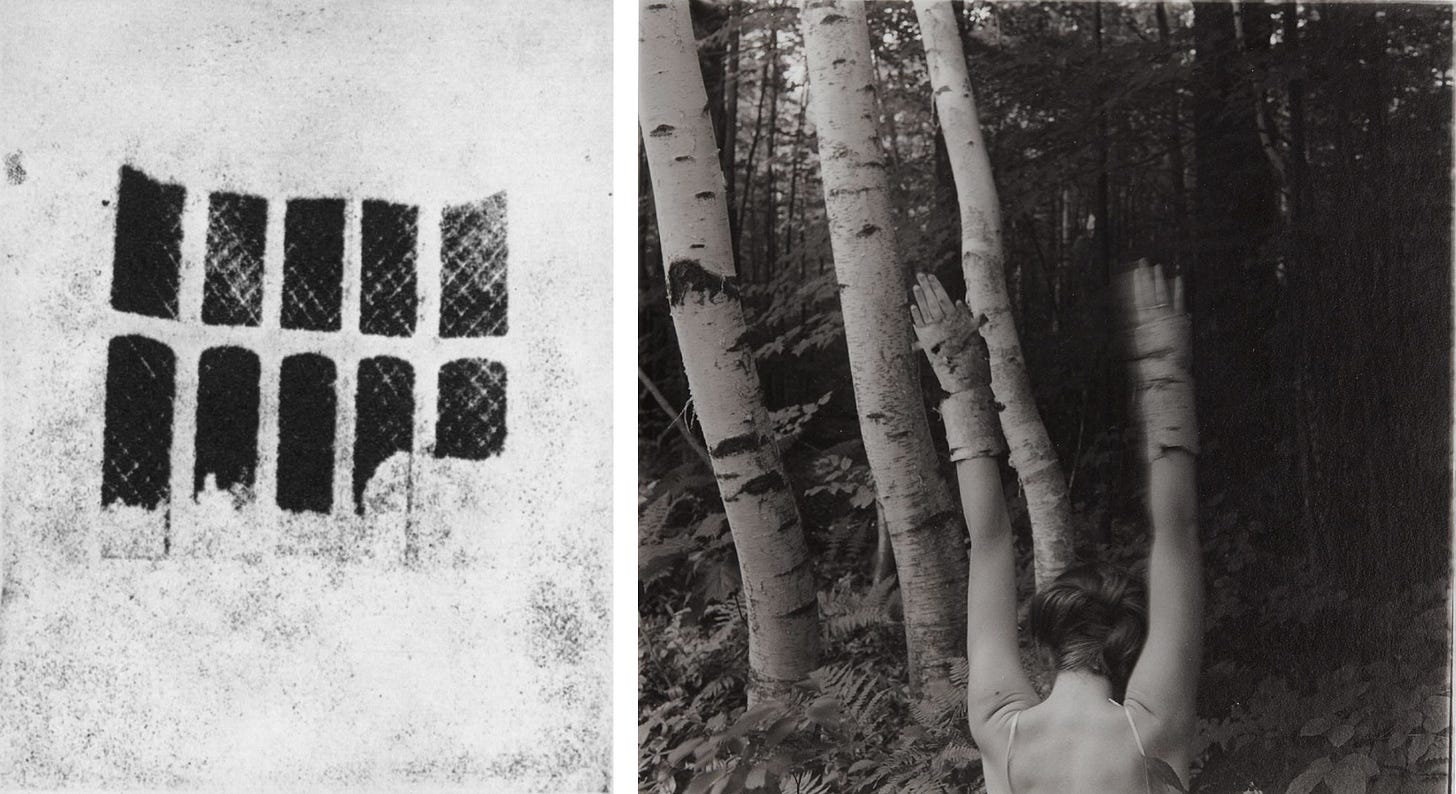
Woodman knew this. She built herself into the image not to disappear but to test where the body ends and the world begins. There is something playful in her transgressions, even when the stakes are high.
The chapter ends with two deaths, narrated with clarity and tenderness. First the father, deep in dementia, gripping her face and looking into her eyes. “He expressed his love by seeing me and I showed mine by offering myself up to be seen.” Then the brother. Dying of cancer, four weeks from diagnosis. In his final hours, words begin to slide. He manages one sentence: “Words are waste” (or “a waste” or “wasted” — she can’t remember exactly). Then he asks for paper and pen, and draws a rapid sketch showing how to reposition his body in the bed. When language fails, the image remains.
But before this, she tells a story about her other brother, sitting vigil by the father’s bed, suddenly announcing that if he weren’t there he’d be running through the city dressed as a gorilla. A colleague had hired fancy dress for a charity race. Once they put the costumes on, they felt ridiculous. Another colleague offered to dress as a banana so they could chase her. “There is nothing silly about a gorilla if they’re running after a banana.” They laughed and laughed, forgetting the man beside them was dying, knowing how much he would have loved the story.
That’s the spirit of the book. Death is there, but so is the gorilla.
There’s much else to love. Chapters on caves, Netherlandish painting, seasickness, the colour spectrum, etc. The two mentioned here offer plenty of sustenance for teachers and students of photography. The conversation with Paul Fletcher could open a discussion about perception. The Woodman material invites questions about the body in the frame, what it means to be present, to disappear, to test a boundary. Fox Talbot could prompt a discussion about what photography can and cannot fix.
But mostly I’d say read it slowly. It’s a book about looking. And it’s delightful.
Thanks for reading PhotoPedagogy! Subscribe for free to receive new posts.
These posts will always be free but, if you enjoy reading them, you can support my analogue photography habit, and that of my students, by contributing to the film fund. Thanks to those of you who have already done so. All donations of whatever size are very gratefully received.
* Here’s the complete list of chapter headings, a kind of poem. Each one would make a fantastic photography assignment:
One thing beside another (a foreword)
Caves, sleep, absence of light
Solidity, appearance, dullness
Distance, deception, glow of fire
Boredom, repetition, fixatives
Seeing clearly, glimpsing, picturing
Becoming, resistance, dissolve
Black and white and colour
The body, open, itself
Peering and noticing, flits and swerves
Pattern, machinery, punctuation
Staying put, locked doors, wallpaper
Eye-catchers, furniture, peepshows
Unanchoring, sinking, at sea
Curiosity, wonder, rupture
Disorder, slippage, glare
Invisible, unseen
The imagined image