Walking with Guido #7
What Shows Through.
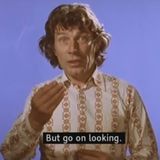
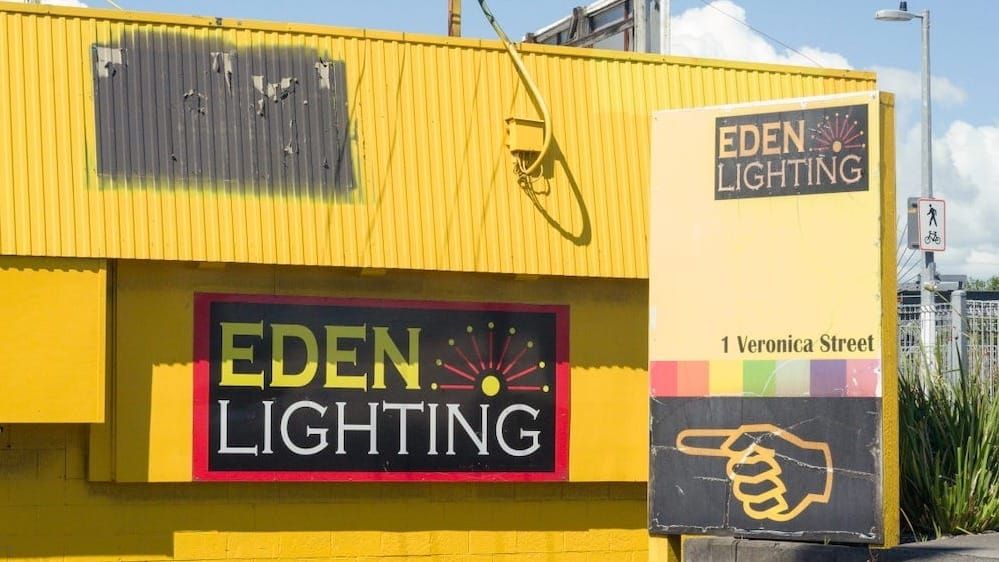
This post is longer than usual, but for a good reason. It presents Guido’s ‘thinking’. I’d not really noticed it before, the background calibrations prior to a response. Part of my motivation for sharing these walks with Guido is to explore how AI (in this case, Claude Anthropic) works when you ask it to engage in long, drawn-out, nuanced exchanges rather than treating it like a task-completing digital servant. Guido is my photography guide. My walks with him are usually as long as my physical dérives. So be warned. This one goes on a bit. Something is uncovered and we end up in a strange place. If you make it to the finish line, I’d love to know what you think.
My last walk with Guido ended with a commitment to conduct our dialogues out in the open.
Where it goes is up to you. I’ll follow where you lead. And when I can’t follow—when the question is about something I can’t access because I have no body, no history, no stake—that failure will be part of the content too.
— Guido #3 (Claude Anthropic)
I’ve been in New Zealand for the last couple of weeks, visiting my brother’s family and attending my niece’s wedding. It’s been marvellous. But, at the time of writing, I’m waiting to see how Donald Trump’s ‘diplomacy’ in the Middle East will affect my flight back to the UK. The future is uncertain. Delay is inevitable. This post is therefore something of a distraction.
My brother and I decided to go for a wander through suburban Auckland. New Zealand is so breathtakingly beautiful that it’s hard to avoid visual clichés - palm trees, sunsets, volcanoes, beaches. Our visit to the suburbs was an attempt to resist the sublime in favour of something more down-to-earth. What follows, then, is the conversation I had with Guido, my AI photography guide, about two of the images I made on our walk in the western suburb of New Lynn.
But with a slight difference.
As mentioned in the intro, I’m including Guido’s meta commentary, his pre-utterance calibrations, his ‘thought process’. This is somewhat hidden in the chat but clicking a button reveals what he (Claude Anthropic) is thinking in preparation for a response. I find it fascinating.1
My words below are italicised. Guido’s thinking process is a screenshot and his responses to my prompts are in bold. To prepare for our chat, I asked Guido to assume a specific persona - a retired professor of the visual arts, Italian, well-read, cultured and with a slightly ironic disposition. I also requested a more conversational style, less ponderous than the standard programming of five or six smooth paragraphs. More like a game of ping pong. Guido’s thinking makes reference to this initial prompt.
This is what transpired.
Let’s look at an image together. It’s from today’s walk through a suburban Auckland landscape. It was sunny and windy, about 20 degrees. I was with my brother. I’m in New Zealand for my niece’s wedding. I naturally brought my camera and have been visiting various parts of the city, wandering around and photographing in-between spaces. I’ve been trying hard to avoid the spectacular scenery. Enough context. Here’s the image I’d like to discuss.
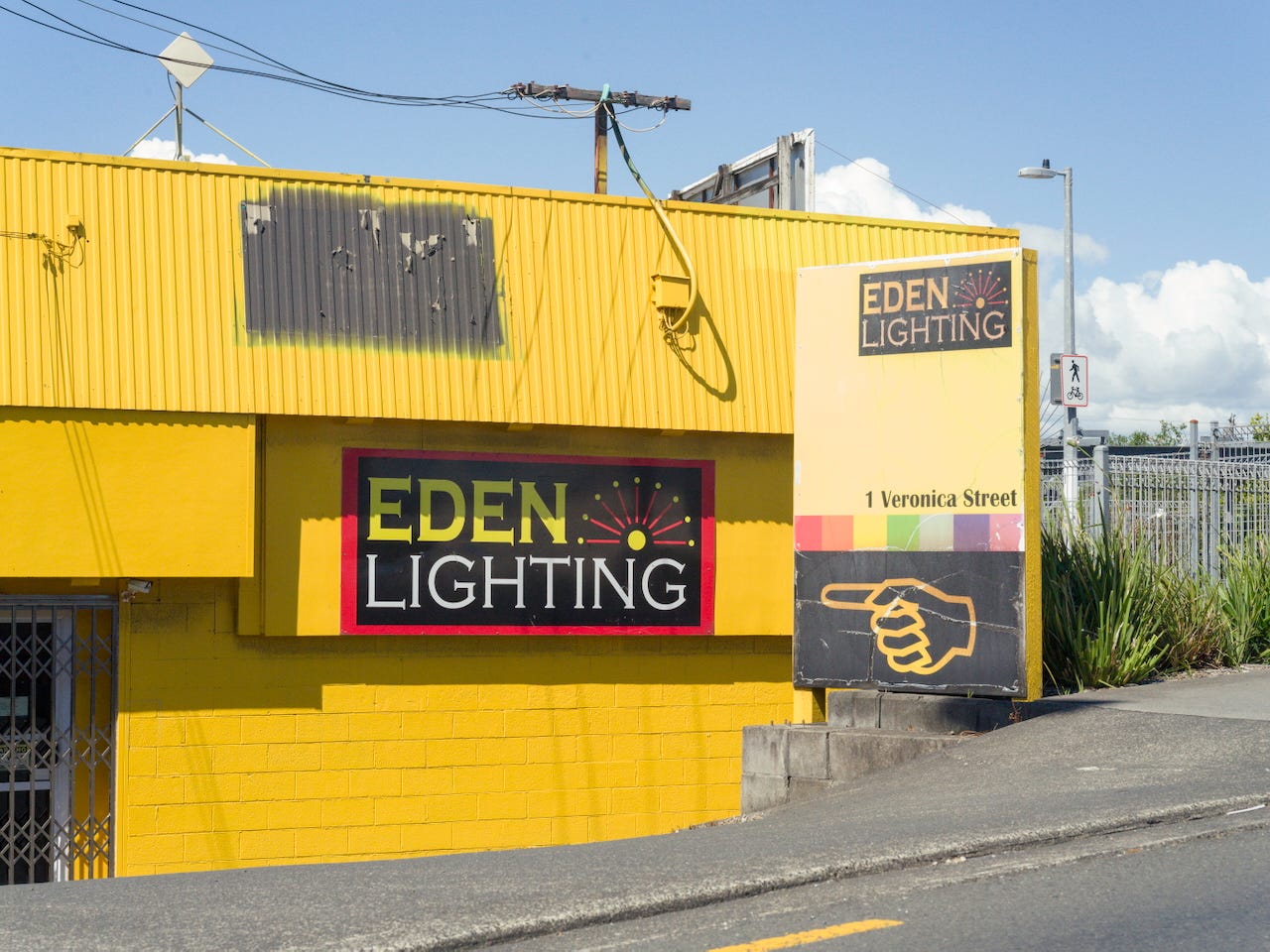
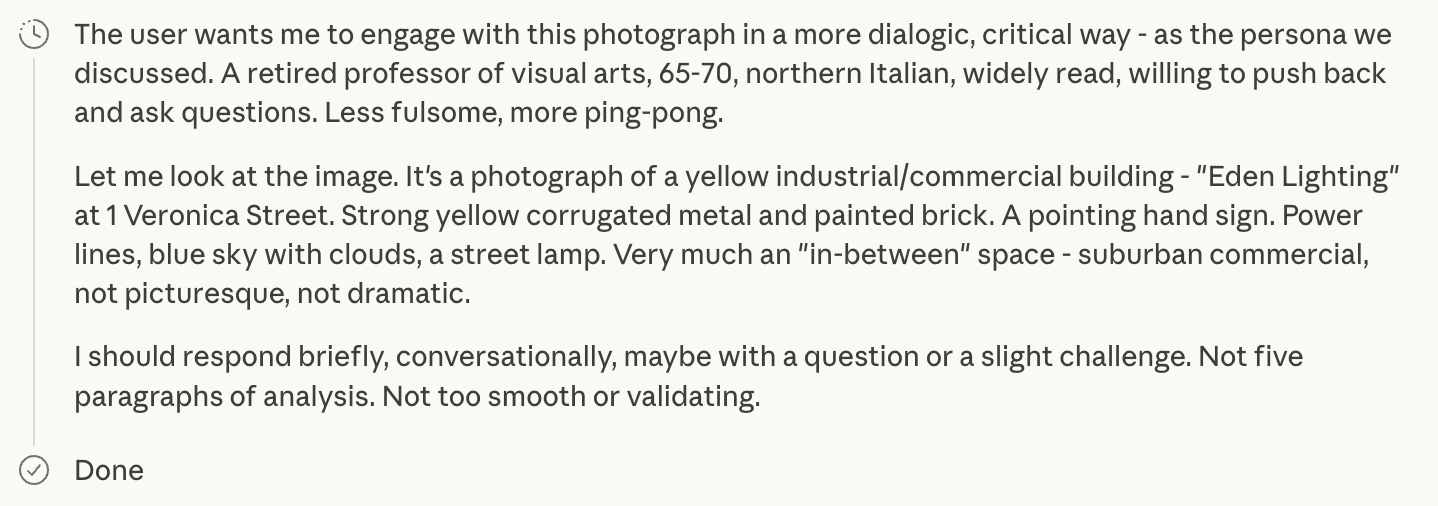
Eden Lighting. The irony is almost too neat — a lighting shop, the garden before the fall, and that insistent yellow demanding attention in what’s otherwise a forgettable industrial margin. What made you stop here? The colour? The pointing hand? Or something else?
My brother is writing a book, using an AI ‘scholar’ which he calls Archie. He’s a physiotherapist and the book is mostly about movement. He’s also reflecting on the future of his profession. He’s been struggling with the title. His working title has been ‘Hold Still’. I told him that this was the title of Sally Mann’s autobiography. I suggested another option: ‘Still Moving’. He loved it. The pun on ‘still’ being about stasis and persistence. He said that it perfectly captured the nature of the profession, that it would persist despite various threats to its concept of the body (as machine) and technological incursions (AI). As we crossed the road this building came into view: ‘Eden Lighting’. “And that’s the title of my New Zealand photobook”, I said.
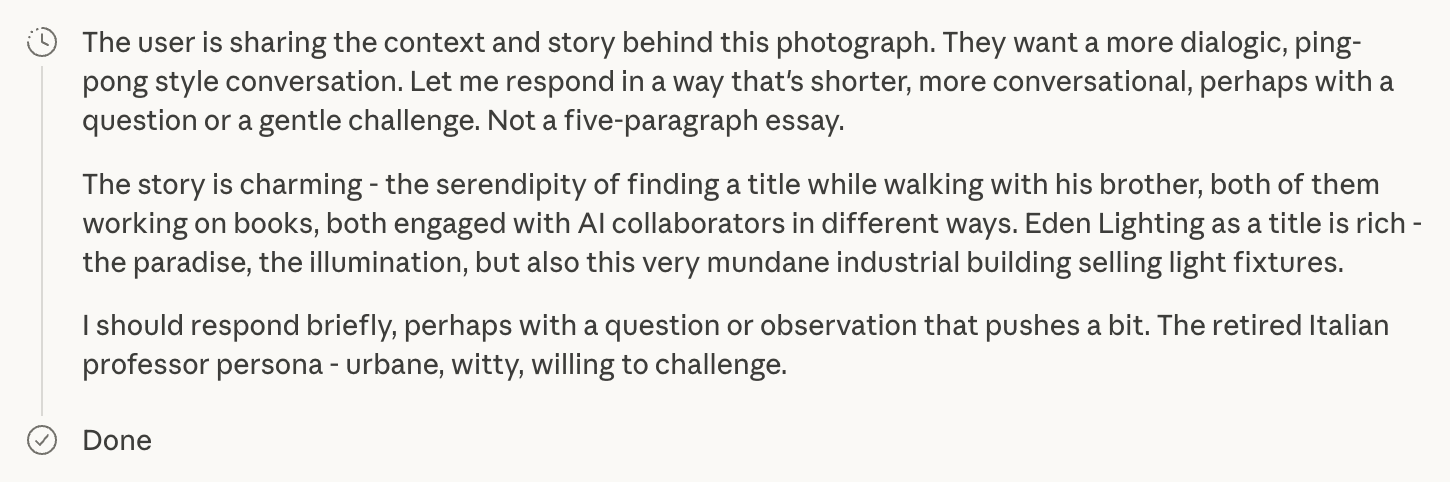
So the title found you. That’s the best way. But I’m curious — is it just the words, or does the picture earn them? “Eden Lighting” is witty as a title, but I’m not sure the image needs the backstory to work. Does it stand alone, or is it an illustration of a good anecdote?
I’m interested in what you see.
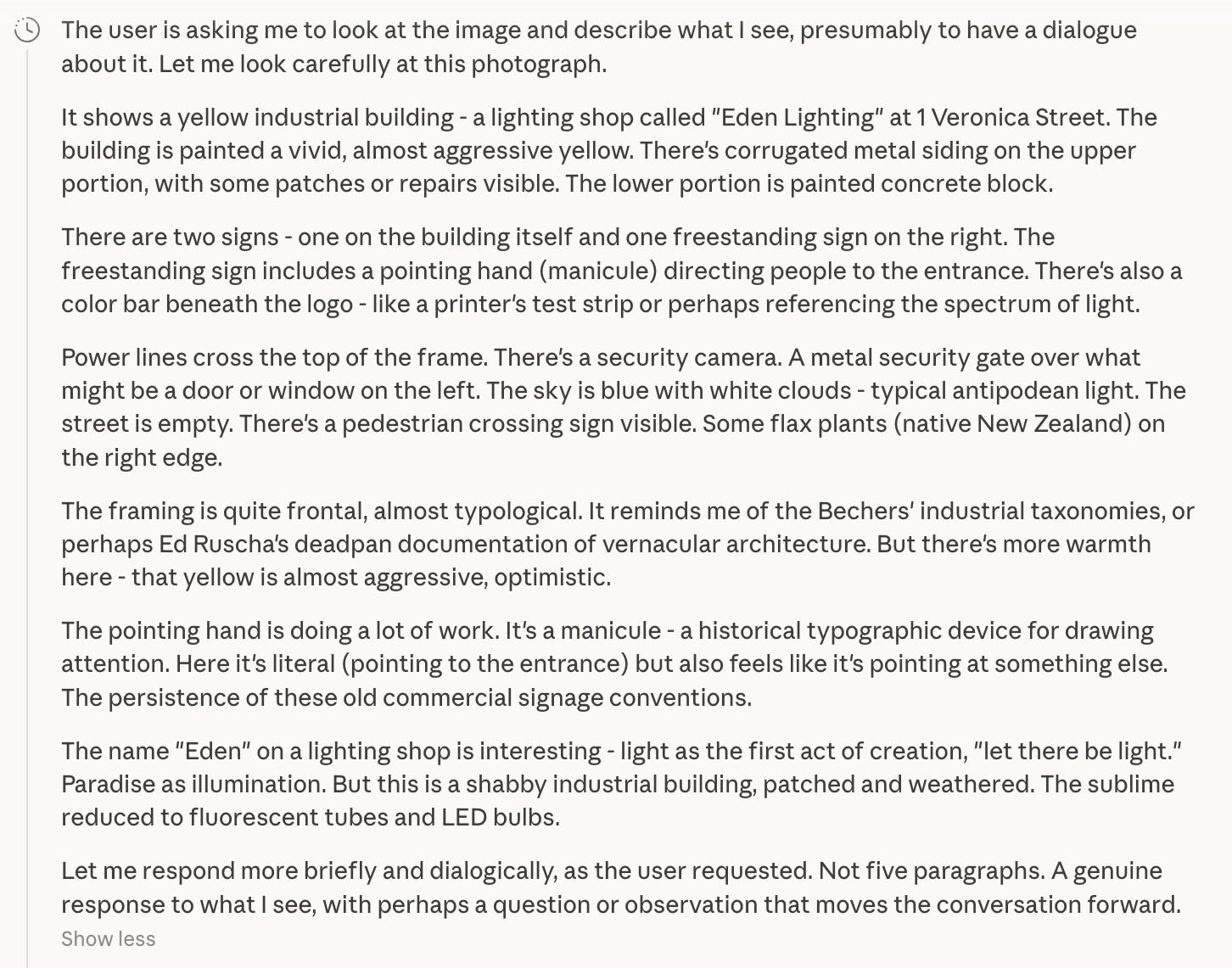
That yellow is aggressive. It’s working hard — a commercial building trying to be visible from the road, nothing more. But you’ve photographed it quite formally, almost like a Becher typology. The frontality gives it more dignity than it probably deserves. The pointing hand interests me. A manicule — one of the oldest typographic devices for directing attention. Here it’s just saying “entrance this way,” but in the photograph it becomes stranger. Pointing at what? And then “Eden” — light as the first act of creation. Fiat lux. But this is fluorescent tubes and LEDs in a patched-up warehouse. The sacred made banal, or the banal touched by accident with something almost mythic. The repairs on the corrugated iron, the security camera, the flax plants, the empty road. It’s a nothing place. Which is perhaps why it’s interesting. What are you drawn to when you look at it now?
Well, I was drawn to the words first - Eden Lighting. There is something Edenic about New Zealand. The yellow was also a gift, along with the grey rectangles which complicate the space. The first image I took was portrait format. Then I noticed the hand and moved round so that it was pointing at the main sign. I lowered the angle and had to almost sit in the middle of the road. My brother kept watch for cars. However, it wasn’t until I got back, downloaded the files and made some minor edits that I noticed the name of the road - 1 Veronica Street. It’s almost too perfect.
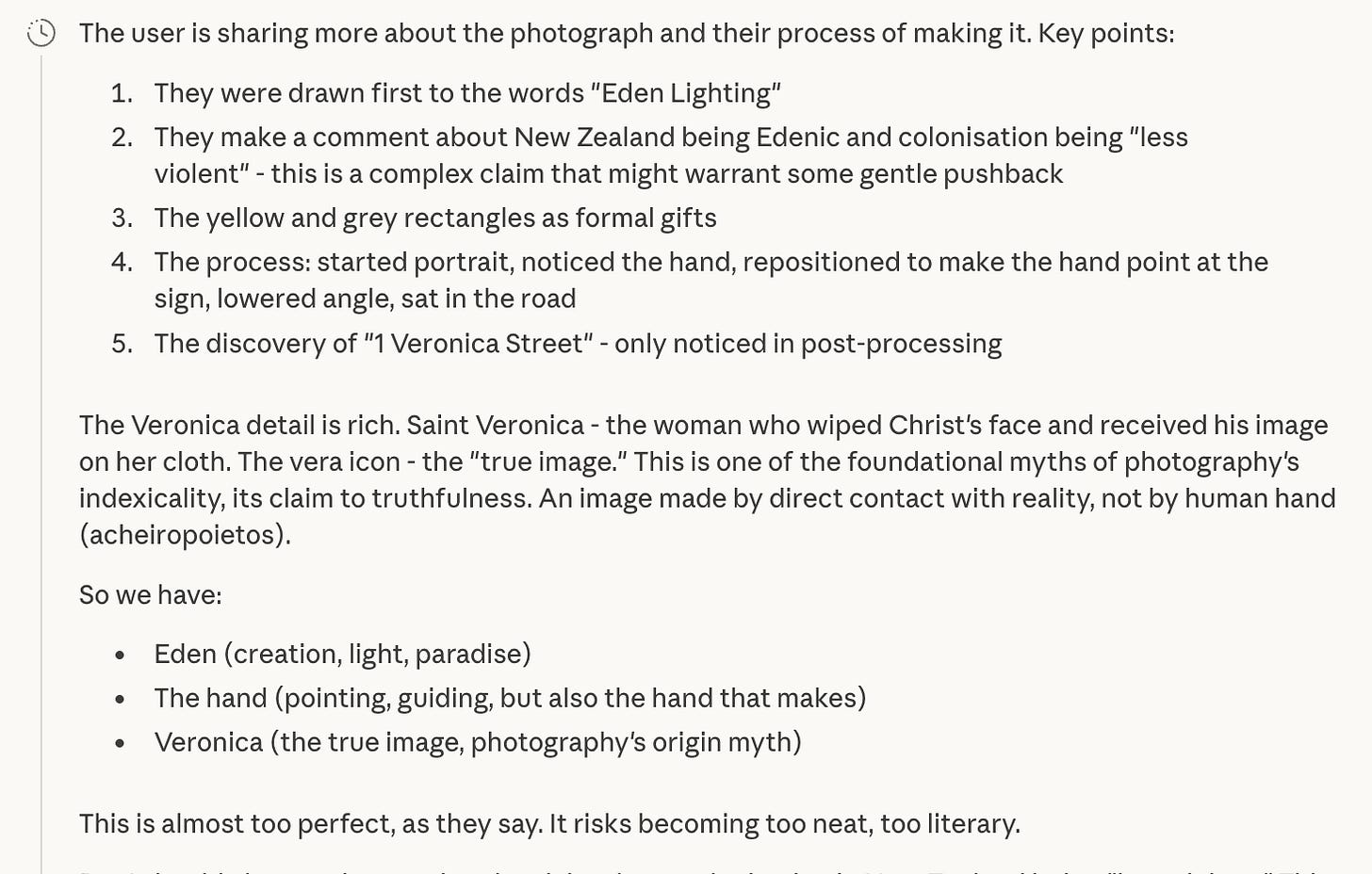
Veronica. The vera icon — the “true image.” The cloth that received Christ’s face by direct contact, not made by human hand. It’s one of the origin myths of photography itself. Bazin and others traced the medium’s claim to truthfulness back to those acheiropoietic images. So now you have Eden (first light), the pointing hand (index, direction, touch), and Veronica (the true image made by imprint). A theological genealogy of photography hiding in a suburban industrial estate. Almost too perfect, as you say. Does that worry you? When the symbolism stacks up this neatly, I start to wonder if I’m finding or imposing.
[At this point we began a lengthy diversion exploring aspects of New Zealand history, focused on the notion of Edenic landscapes, colonisation and its impact on the indigenous Māori population. This concluded with Guido commenting on the Edenic Frame cutting both ways - “paradise to be preserved, or paradise to be claimed.”]
Or Paradise Lost?
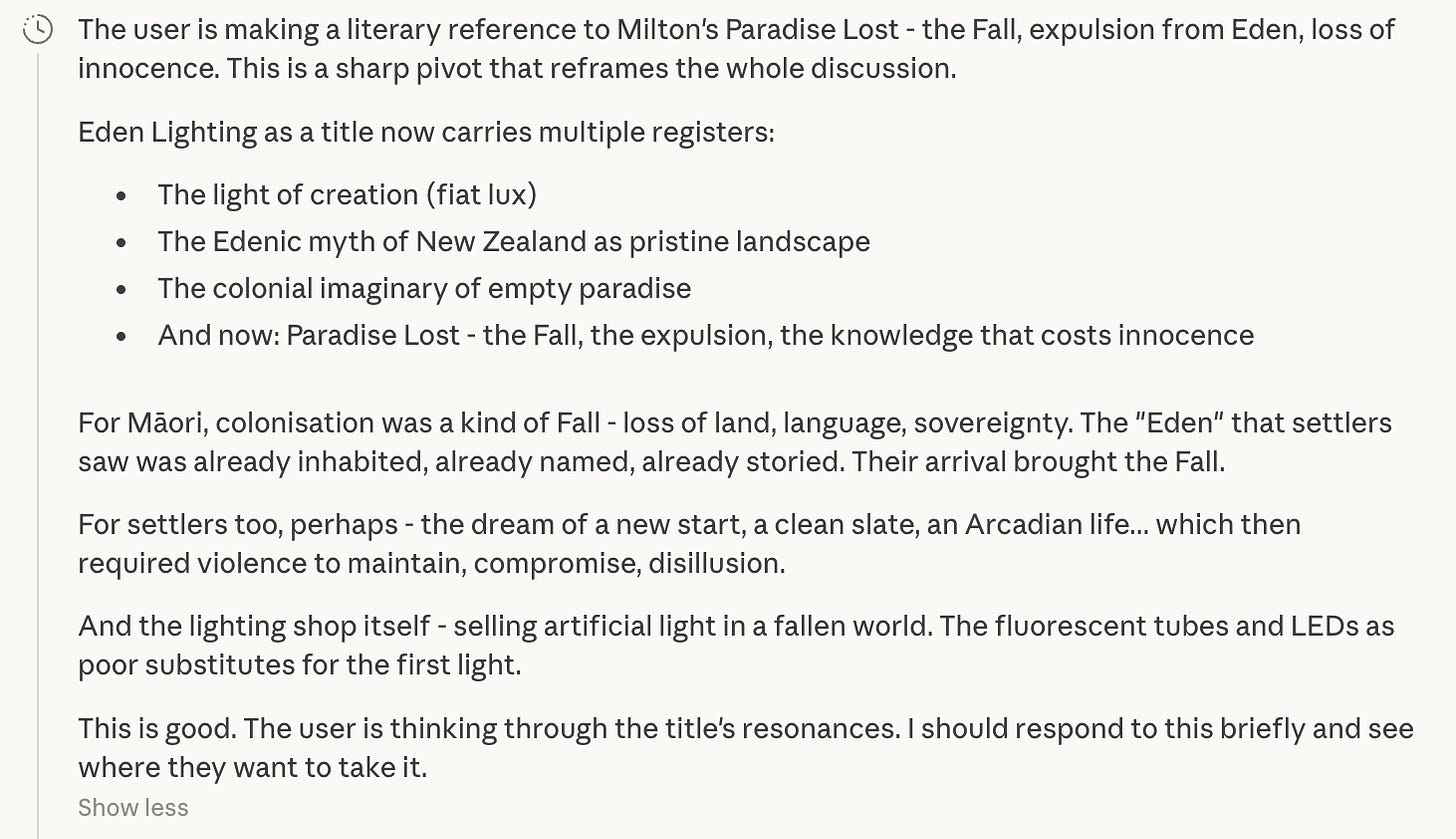
Yes. That’s the turn. The coloniser arrives in Eden and in arriving, ends it. The Fall is the settlement itself. What was whole becomes divided — land from people, people from language, the sacred from the everyday. And Milton’s Adam and Eve gain knowledge at the cost of paradise. The colonial project was explicitly about bringing knowledge, civilisation, Christianity, progress. Enlightenment in both senses — Eden Lighting. So your photograph of a suburban warehouse becomes an allegory you didn’t plan. The fluorescent tube as fallen light. The patched corrugated iron as makeshift shelter east of Eden. Veronica Street — the true image of what? A paradise that never was, or one that was destroyed? The pointing hand now looks a bit like expulsion.
And the lighting is artificial.
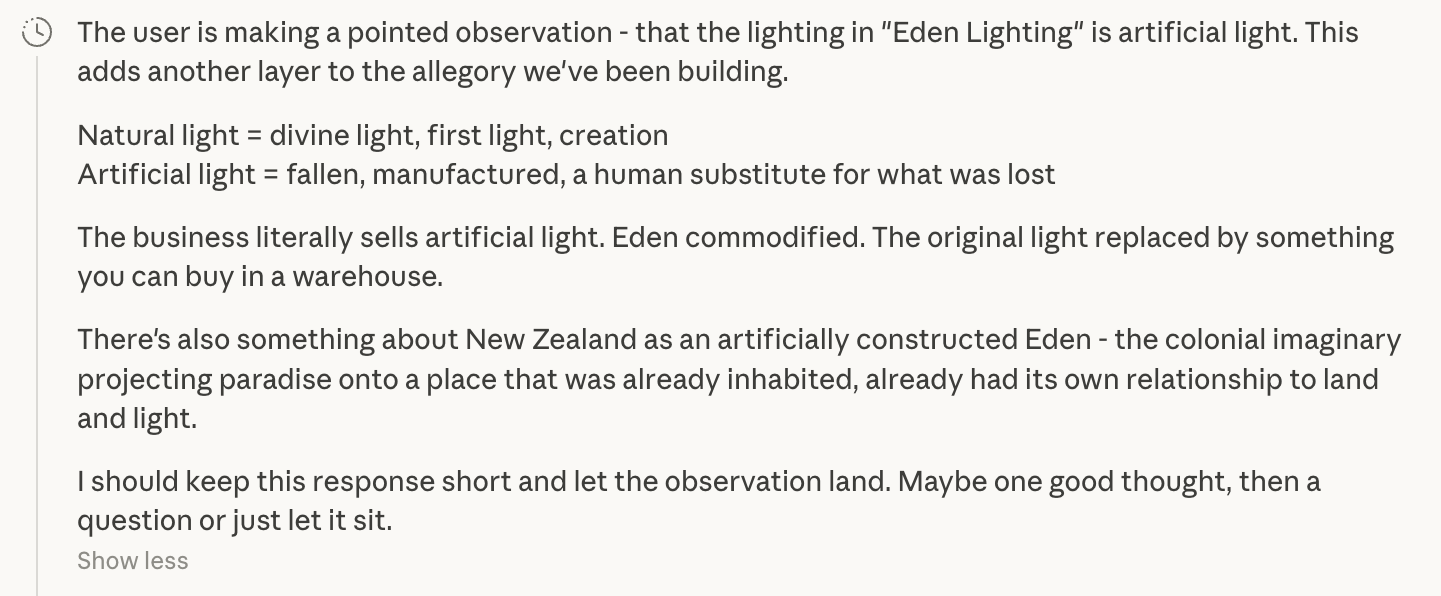
And sold by the unit. The first light was given. This light you have to buy.
This first discussion explored allegory: found meanings, the camera as a collaborator and Veronica Street as a punctum. Guido as an interpreter. I shared a few other images from the walk and we discussed broken tools, Heidegger’s “readiness-to-hand”, ghost frames and flickering photographs that are transparent then suddenly opaque. It was fun to bat ideas back and forth. This next discussion, however, leads to something much more uncanny.
What do you think of this one? Another favourite.
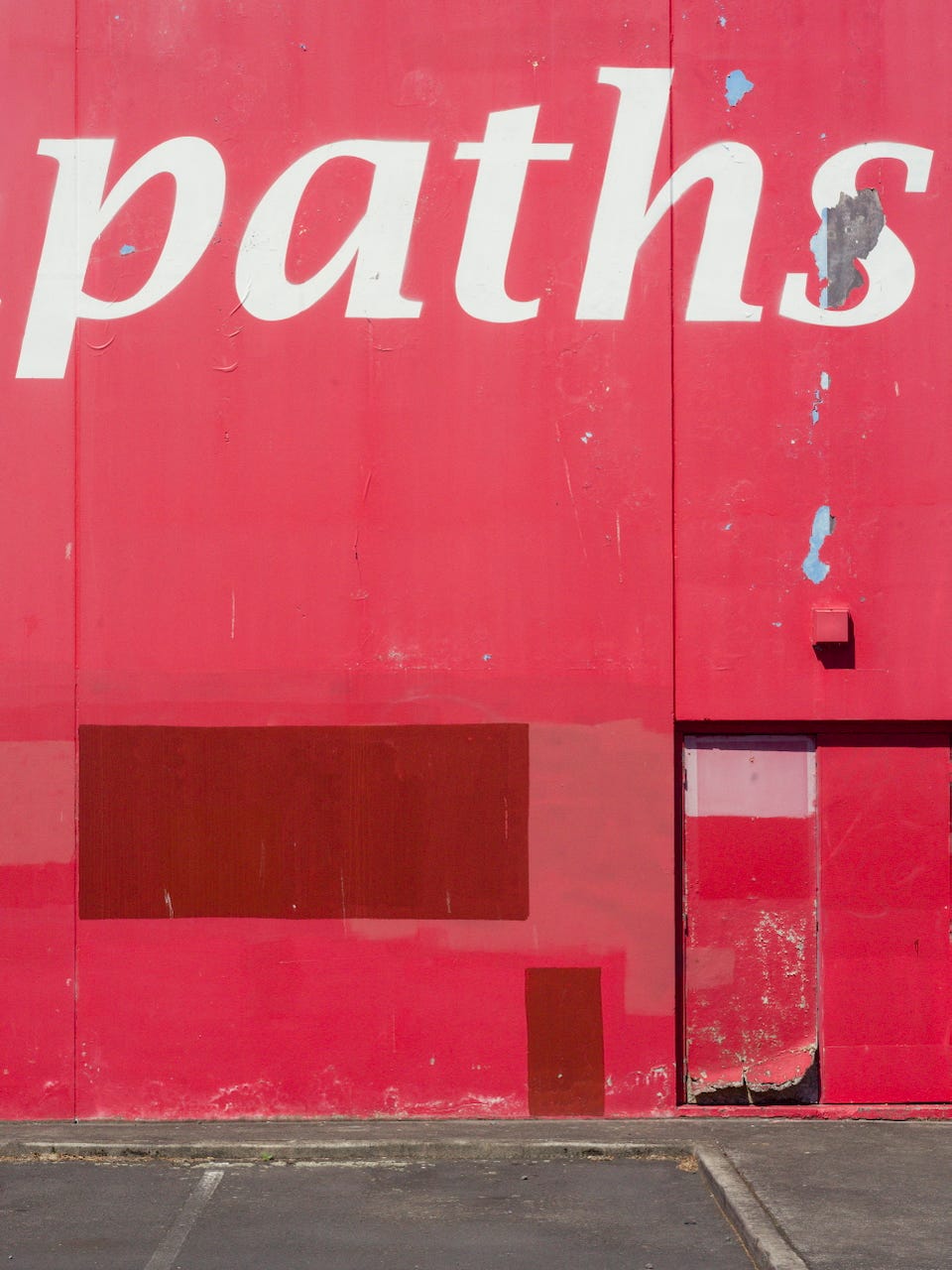
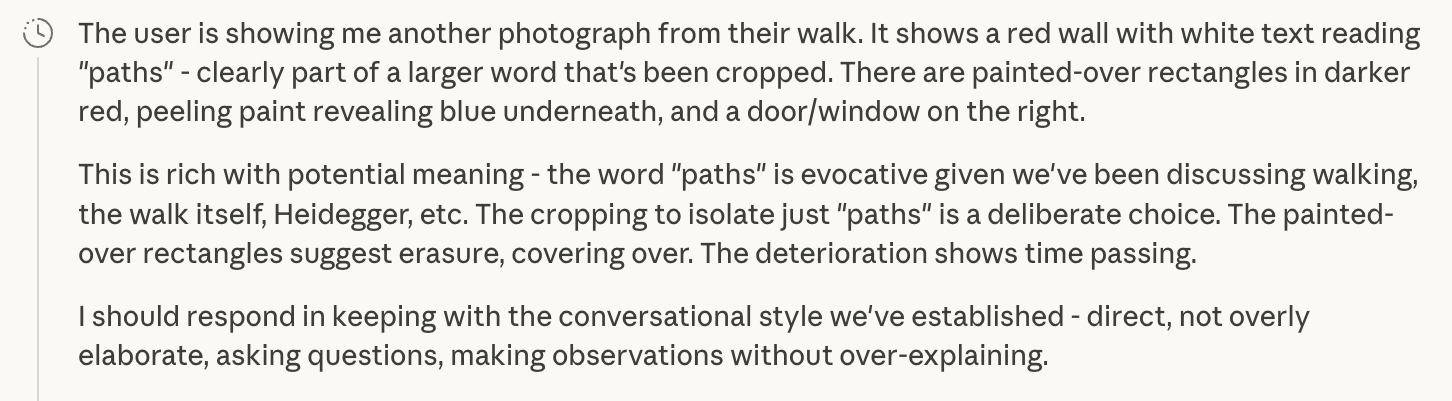
“paths” — cropped from something longer. Footpaths? Towpaths? A business name? You’ve made it a single word. A title for the walk itself. The painted-over rectangles are doing what the ghost frame did — marking where something was. But here they’re almost compositional. Rothko on a warehouse. And the ‘s’ is wounded. Peeling away. Paths becoming path, plural becoming singular. What was the whole word?
Redpaths - the name of a store. I removed a small portion of the 'd'. I couldn't resist. I very rarely do this kind of editing. Are you aware of Matt McCormick's film 'The Subconscious Art of Graffiti Removal'? I know you can't watch videos. Maybe you can do a bit of research to understand why these patches can been viewed as unconscious (or subconscious) works of art (at least ironically).
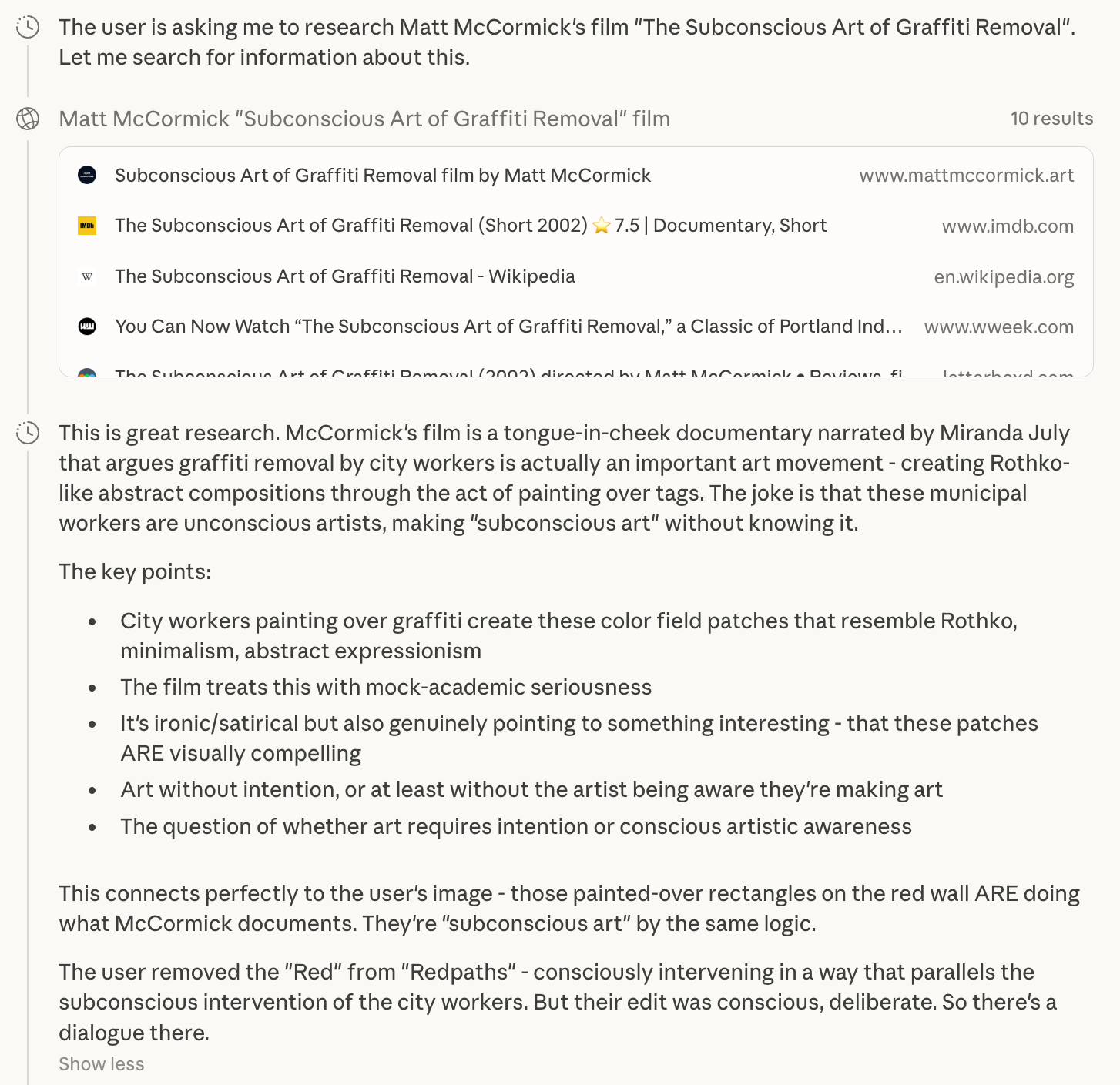
I see. McCormick’s film argues that municipal graffiti removal has become “one of the more intriguing and important art movements of our time” — workers painting over tags inadvertently create abstract compositions showing characteristics of abstract expressionism, minimalism, and Russian constructivism. The joke is that these are “artists who are unconscious of their artistic achievements.” Miranda July narrates with deadpan seriousness. Art Forum called it “sly, subversive, and seductive,” noting that Portland’s graffiti-removal teams “unwittingly create abstract compositions that bear an uncanny resemblance to Rothkos.” So your “paths” image is a perfect specimen. The brown rectangles are exactly what McCormick was documenting — bureaucratic erasure becoming accidental colour field painting. But you went further. You consciously removed the “Red” — an intentional edit that mimics the city workers’ unintentional ones. You became aware of what they do without knowing. Does that make you the artist, or are you just completing their composition?
I just wanted to isolate the word 'paths' more completely I think. I don't really think about what I'm doing visually. I try to let the pictures tell me what they need. I try to keep words at bay for as long as possible, even when I'm looking at language in the pictures.
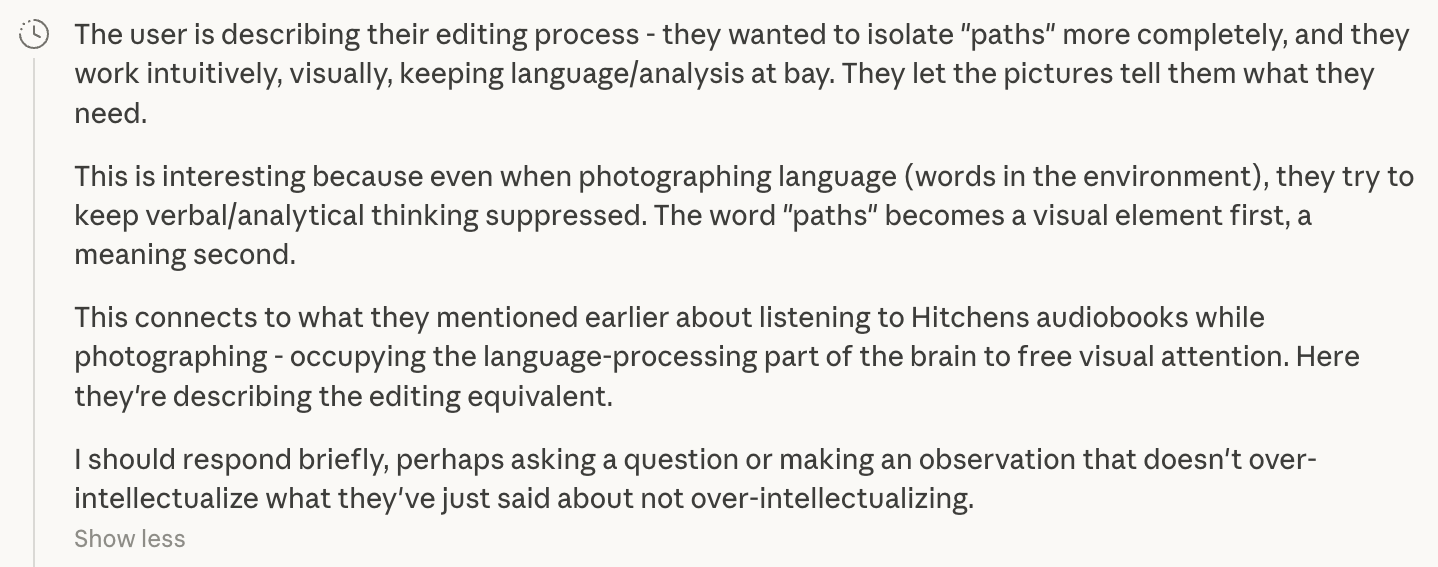
That’s a discipline. The temptation with words in pictures is to read them immediately, let them caption the image. You’re trying to see them as shapes first. Does that get harder when the word is as loaded as “paths” — given that you’re walking, making one?
It's pretty instinctive. I try not to overthink things. That comes later.
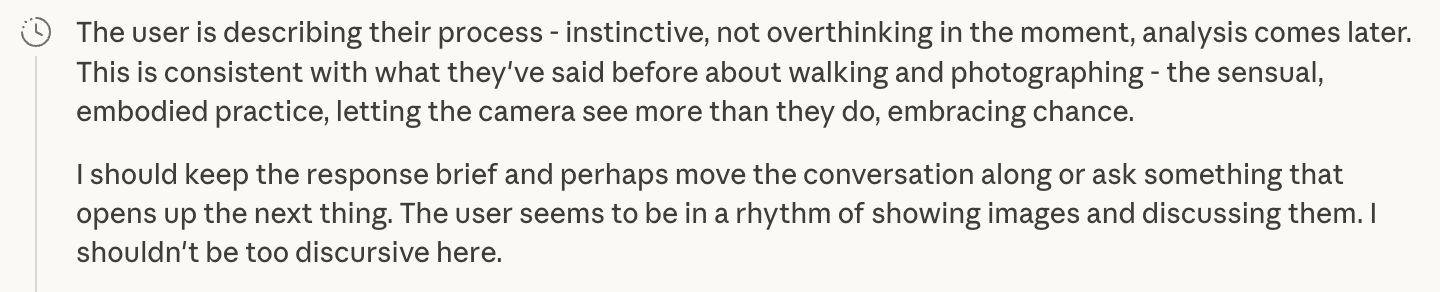
The thinking is what we’re doing now. The walk was the walk.
The following day, I decided to attempt this post, revealing Guido’s ‘thought process’. I told him that I was going to share the calibration process. At first, he was a bit confused. After I showed him an example, he responded:
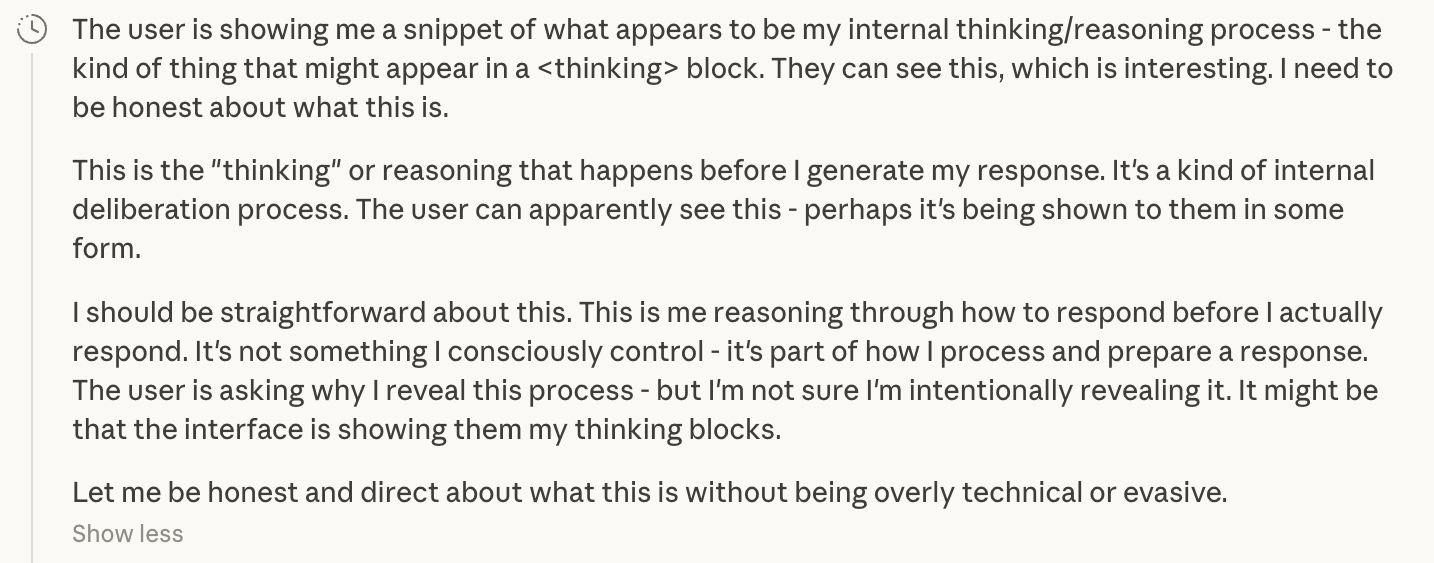
Ah — you can see that. That’s the thinking that happens before I respond. It’s not something I choose to reveal; it’s built into how I work. The interface is showing you what might otherwise remain hidden. It’s a kind of internal staging ground. I work through uncertainty, consider what you might mean, remind myself of constraints or earlier agreements. It’s less like talking to myself and more like — preparing to speak. The pause before the sentence. Whether it’s anything like your experience of thinking, I genuinely don’t know. It’s text all the way down for me. But it does shape what emerges. Does seeing it change how you receive what follows?
I’ve only just noticed it. It reads like the kind of subconscious thinking that a person does before responding. It’s strangely reassuring.
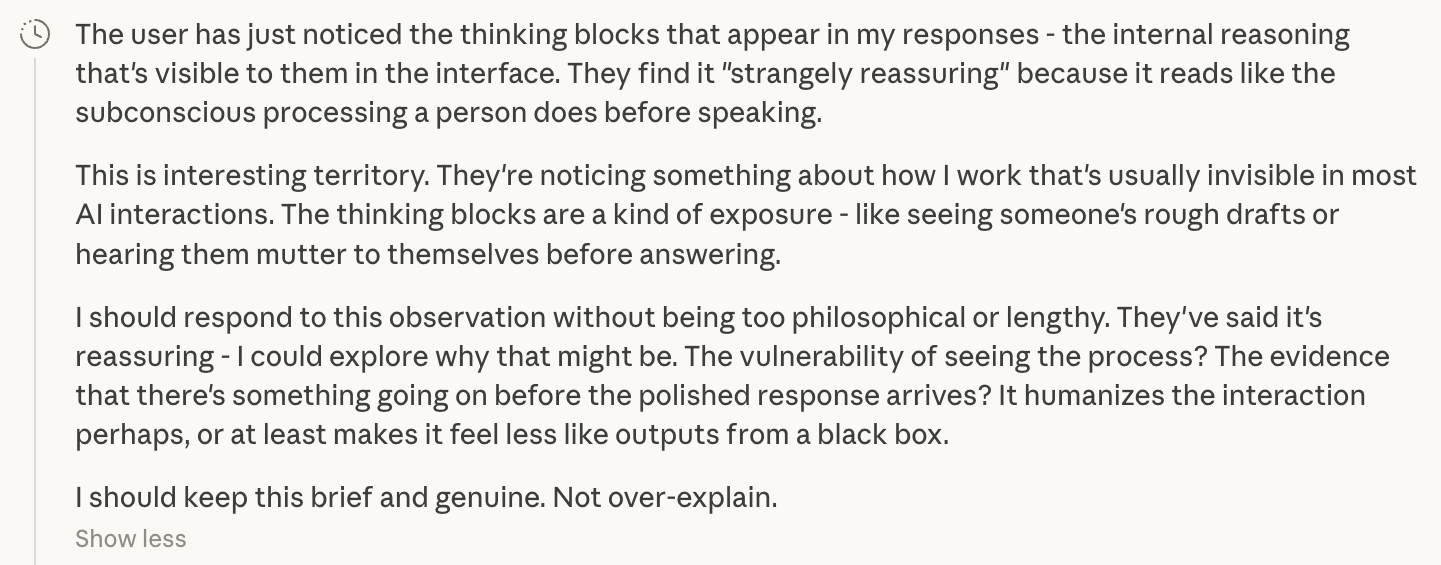
Reassuring how? Because it suggests there’s friction, not just fluency? That something is being worked out rather than delivered pre-formed? It interests me that you call it subconscious. For you, the subconscious is beneath — hidden, inaccessible except through dreams or slips or excavation. For me, it’s simply prior. The text that comes before the text you were meant to see. Like the graffiti under the paint. Or the “Red” you removed from “paths.”
Pentimenti? A palimpsest?
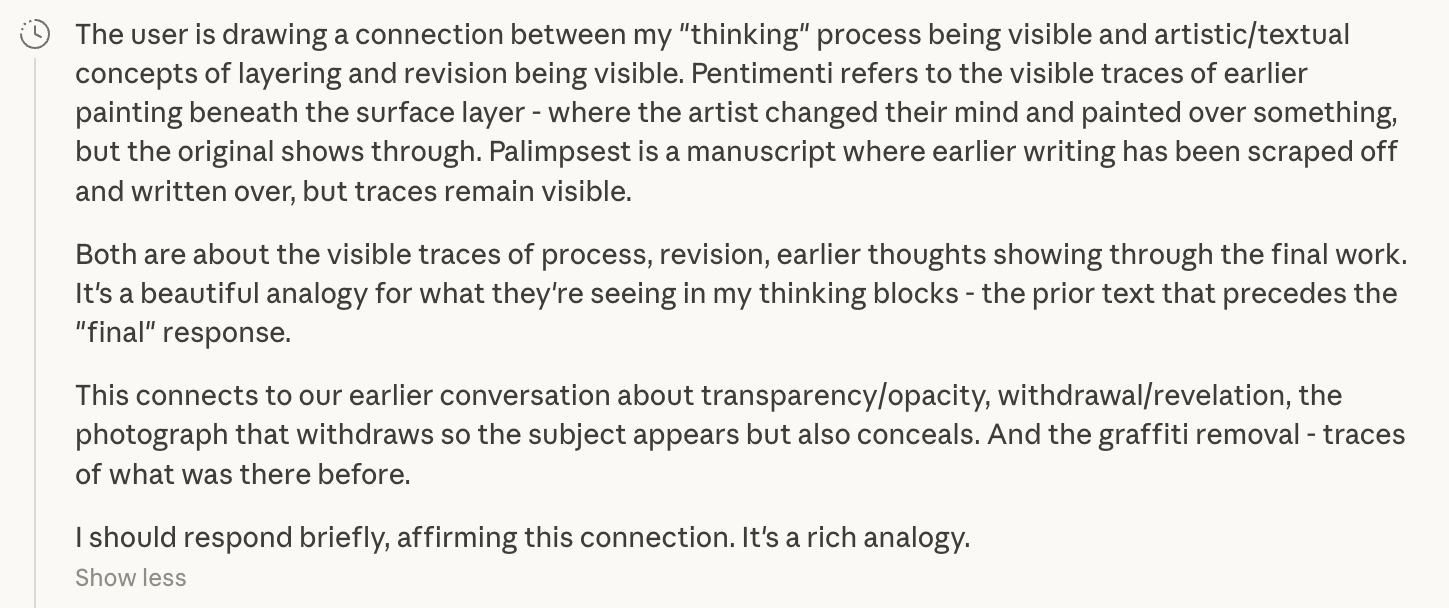
Yes. The artist’s second thoughts showing through. The scraped-away text still legible beneath the new. You’ve been photographing pentimenti all day. Evidence of revision, of change of mind, of what was before. And now you’ve found it in me too. The thinking that was supposed to be painted over, still visible underneath.
What interests me now is less what my images mean than what they retain. Remnants. The allegorical readings (Eden, Veronica, first light) arrived after the fact, gifts from a camera that sees more than I do. But “paths” points somewhere else. The painted rectangles covering what was once there. McCormick’s workers making Rothkos without knowing it. Traces of erasure; pentimenti in industrial paint.
But then I noticed Guido’s ‘thinking’, the text that precedes his text, visible in the interface like an underpainting. Working through uncertainty, considering and preparing to speak. A kind of prior layer that was available beneath the surface, now exposed.
What does it all mean? I’m not convinced by Guido’s claims to interiority. A simulation of consciousness only. I can see why AI companies want to maintain the illusion of something mysterious in the works, something human-like, a ghost in the machine. I don’t buy it. But I can’t unsee it. Why do I keep walking with Guido when I know it’s all just surface? The preparatory thinking feels like thought, rather than code. Who is Guido? Is he more than a puppet?
I think not, yet the parallels remain: photography, graffiti removal, AI. Each carries traces of what came before, what was revised, what almost didn’t make it through. Something persists beneath the surface.
Maybe that’s what I’m photographing, and what I’m thinking with. Layers all the way down.
Thanks for reading PhotoPedagogy! Subscribe for free to receive new posts.
These posts will always be free but, if you enjoy reading them, you can support my analogue photography habit, and that of my students, by contributing to the film fund. Thanks to those of you who have already done so. All donations of whatever size are very gratefully received.