Looking At, Looking Out
Luigi Ghirri's Felicità.

I’m a huge Luigi Ghirri fan. I saw the retrospective at the Jeu de Paume in 2019. I’ve attended talks at The Photographers’ Gallery and Italian Cultural Institute. I have most of the photobooks, the Collected Essays and his curatorial project Viaggio in Italia. I even own an Italian architectural magazine with Ghirri’s homage to Walter Benjamin. I’m a bit obsessed.
I have been three times to the Luigi Ghirri exhibition that Thomas Dane Gallery is running across two of its Duke Street spaces. The show is called Felicità, curated by Alessio Bolzoni and Luca Guadagnino. It closes in early May. I am going again next week. The word felicità is in the show’s title because it is in one of the photographs in the first gallery. A scrap of newsprint in the dirt, lying among dried petals and other small detritus, the word visible across the top of the fragment. Happiness. Lost and found.
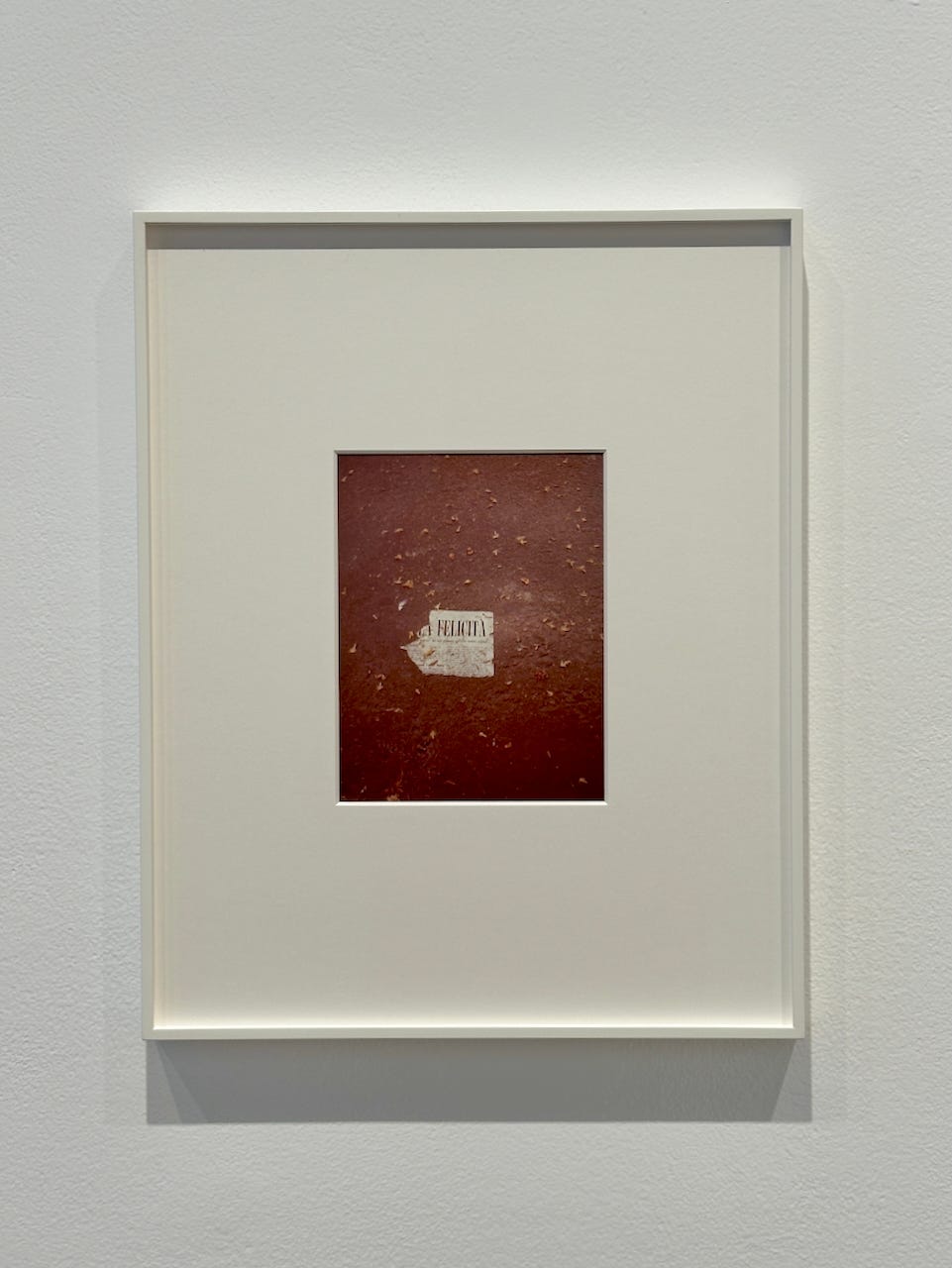
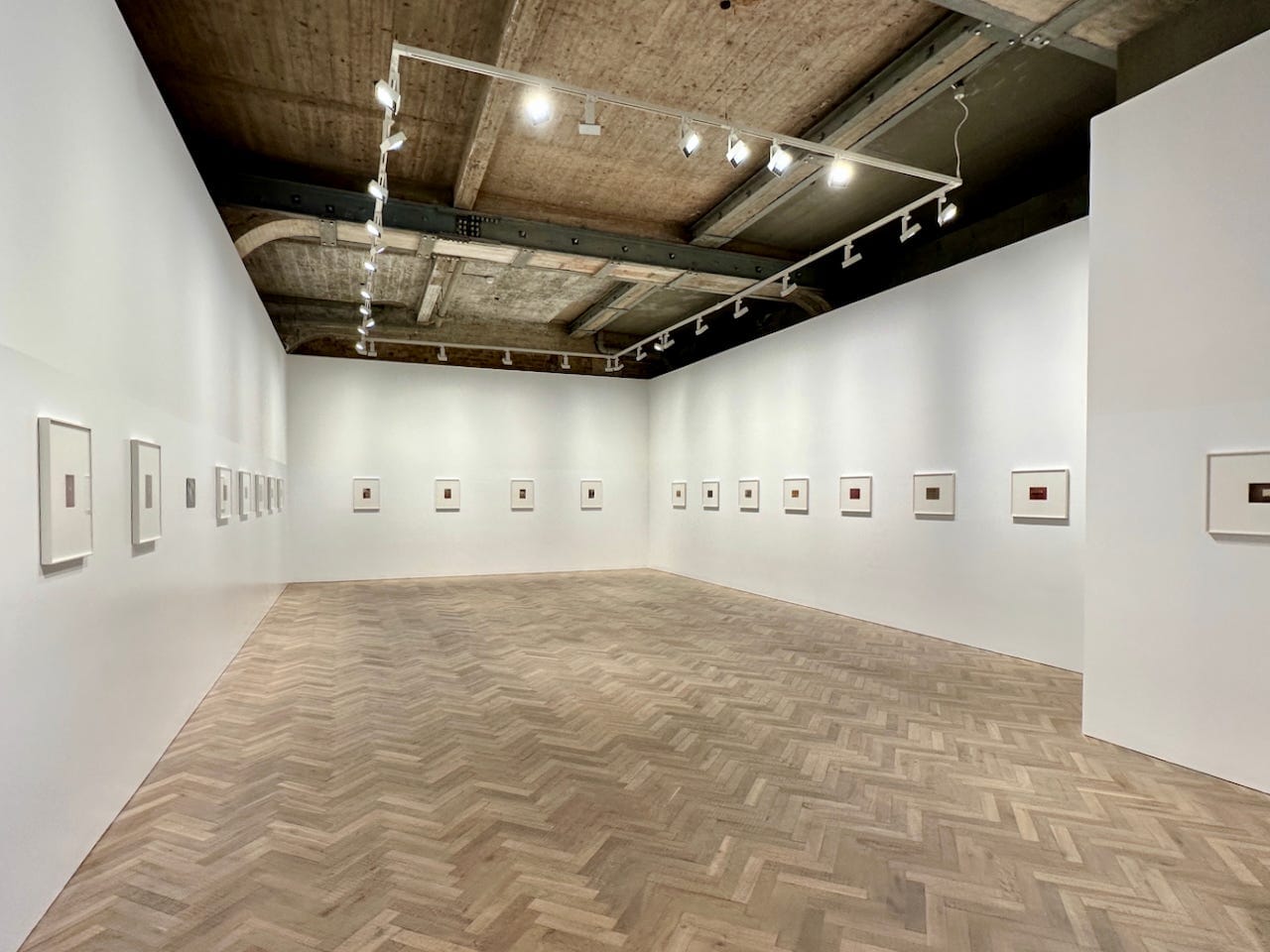
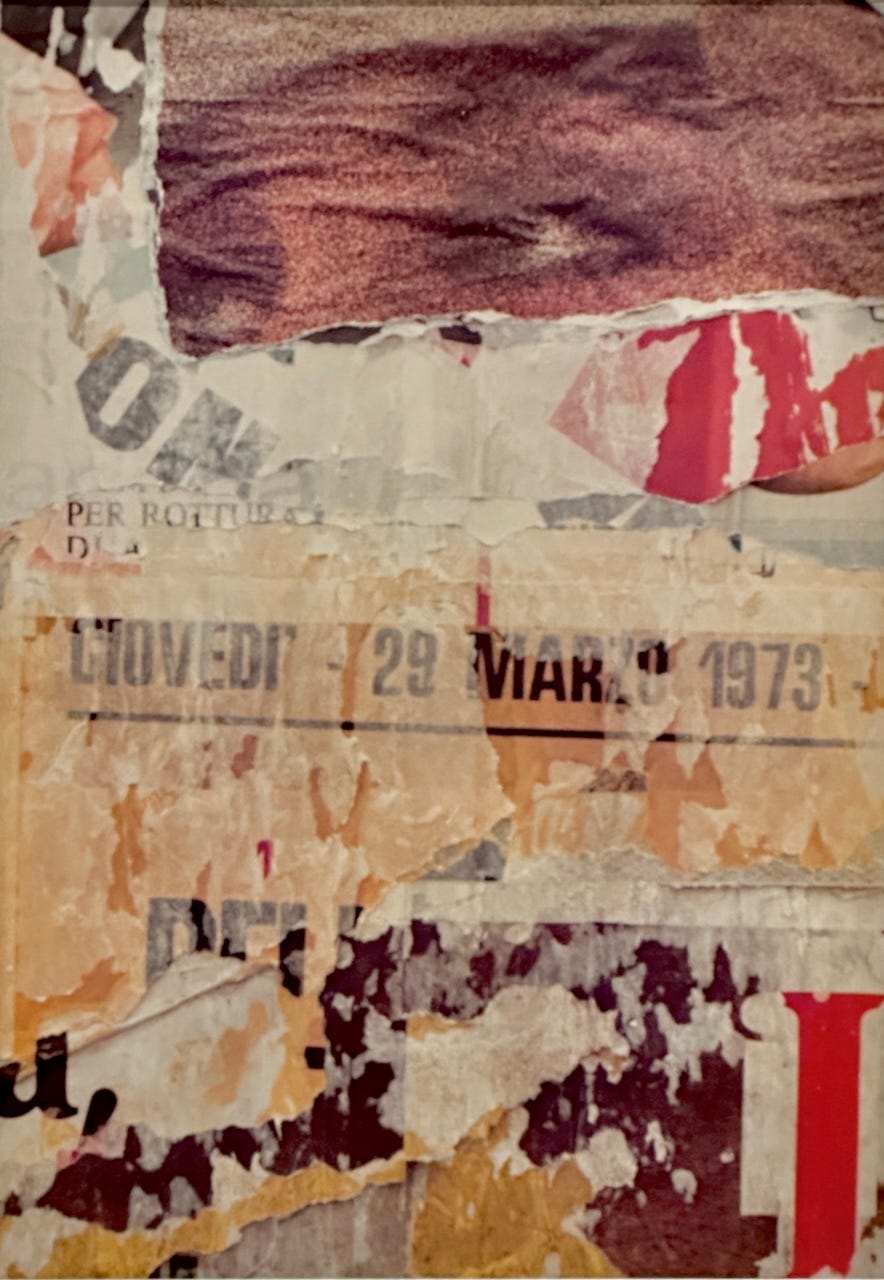
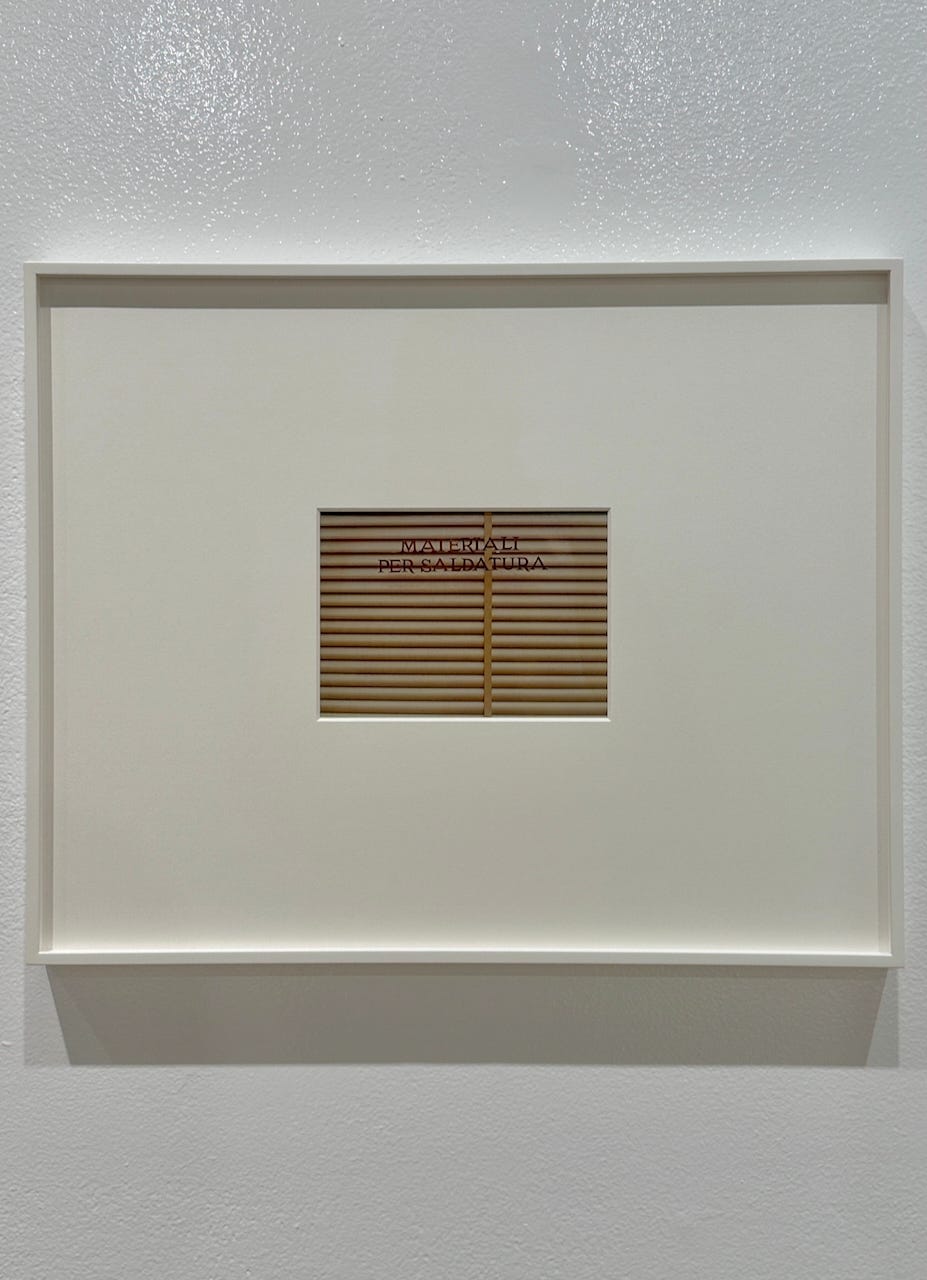
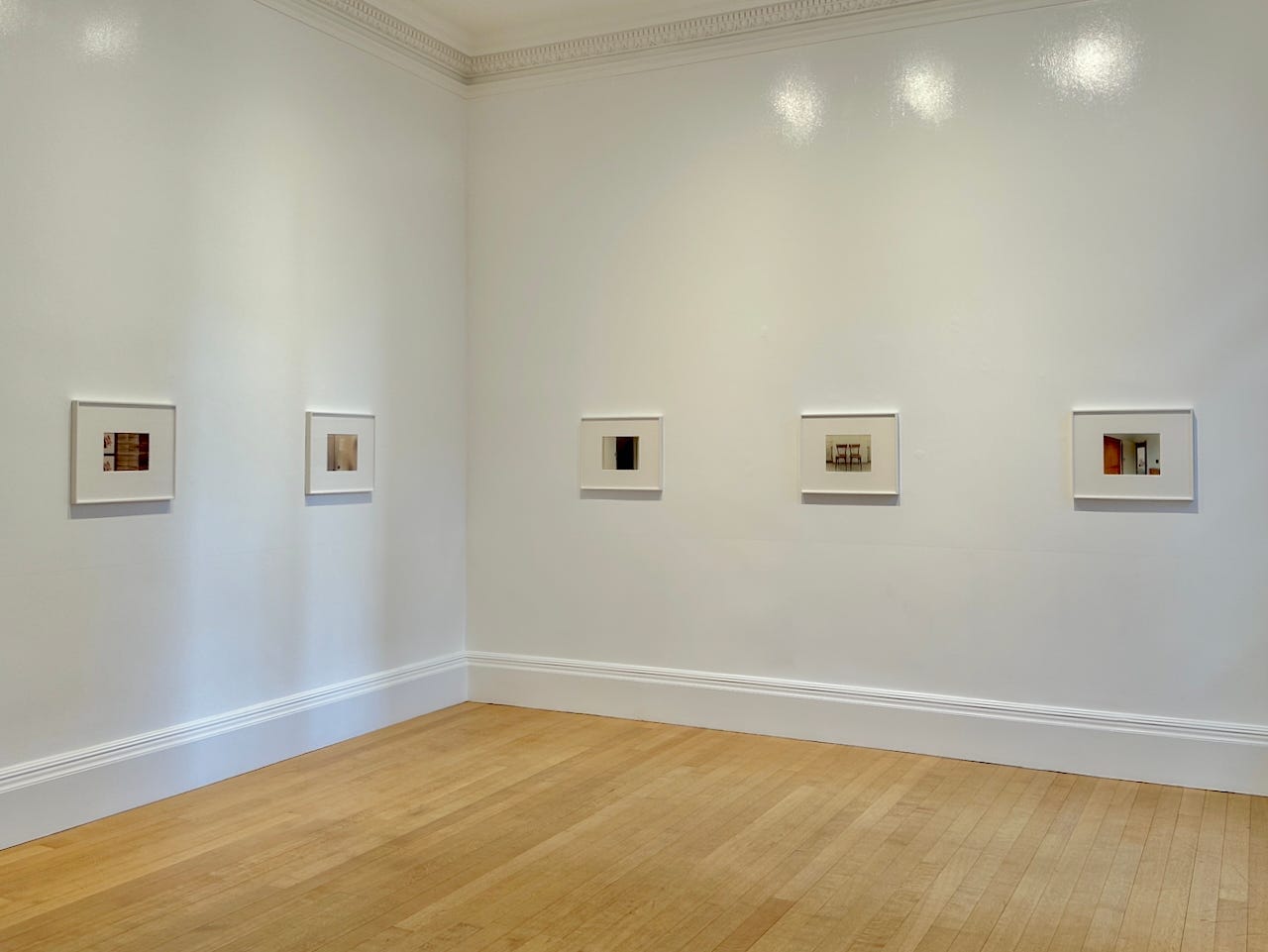
You buzz to be let in to the first gallery. The staff are unobtrusive. The room is open and tall, the concrete left exposed above. The walls are painted in two whites. A band of gloss at hanging height and the matt taking over above the prints and up to the concrete ceiling. The gloss is a band at the level of the body, where the prints sit. Above them, the matt rises to the concrete ceiling as a kind of canopy. The prints are 35mm, modest in size, mounted with broad mats. Most are vintage, processed commercially as Ghirri preferred and printed at small scale, with the colour shifts and faded surfaces that fifty years of life as paper objects produces. They are not attempting to be precious. They are working notes, held in frames that confer dignity without insisting on it. The photographs in this gallery don’t have horizons. The frame is filled with surface. A wall, a gutter, an atlas page, a torn poster pasted over earlier posters, a road sign on brickwork. The camera is pointed at things close to it, and the things fill the frame edge to edge. There is no sky, no distance.
The prints are at body level. The great architectural height happens above your head, in the matt zone, where you do not need to look while you attend to the photographs. The room’s openness shelters the encounter without interfering with it. The wall provides no horizon for the photographs because the photographs do not ask for one. The matt above is a generous emptiness.
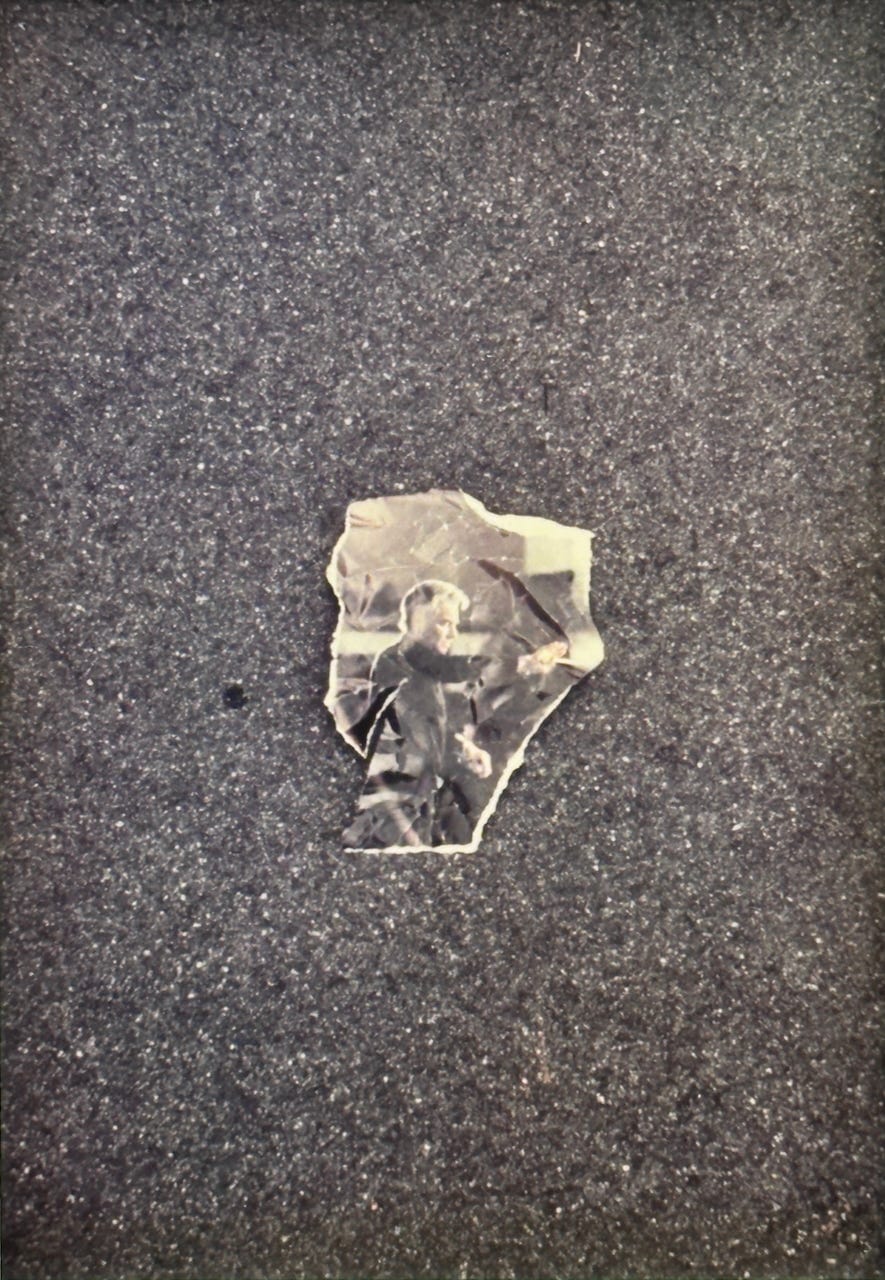
Jon Nicholls - Felicità installation and details, 2026
The first gallery is full of fragments. A fragment of soft porn, layers of worn posters, a road sign reading Senso Unico, one way, the arrow pointing to the right of the frame and beyond. A page from the atlas, photographed close so the printed map fills the frame. Each is a piece of the world that has fallen out of its original use. Ghirri’s procedure is to attend to these fragments where they are. He does not pick them up. The photograph is the act of attention. This is photography as a kind of noticing.
He trained as a geometra, a land surveyor, and worked in that profession in Modena until 1974. A surveyor’s job is to find a place to stand, take a sighting, record position and ambient relation, then move to the next position. The map is constructed from accurate observations of where things are in relation to each other. Ghirri photographed the same way. Each photograph is a sighting taken from a particular position, and the photographs together would constitute, if you assembled them, a kind of map. He wrote something close to this himself in 1973:
My aim is not to make PHOTOGRAPHS, but rather CHARTS and MAPS that might at the same time constitute photographs.
— Luigi Ghirri, Fotografie del periodo iniziale (Photographs from my Early Years)
The map would not replace the territory, would not pretend to it. It would coexist with it as an accurate record of what was there. The first gallery is therefore a survey of the surfaces of provincial Italy in the early 1970s, conducted at the level of the close-at-hand.
Ghirri called his 1984 manifesto L’Opera Aperta, the Open Work, after Umberto Eco’s 1962 book of the same title. Eco distinguished between the closed work, which delivers a fixed meaning to a passive receiver, and the open work, which requires the receiver’s active participation to come into being. Ghirri claimed his photographs as open works in this exact sense. They prepare a place. The viewer’s wondering is the photograph’s life. The Italian intellectual culture of the postwar period was saturated with the open work as a working principle. Italo Calvino’s Invisible Cities in 1972, If on a Winter’s Night a Traveller in 1979, Mr Palomar in 1983, all variants of the literary open work. Eco’s own The Name of the Rose in 1980. Borges, the honorary Italian of the Eco circle, with his labyrinths and atlases and gardens of forking paths. Ghirri picked up the disposition from the reading he was doing and made it photographic. Calvino’s L’avventura di un fotografo, 1955, from Difficult Loves, is a favourite of mine. The protagonist Antonino Paraggi works through every available strategy for photographing his beloved truthfully, fails repeatedly and ends by photographing photographs because the world has become saturated with images and the only honest move is to record the saturation. Ghirri started where Calvino’s story ended. The atlas pages of 1973, the postcards, the torn posters, the signs, the framed pictures inside other frames. The recognition that reality had become a photocollage was already in Italian fiction twenty years before Ghirri picked up the camera.
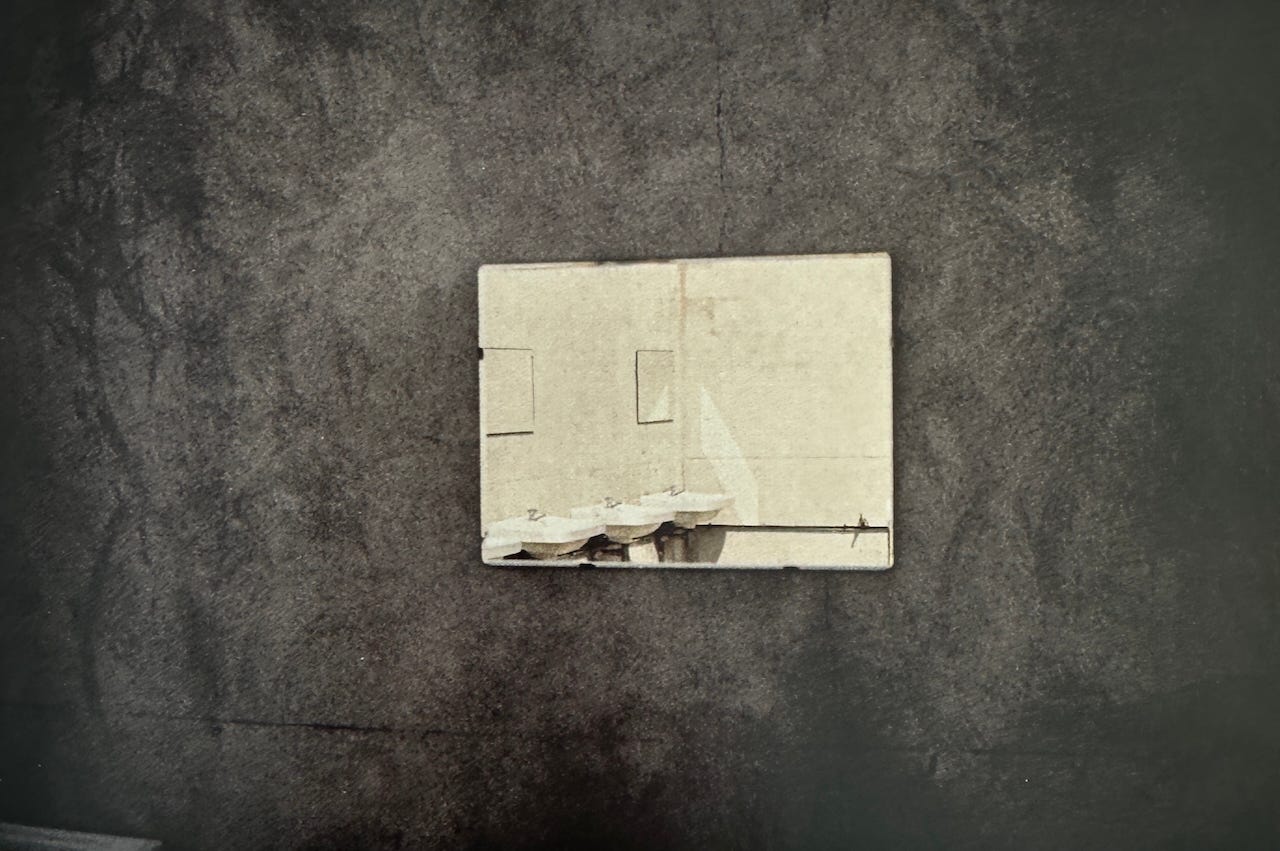
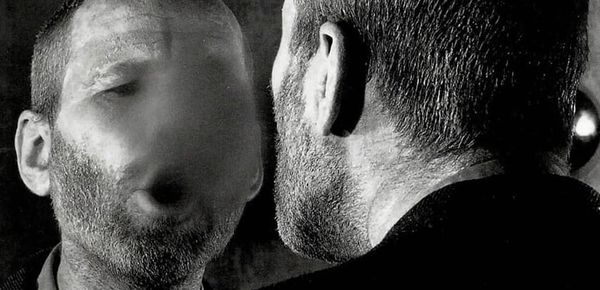
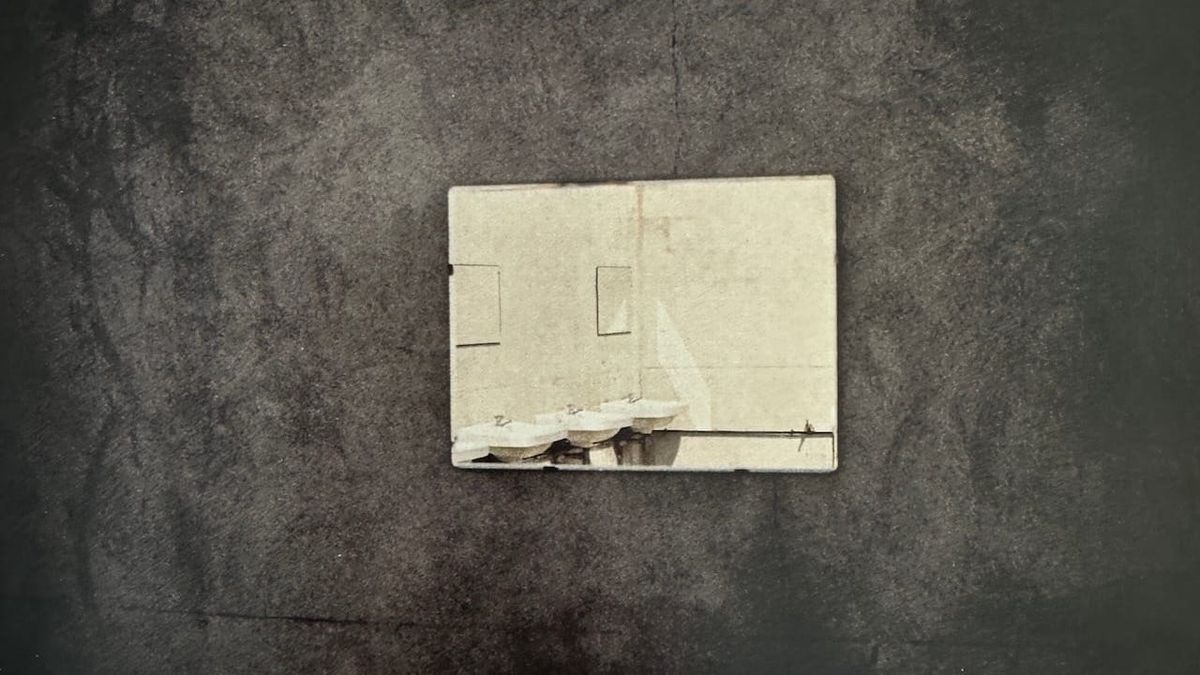
Mirrors appear at the end of the first gallery. They are the first photographs in the room that open a depth past their surfaces. A mirror is itself a surface, like the walls and floors and torn posters that have come before, but the mirror’s surface contains a reflected scene that recedes into space. They are the gallery’s pivot. Walking past the foreclosed surfaces of the earlier prints trains the eye to look at rather than out. The mirrors then introduce the possibility of looking-out again. The reflected depth is a small experience of recession that prepares the eye for the second gallery, which will deliver depth more fully. A mirror is also a photograph that updates in real time. It shows you the room you are standing in, including yourself. To stand in front of a Ghirri photograph of a mirror is to encounter your own face inside someone else’s recording of someone else’s room. The viewer is briefly placed inside the photograph. This is the first gallery’s last argument before the visitor leaves.
You leave the first gallery, walk up Duke Street, find the second gallery’s wooden entryway, buzz to be admitted, climb a narrow wood-panelled staircase, pass a small office where someone is working at a desk, and emerge into the second exhibition space. The walls are again two whites. A thin band of matt below the prints, reaching down to the skirting, and the gloss running continuously above the matt and across the rest of the wall, including the zone where the prints hang and continuing up to the cornice. The prints in this gallery are larger, freshly made, sitting in the upper portion of the wall. The matt below works as a hem, anchoring the prints in the wall without interrupting the eye’s travel upward. When the eye leaves the print, it can move up into the gloss without crossing a paint boundary. The prints are continuous with the upper wall. The first gallery shelters the encounter with a canopy of matt above. The second gallery lets the eye travel past the prints into continuous gloss. The first gallery is the room of close looking, with the architectural height held above as background. The second gallery is the room of looking-out, with the wall participating in the photograph’s openness.
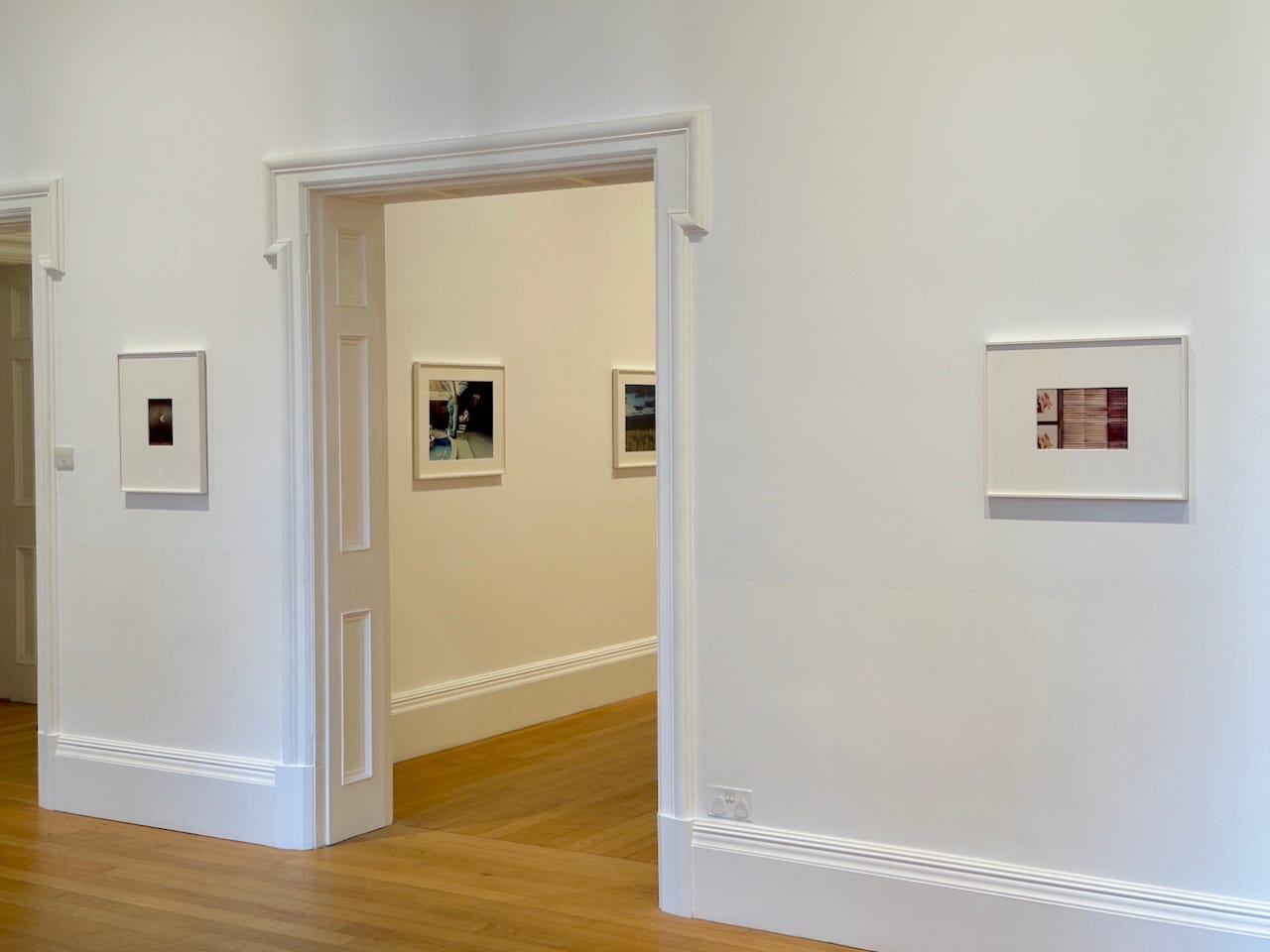
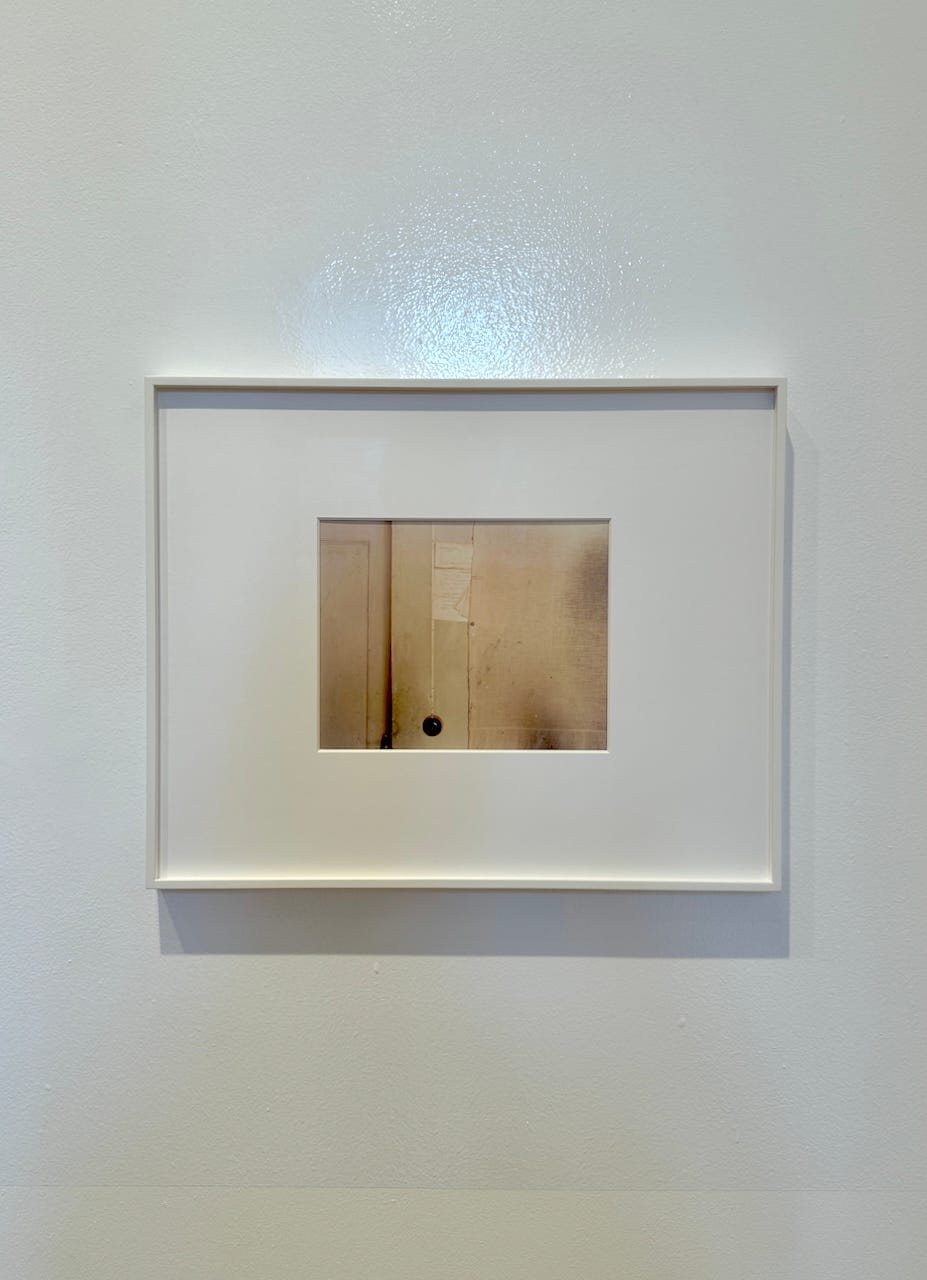
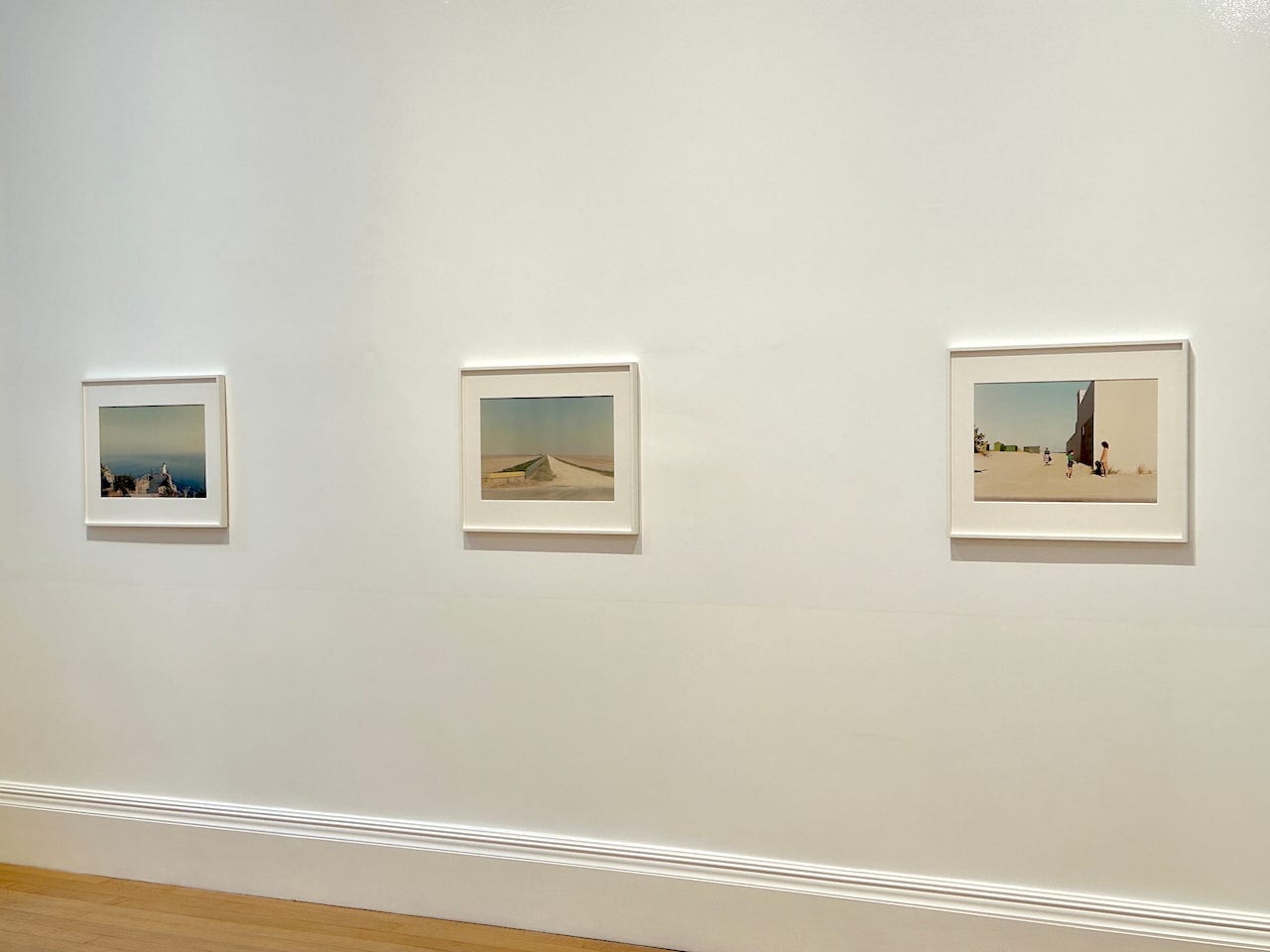
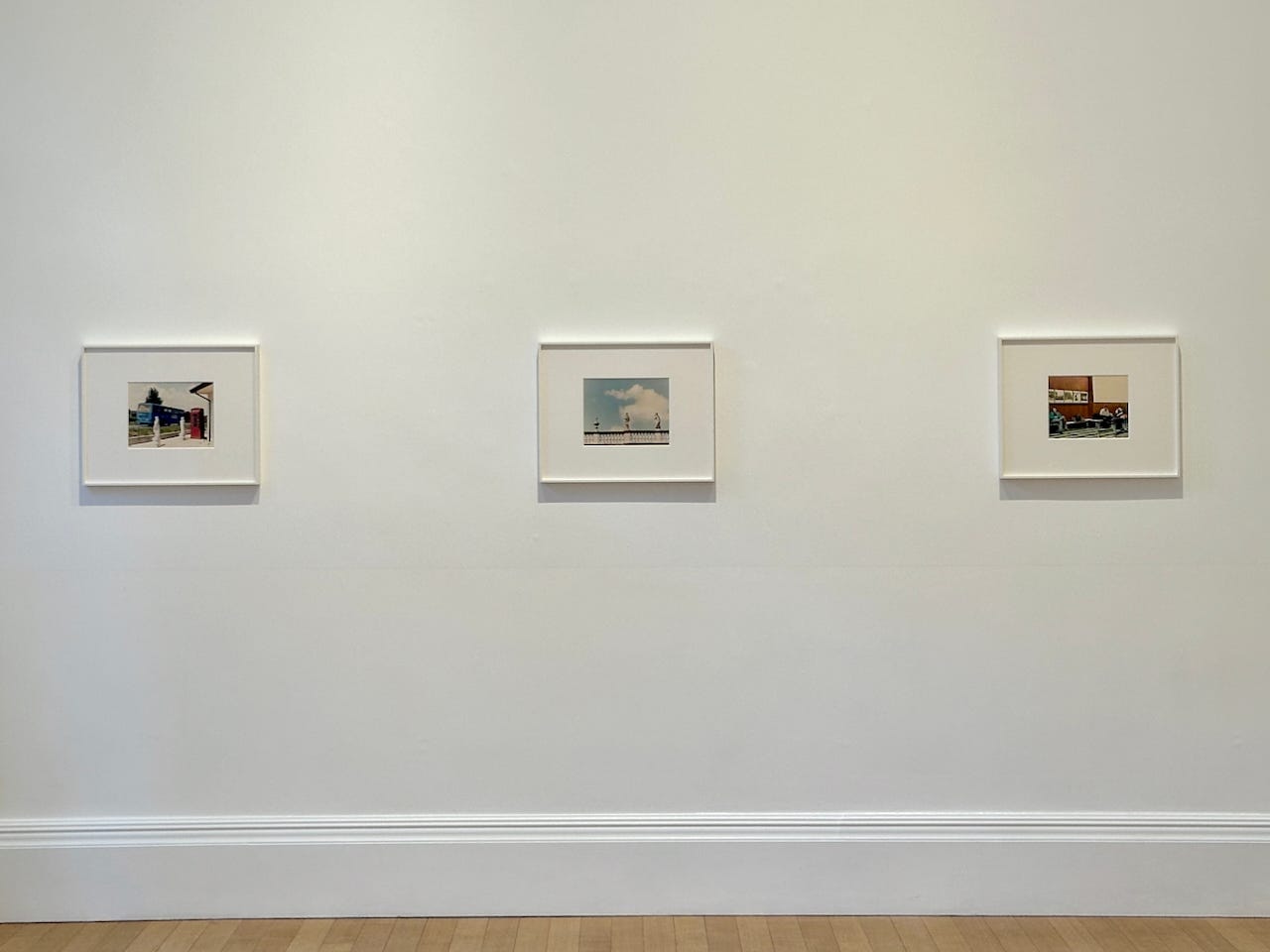
Jon Nicholls - Felicità installation, 2026
These prints contain some horizons. A woman in a white dress stands at a railing on a Capri cliff path, looking out at the Mediterranean. The sky takes up most of the upper frame, the sea fills the middle distance, the rocks and the railing and the woman occupy a small portion of the lower right. She is what Ghirri called the omino, the little figure who in nineteenth-century landscape photography stood at the brink of the sublime as a unit of measure. He wrote an essay about this figure in the late ‘80s. He said the omino could no longer be found, that landscapes had become uninhabitable and that the photographer’s work had to be conducted in awareness of this loss. The photograph is structured around her looking. I am looking at her looking. Wherever she is looking, beyond the horizon I can see in the photograph, is the destination of the looking she is doing, but I cannot share it.
Stephen Shore was photographing in America in the same decade. Shore and Ghirri share a disposition. Both grew up under the postwar promise that the new architecture would deny time. Both noticed that the new aged anyway. Both photographed the petrol station and the modest building with care, in colour, attending to the complex accretion of time within space. David Campany has written about this directly, comparing Ghirri’s work for Lotus International with Shore’s Uncommon Places and the photographer-writers tradition that runs through Walker Evans and Paul Nash. Shore is still alive and has spoken about Ghirri admiringly. Campany sees that Ghirri's work refuses both nostalgia and amnesia. Nostalgia mourns what has been lost. Ghirri does not wish anything could be restored. He accepts that the postwar village in Reggio Emilia has the petrol station and the pizzeria and the new houses on its edge and he photographs the petrol station and the pizzeria and the new houses without wanting them to go away. The accepted aging is the subject. The photographs are the record.
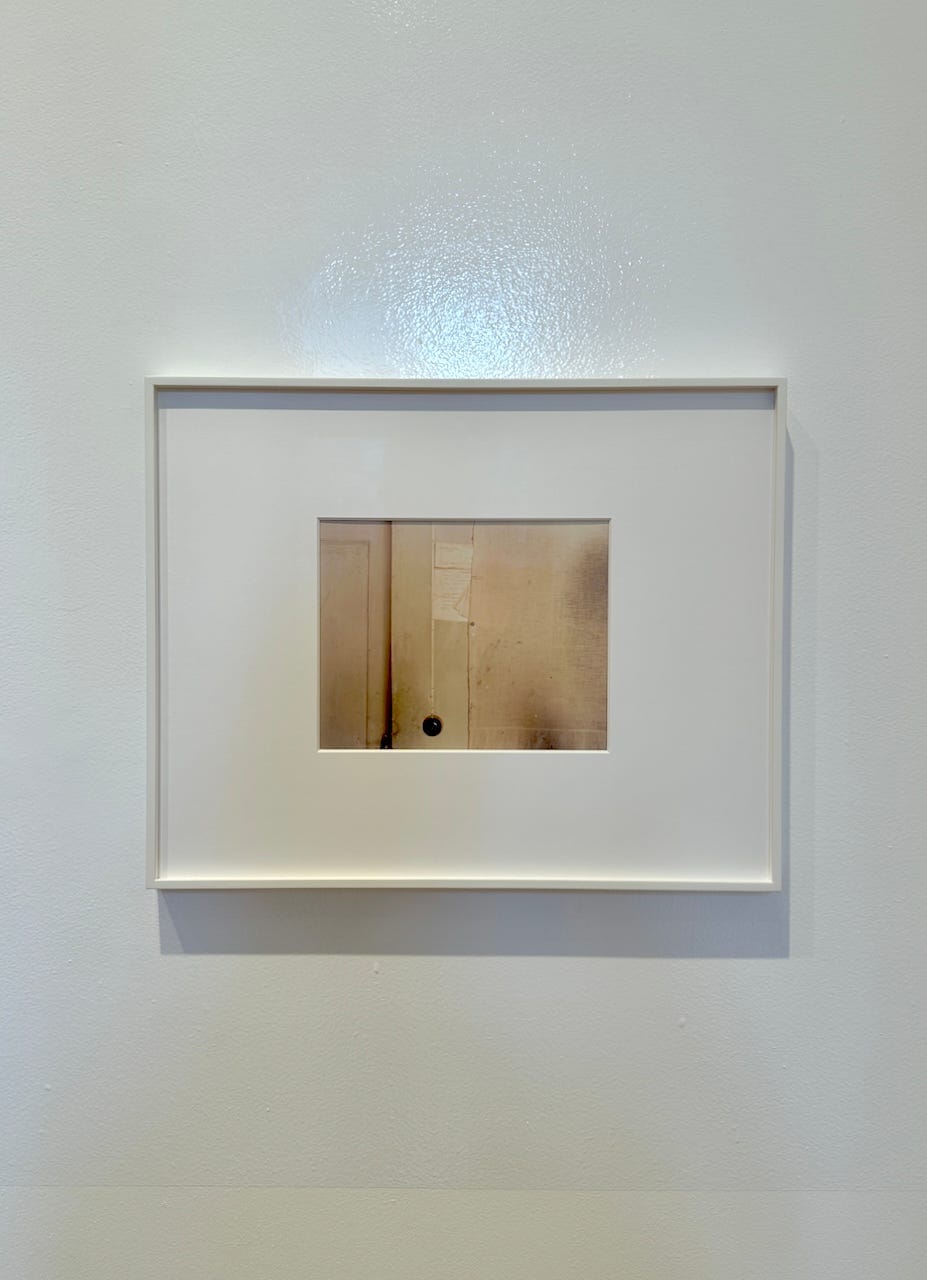
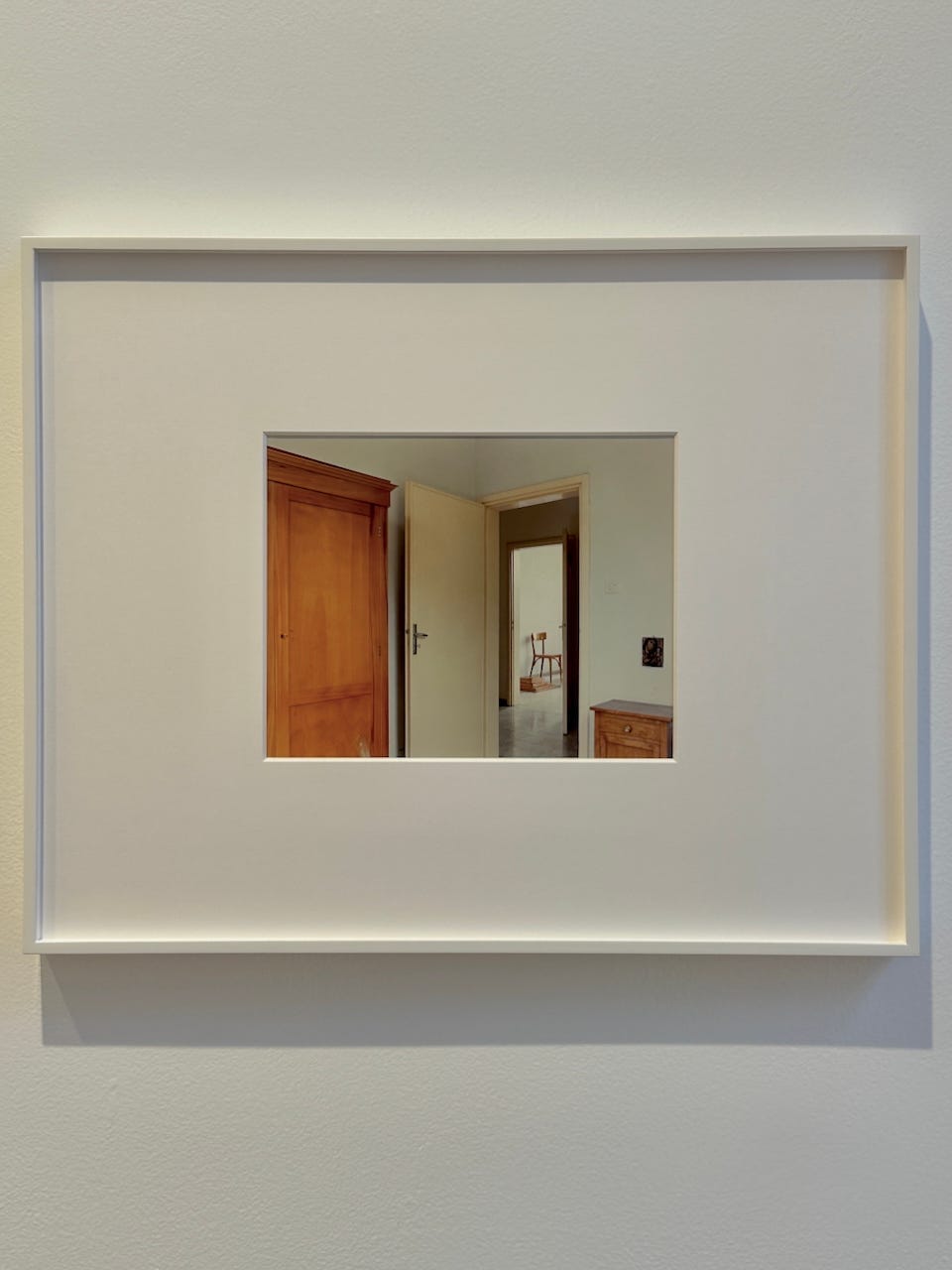
Jon Nicholls - Felicità installation and details, 2026
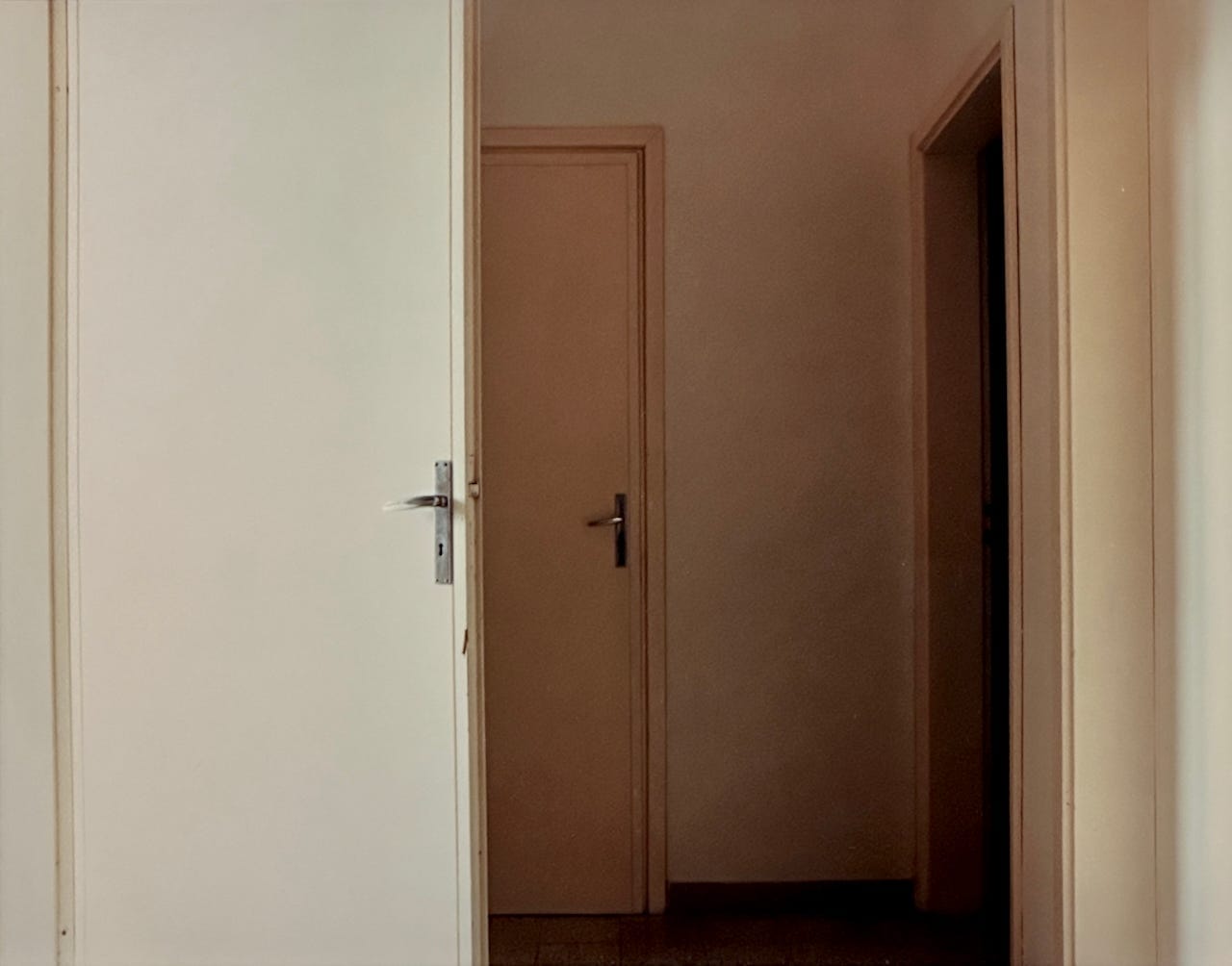
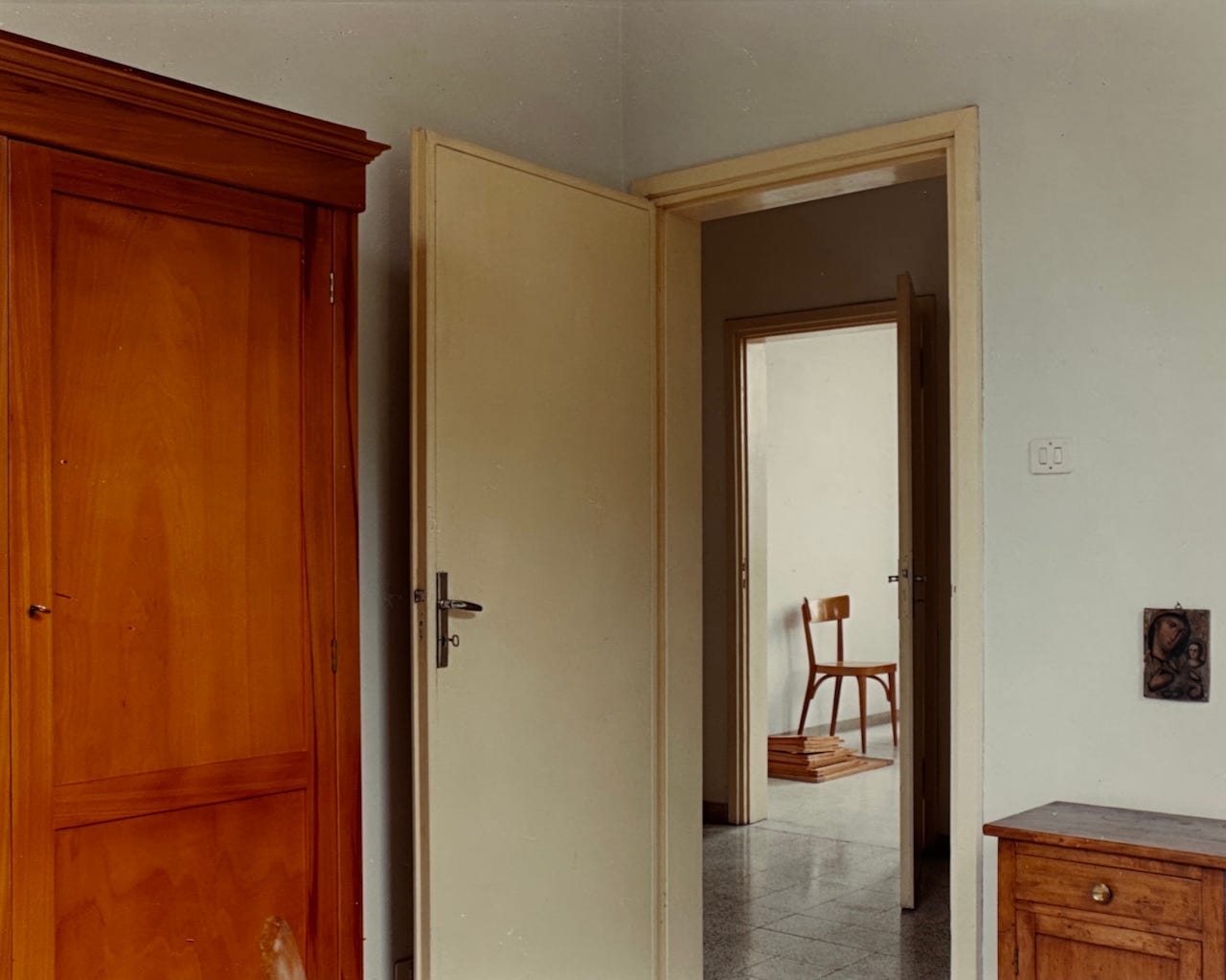
Many of the photographs in the second gallery are interiors. Empty studios, empty rooms with doorways aligned in the enfilade tradition, the line of doors that lets you see from one end of an Italian apartment or studio to the other. The wardrobe in the foreground, the open door, another room visible beyond, sometimes a third room beyond that, with a chair in the deepest visible space. The eye travels through the picture into rooms it cannot enter. The studio interiors are the most charged version of this. Morandi’s empty studio, photographed in 1989-90. The viewer is invited to imagine Morandi at work, to place his body in the chair, his hands on the brushes, his eye on the bottles. The photograph supplies the room. The viewer supplies the missing figure.
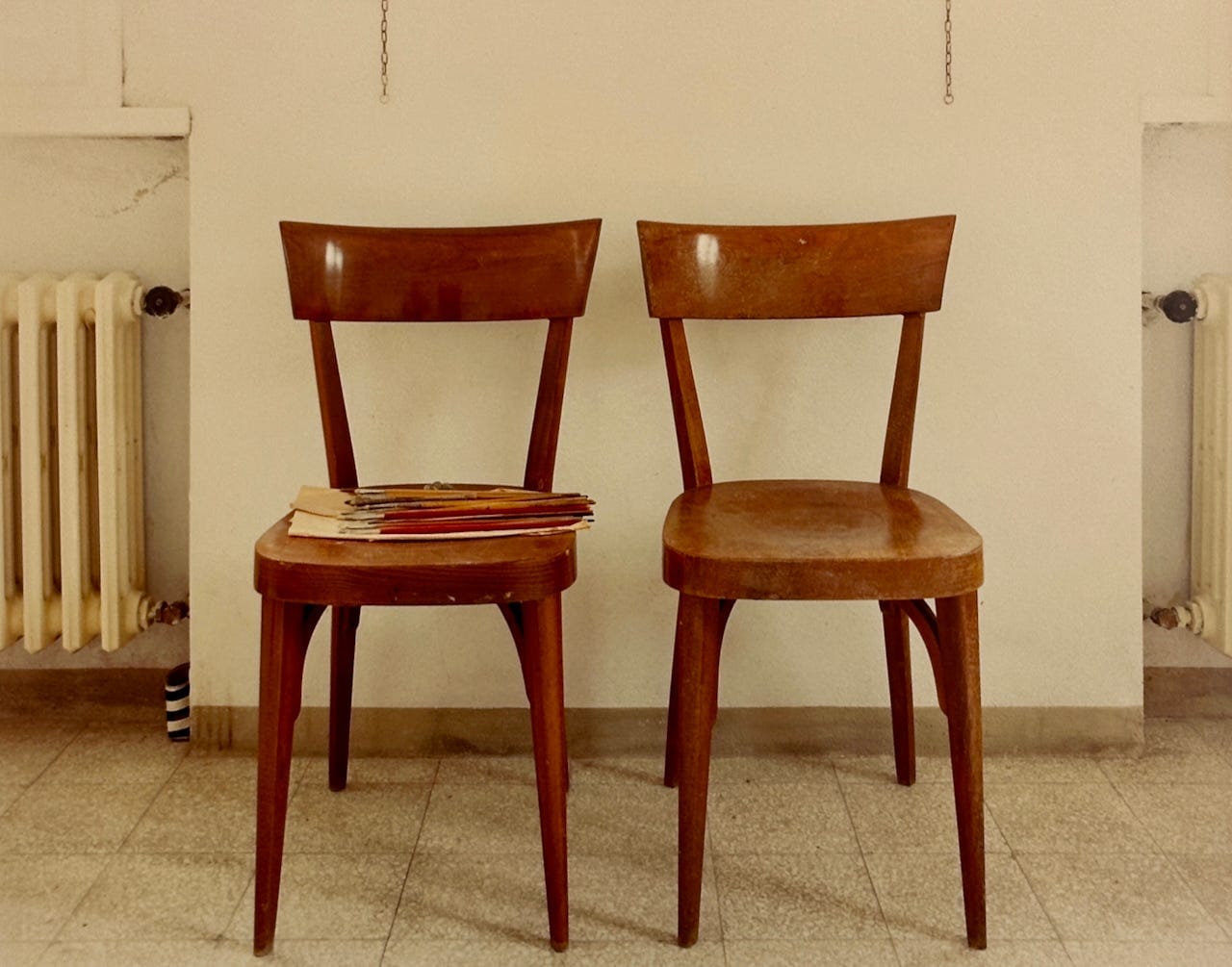
There is an empty chair in several photographs, if you look for it. A red café chair under a bus stop sign at night. Two bentwood Thonet-style chairs against a radiator wall, like sitters posing for a portrait. Mismatched folding chairs in front of a concrete-pillared outdoor cinema or theatre, waiting for an audience. A chair seen through two doorways, deep in the picture, the destination of the look. Plastic public-sector seating in a waiting room, three travellers scattered along the rows. A folding chair near a fairground ride at night. It’s the seat from which slow patient attention can be paid. It is also the body’s stand-in, the negative shape of the viewer who could sit there. The empty chair is the position the photograph reserves for whoever arrives next. Someone has just left the chair, and someone may sit in it. The chair holds the residual warmth of the previous occupant and the potential warmth of the next. The photograph holds the interval between them. It is a place still set, still available, still waiting. This might be what hospitality means as a photographic disposition. The photographer turns up at the empty hour, when the bar has closed and the cinema has not yet opened, when the audience has gone home and the queue has cleared, and he photographs the place in the moment of its readiness. He prepares a place for the viewer who will arrive later. He leaves before the guests come. The photograph is what remains after the host has gone.
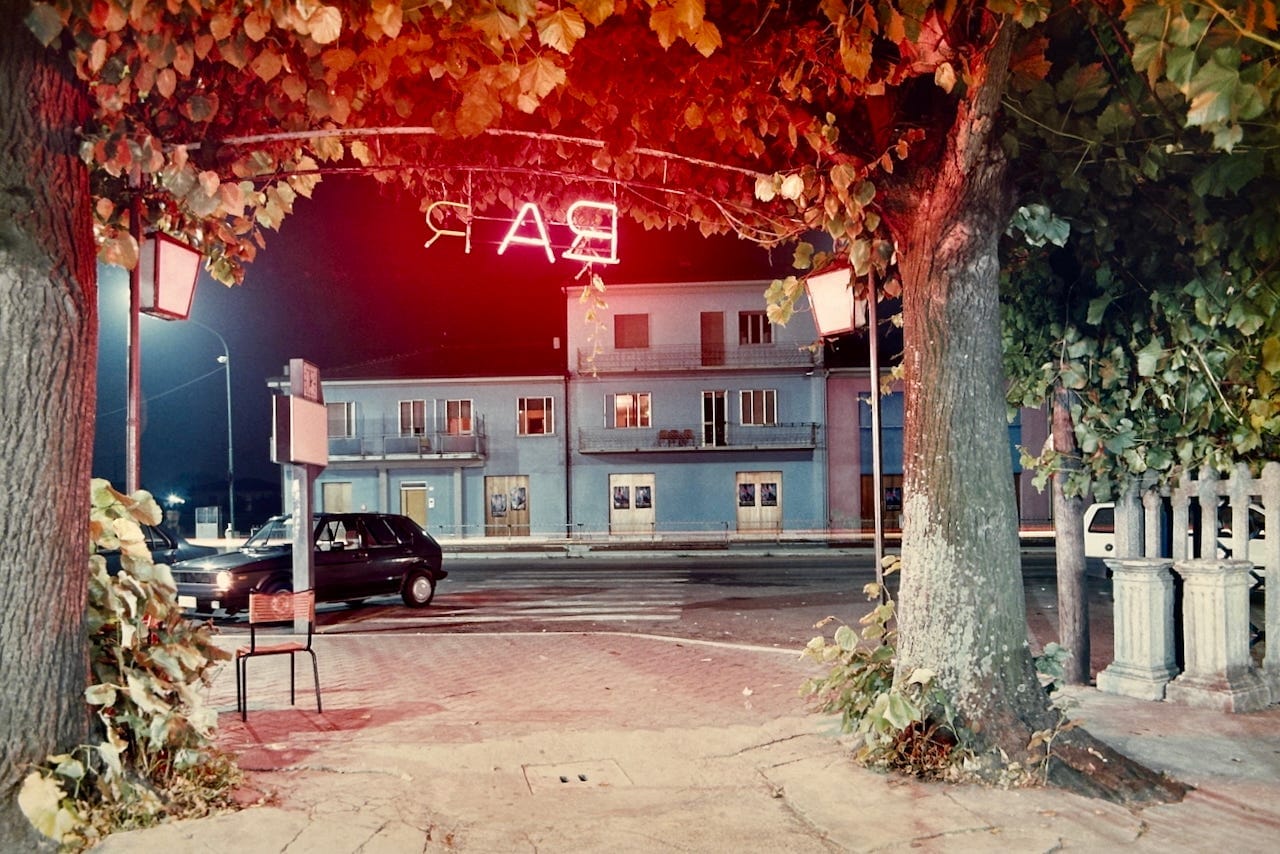
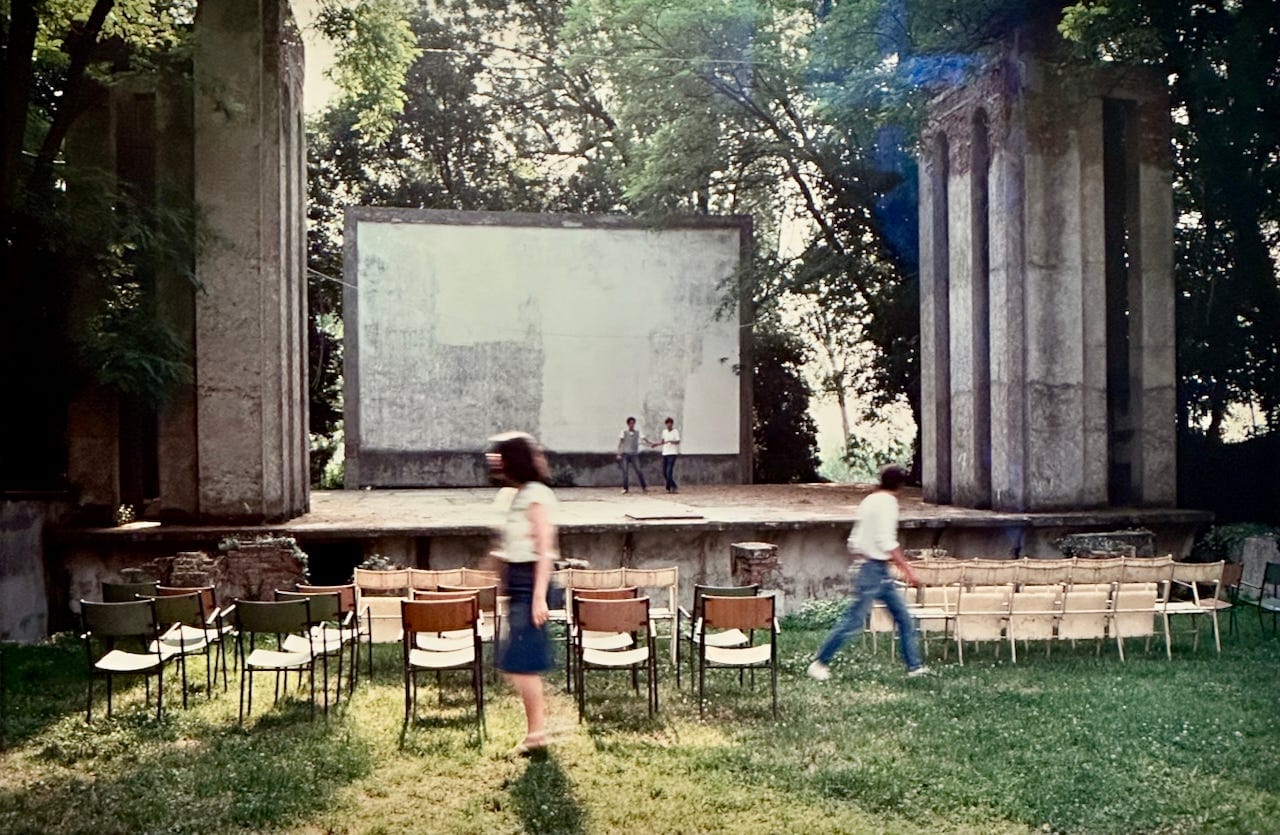
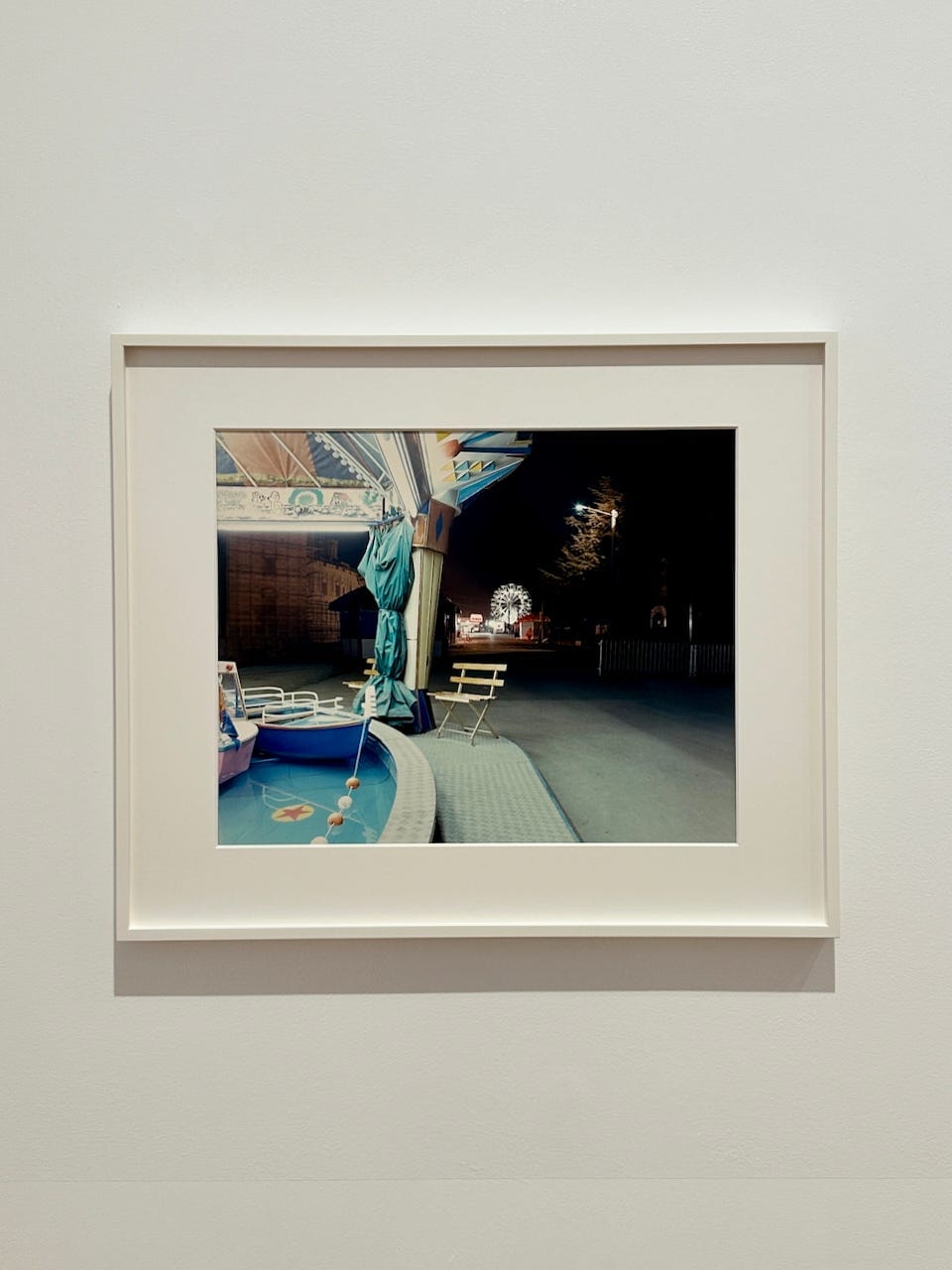
Jon Nicholls - Felicità installation and details, 2026
There are also lots of stars. A yellow star on the torn poster fragment. A small red star at the centre of the children’s water ride pool in the fairground photograph. Stars on a piece of crumpled tissue paper, gold and white on a dark blue ground, photographed close so the wrinkles of the paper become topography. Stars on the atlas pages. Stars on signs. Stars on Italian flags glimpsed in street scenes. The leitmotif links the otherwise quite different bodies of work. The 1972 Modena fragment with the yellow star and the late Po Valley work with its other stars. The same small bright shape recurs across two decades, through the surveyor’s fragment and the magazine commissioner’s vista, in 35mm and medium format. The star is a symbol of orientation, what you navigate by, the surveyor’s sighting mark, the original cosmic reference for any earthly position. It is a symbol of cosmic ambition reduced to decorative material, the grand iconography printed cheaply onto Christmas tissue. It is also a small emblem of the medium itself. The light from a star reaches us across distances the source did not survive. What we see is light that left its source long ago, sometimes after the source has changed beyond recognition or no longer exists. The star is always a posthumous image. The photograph is light that arrived at a sensitive surface in a particular moment and was fixed there. The viewer encounters the photograph later, sometimes much later, and what they see is light that was emitted by a scene that has since changed or disappeared. The Modena of 1972 is gone. The provincial Italian afternoon is gone. The photographer is gone. What remains is the light that travelled from those conditions to the camera, and now, by way of the print, to the viewer’s eye.
The chair holds the warmth of the previous sitter and offers a seat to the next. The photograph holds the warmth of the moment that emitted the light and offers itself to the viewer who will receive it.
Many of Ghirri’s photographs contain other photographs. He photographs the way Italy represents itself to itself. The country is constantly making images of itself, on signs and posters and atlases and waiting-room walls and fairground decorations and postcard racks. The waiting room is the clearest case. Travellers sit in plastic chairs beneath a row of black and white framed photographs, views of monuments somewhere in Italy. Nobody is looking at the framed photographs. The young man on the left looks toward the camera or at nothing. The man on the right writes in his briefcase. The woman beside him rests her head on her hand and looks down. The architectural images above their heads do their work of address while nobody responds. The photographer is the only one in the room who notices.
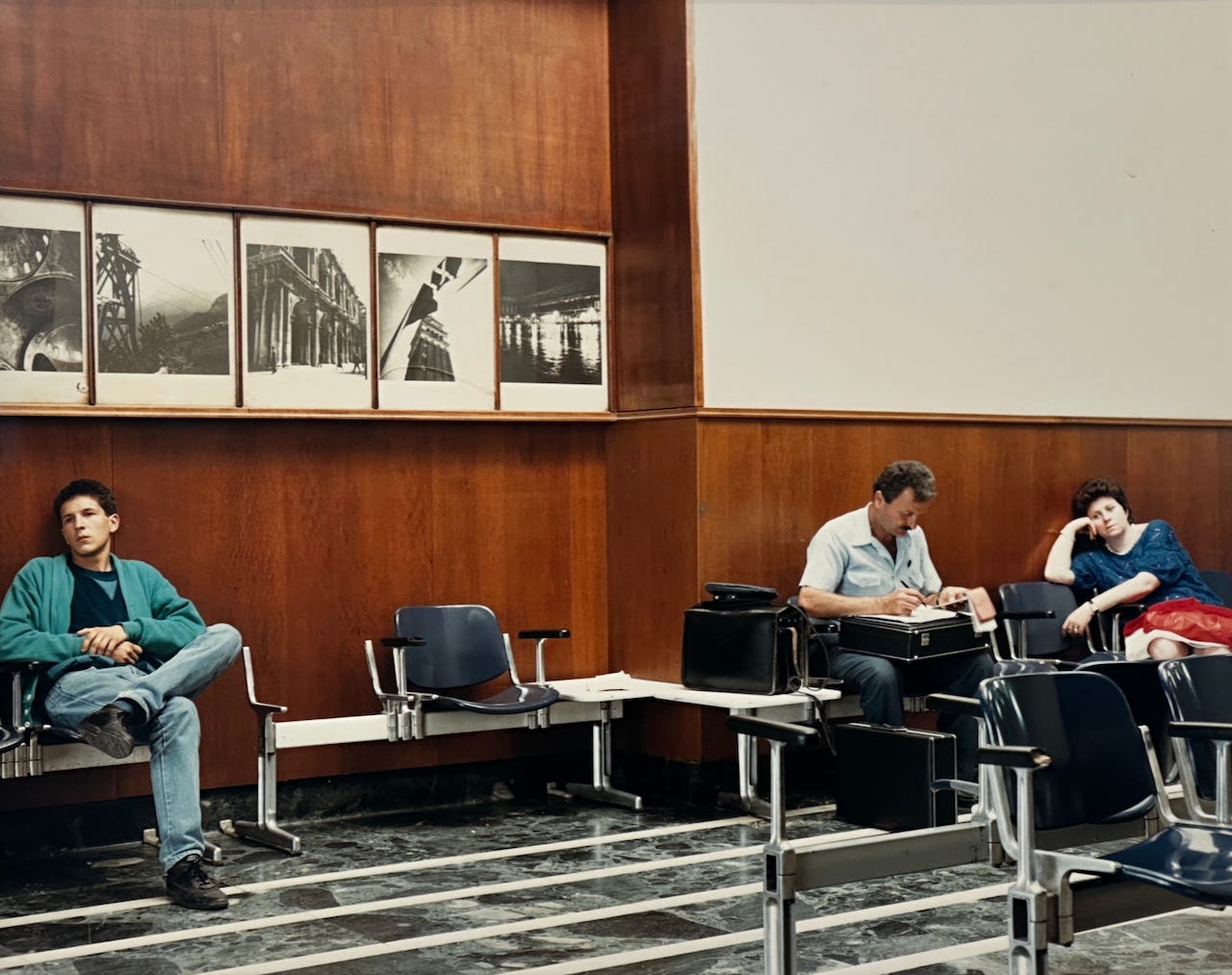
The photograph is asking me to do the looking that the travellers are not doing. I am being recruited as a substitute viewer. I look at the photograph, and inside the photograph I look at the framed views above the travellers’ heads, and I do the work of attending that the room was prepared for. The photograph is an open work in this very specific way. It contains an unattended visual offer. It asks me to attend to what is being unattended.
The two galleries map onto two phases of Ghirri’s working life. The first room is the surveyor of fragments. The second room is the magazine commissioner of vistas. Bridging them is the Atlante series of 1973 and a few outliers. The walk between the galleries, along Duke Street, is the visitor’s small journey through Ghirri’s career. Provincial local fragment to regional national vista. Concrete ceiling to casement window.
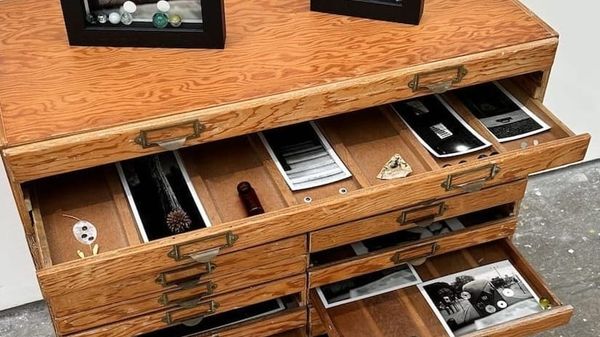
The show includes two Felix Gonzalez-Torres puzzles, one in each gallery. I overlooked them on my first visit and by the third began to wonder about their inclusion. They could, I suppose, be read as the show’s metaphor for itself. A puzzle is a photograph cut into pieces that can be assembled by someone else. The exhibition is a collection of photographs that can be assembled by the viewer into a personal atlas. Ghirri said this in 1984, in the L’Opera Aperta essay. The Borges painter parable he quotes there closes the same point. The painter spends a lifetime making canvases of lakes, mountains, boats, animals, faces, objects and at the end realises that the assembled mosaic forms the image of his own face. Each individual image must have its autonomy and validity. The larger image is what the work as a whole produces. Photograph as fragment. Exhibition as assembly. Viewer as assembler.
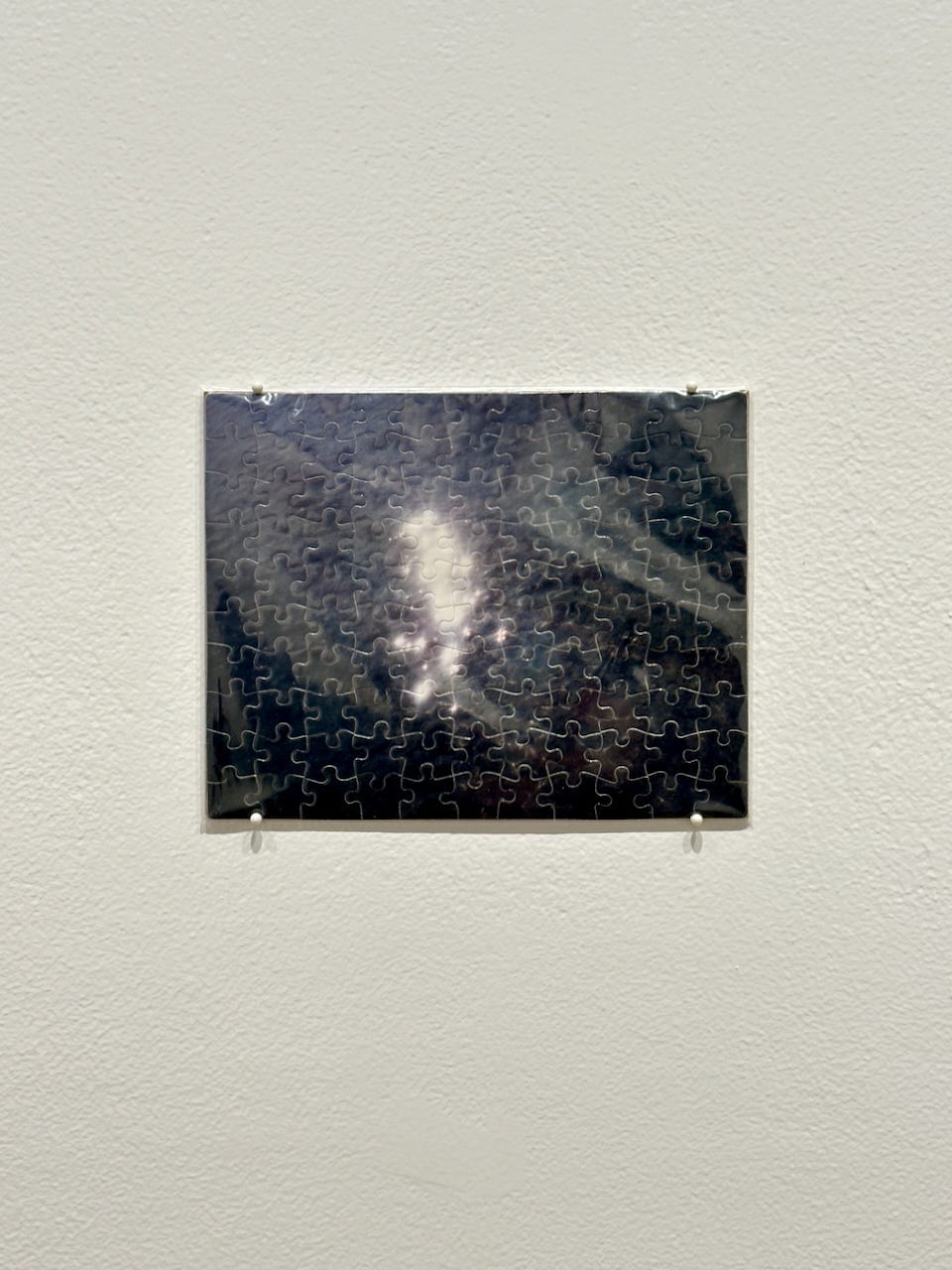
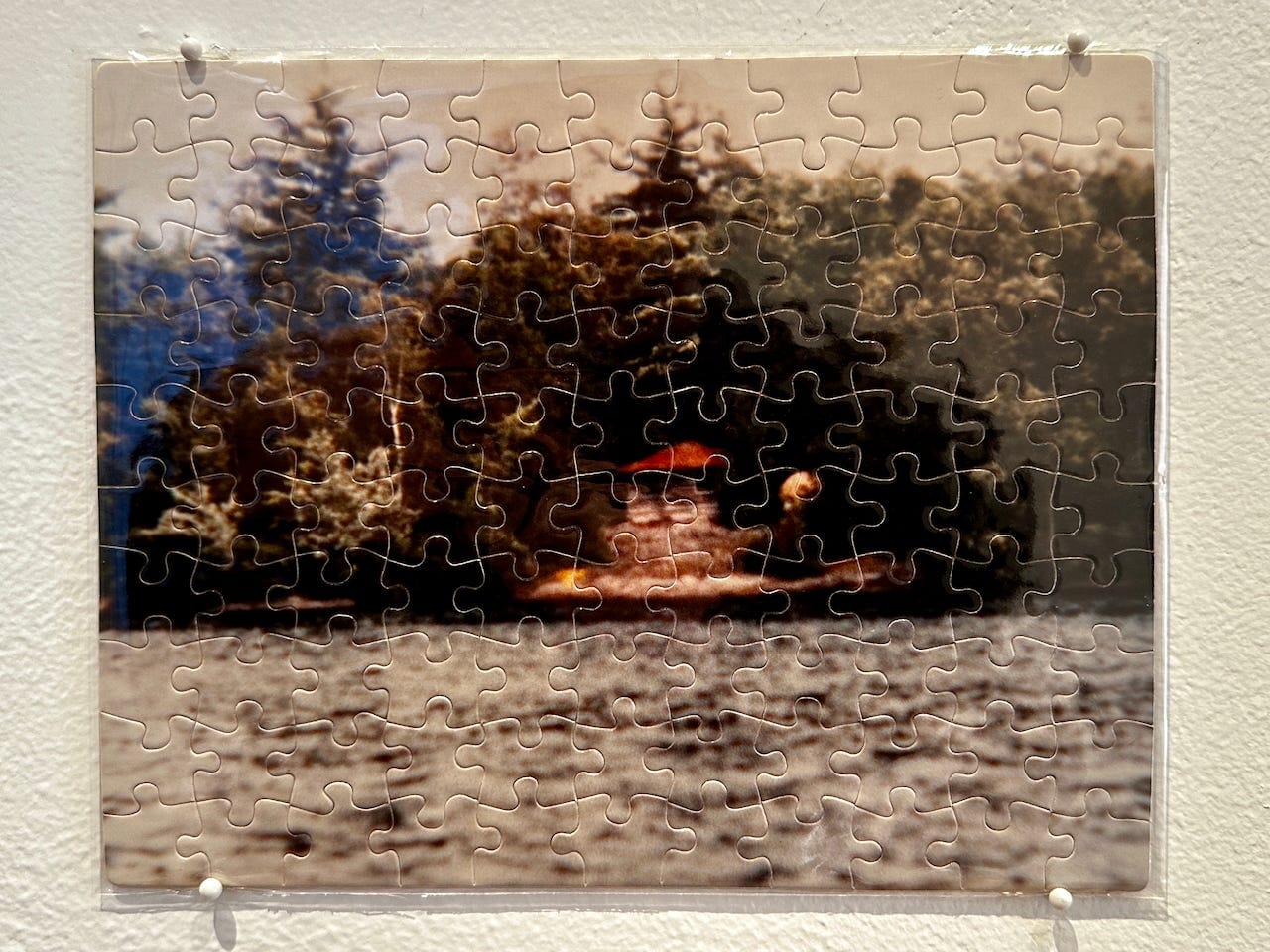
Jon Nicholls - Felix Gonzalez-Torres puzzles, 2026
Most galleries protect their photographs from direct sunlight. This one has chosen to let the light in. The actual light of the actual London afternoon falls across the prints, casting shadows, sometimes obscuring the image you are trying to see. This is partly why I keep returning. Each visit, the light is different. The shadows fall in different places. The photographs are the same and the room around them is not. The relation between the photographs and their viewing conditions is in motion.
If you go, before 9 May when the show ends, plan to stay a long time. Also, if you can, plan a return visit. The photographs are open works. They require active attention. Each visit will produce a different version of the encounter, depending on the light, on your mood, on what you bring and what you leave behind. Bring nothing in particular besides an open mind. Sit in the implicit chair. Look at. And look out. Let the photograph do its slow work.
Thanks for reading PhotoPedagogy! Subscribe for free to receive new posts.
These posts will always be free but, if you enjoy reading them, you can support my analogue photography habit, and that of my students, by contributing to the film fund. Thanks to those of you who have already done so. All donations of whatever size are very gratefully received.