Peace Photography
Fostering peace, dialogue, and non-violent civil resistance through photography.

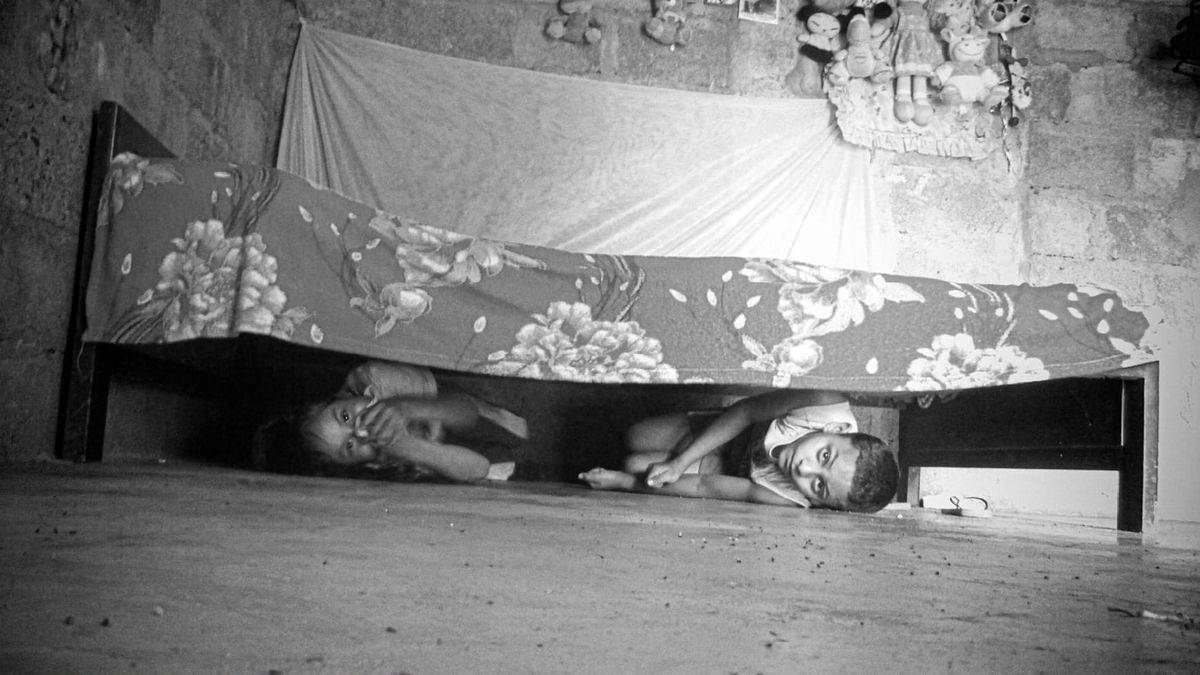
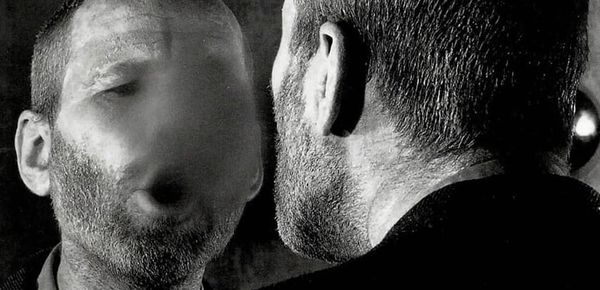
I imagine none of us would struggle to conjure up an image of a war photographer. For me, the site of Dennis Hopper, festooned with cameras, looming out of the jungle in Apocalypse Now is archetypal.
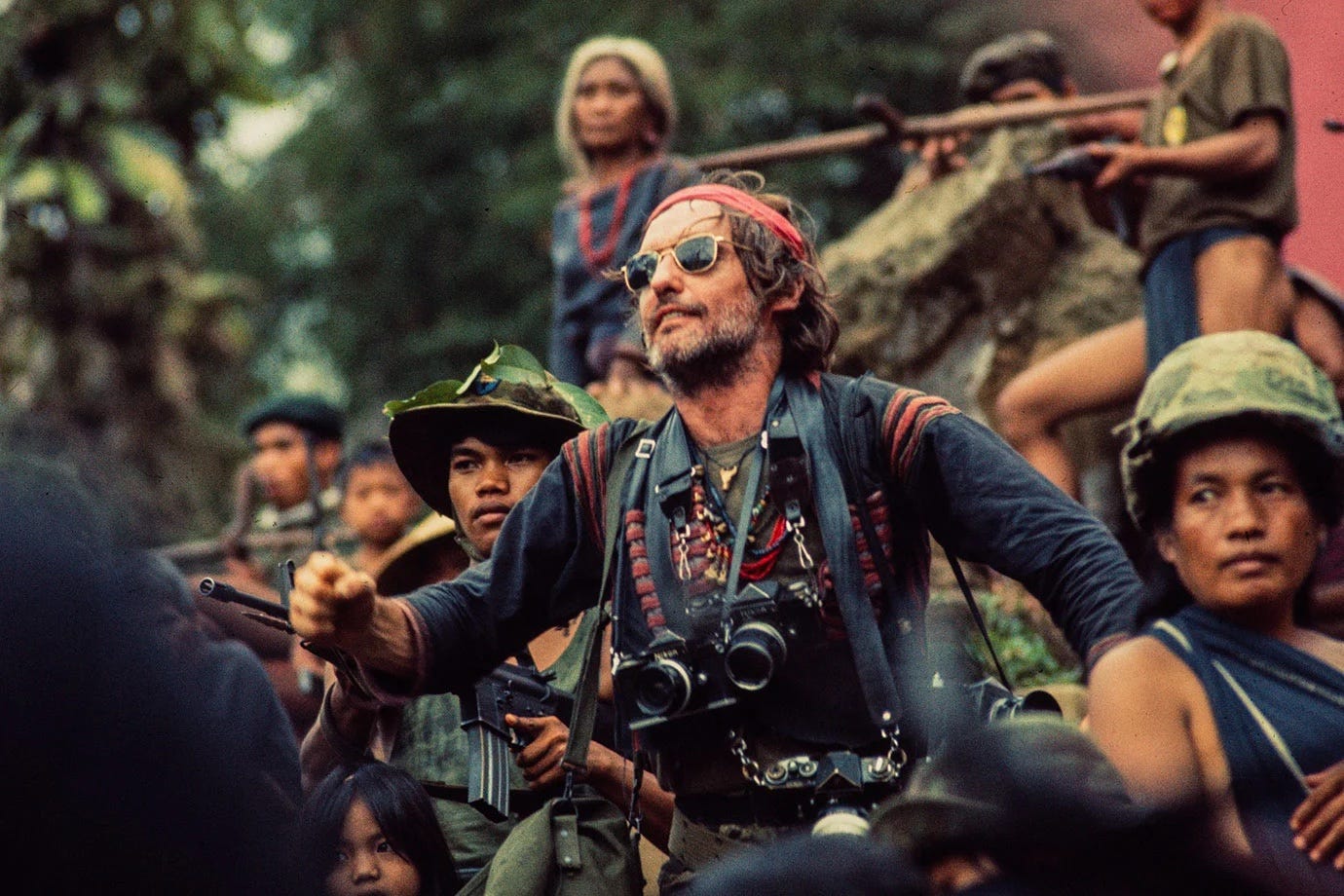
War photography is a recognised genre with a long history, a list of (in)famous practitioners and a continuing contemporary relevance. But what about peace photography?
I confess that the first time I read this phrase I was a little disorientated. What does a peace photographer do? Is peace photography a thing?
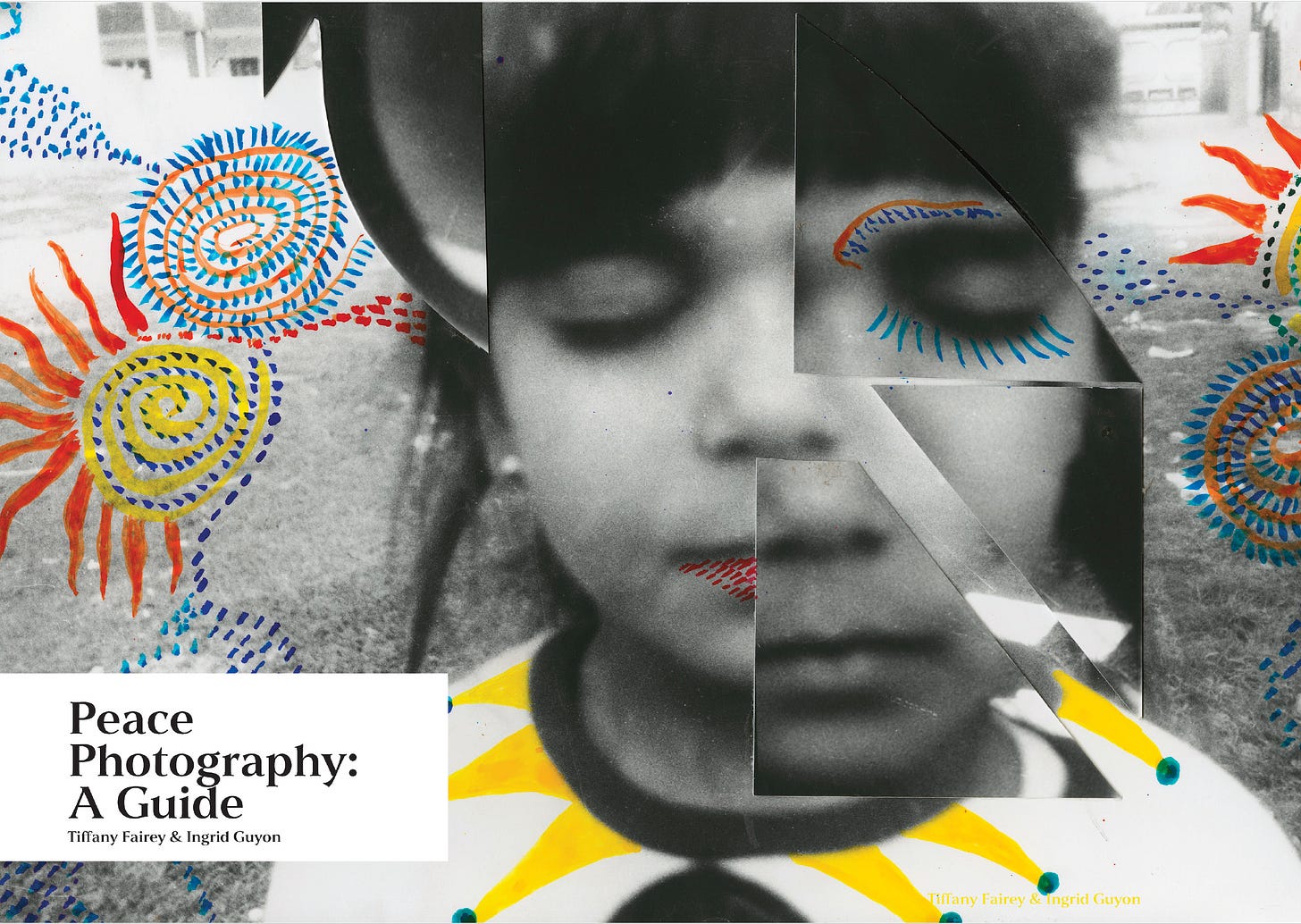
My understanding of peace photography is informed by a fantastic resource recently published as a free download by Tiffany Fairey and Ingrid Guyon. Tiffany was kind enough to contact me recently, in response to a previous post, and it has been my pleasure to meet her to discuss her pioneering work as a Senior Research Fellow in the Department for War Studies at King’s College London. She invited me to the launch of the Imaging Peace exhibition on The Strand and we chatted about her work and the project.
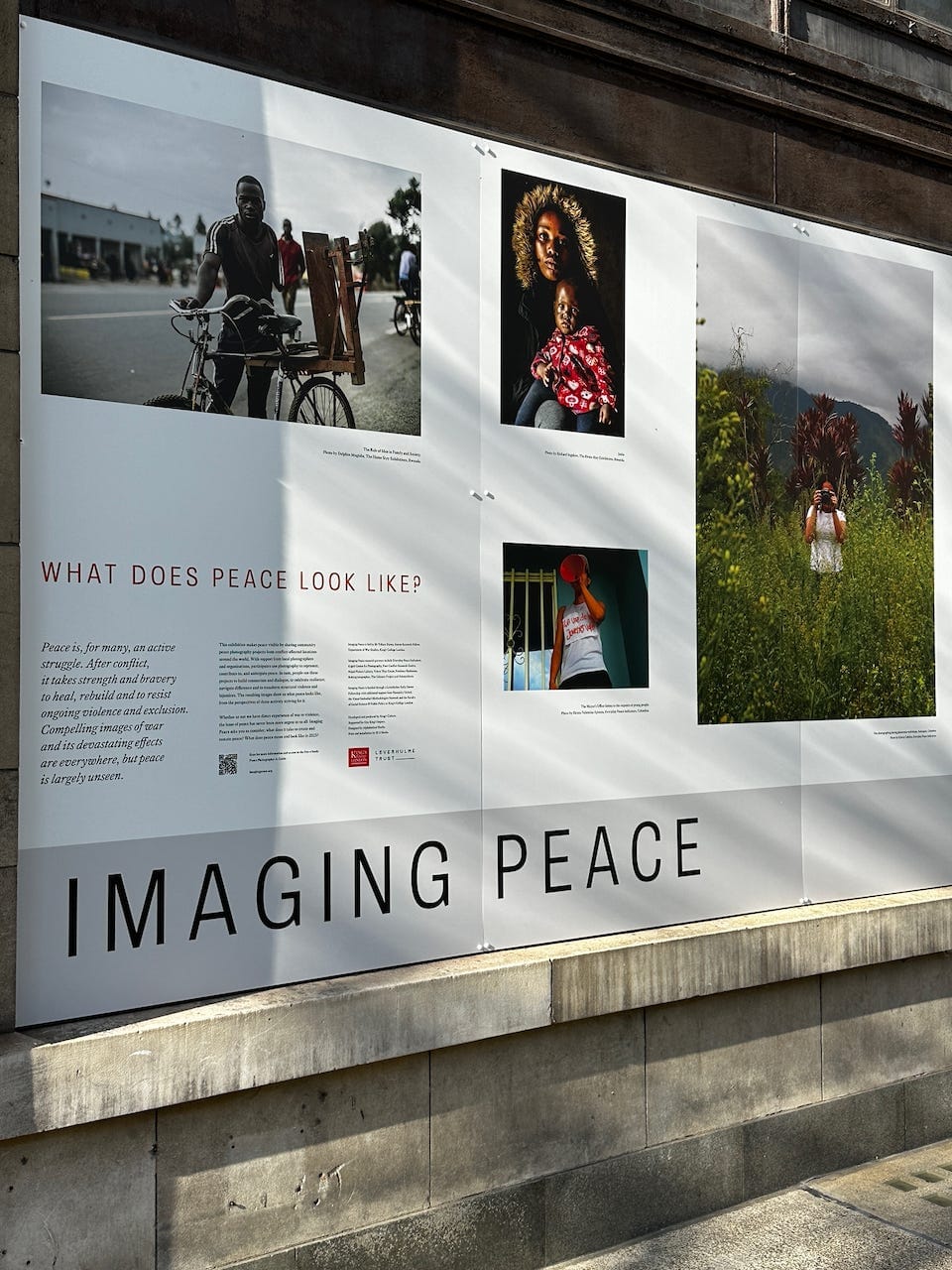
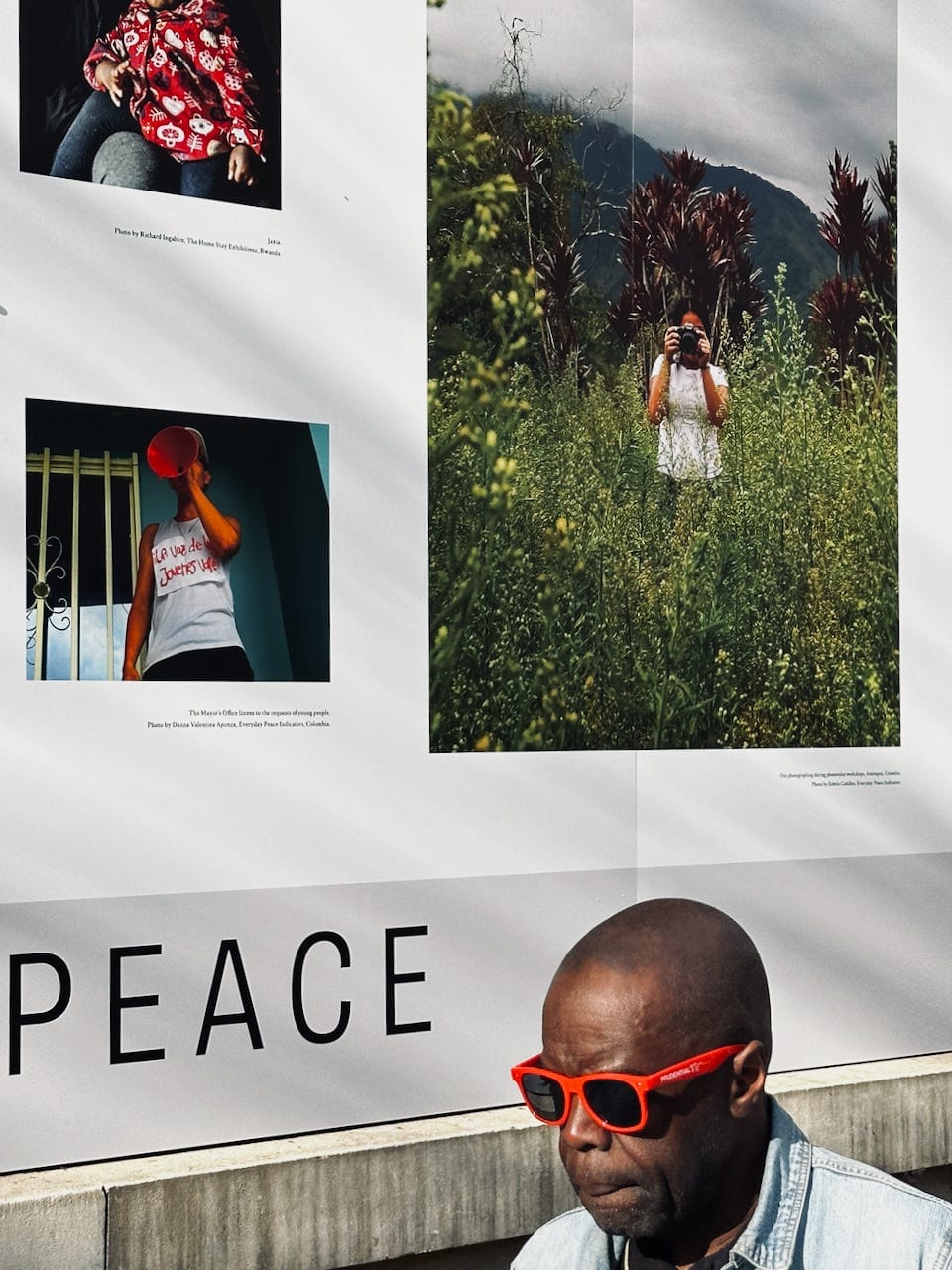
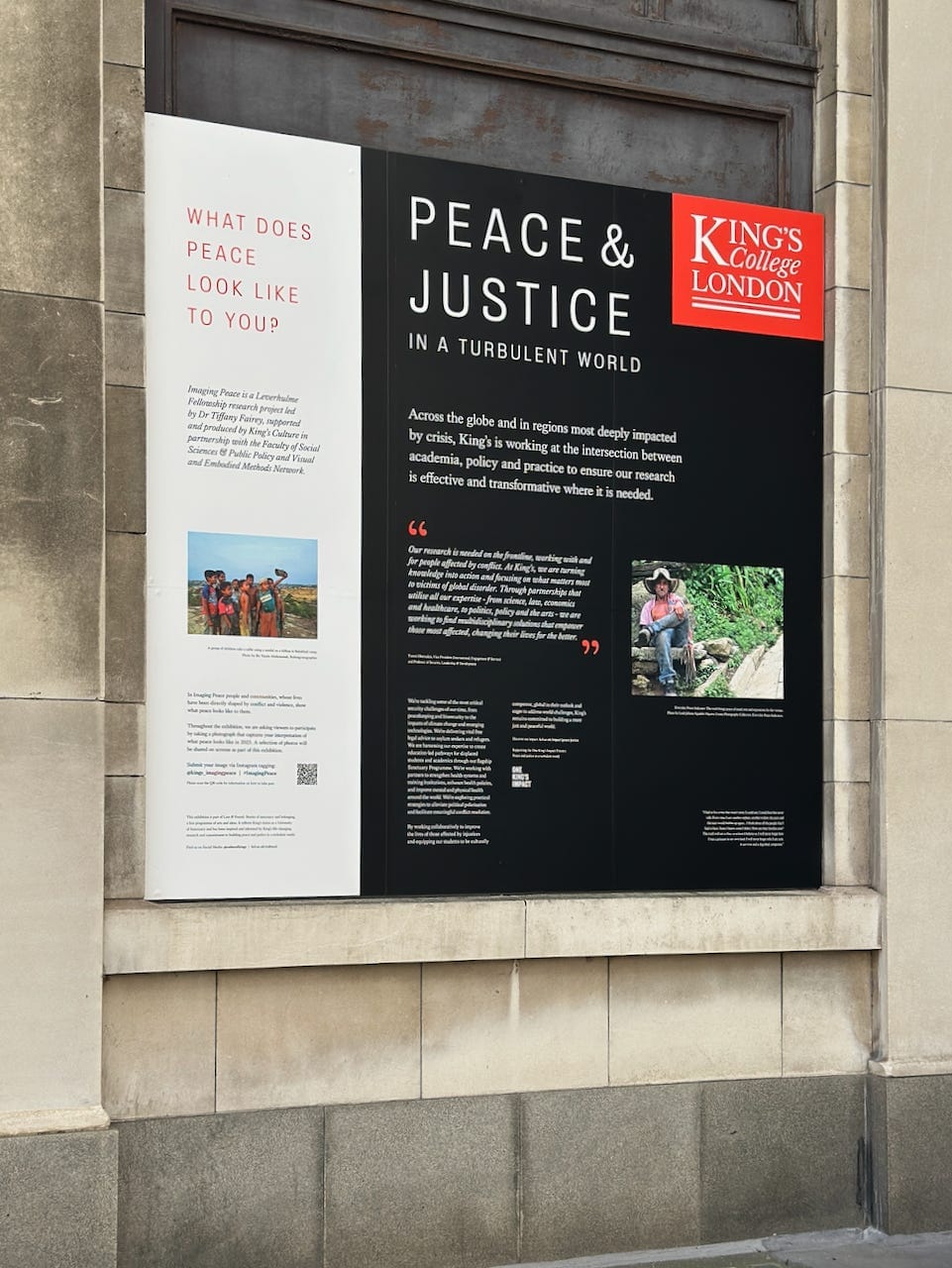
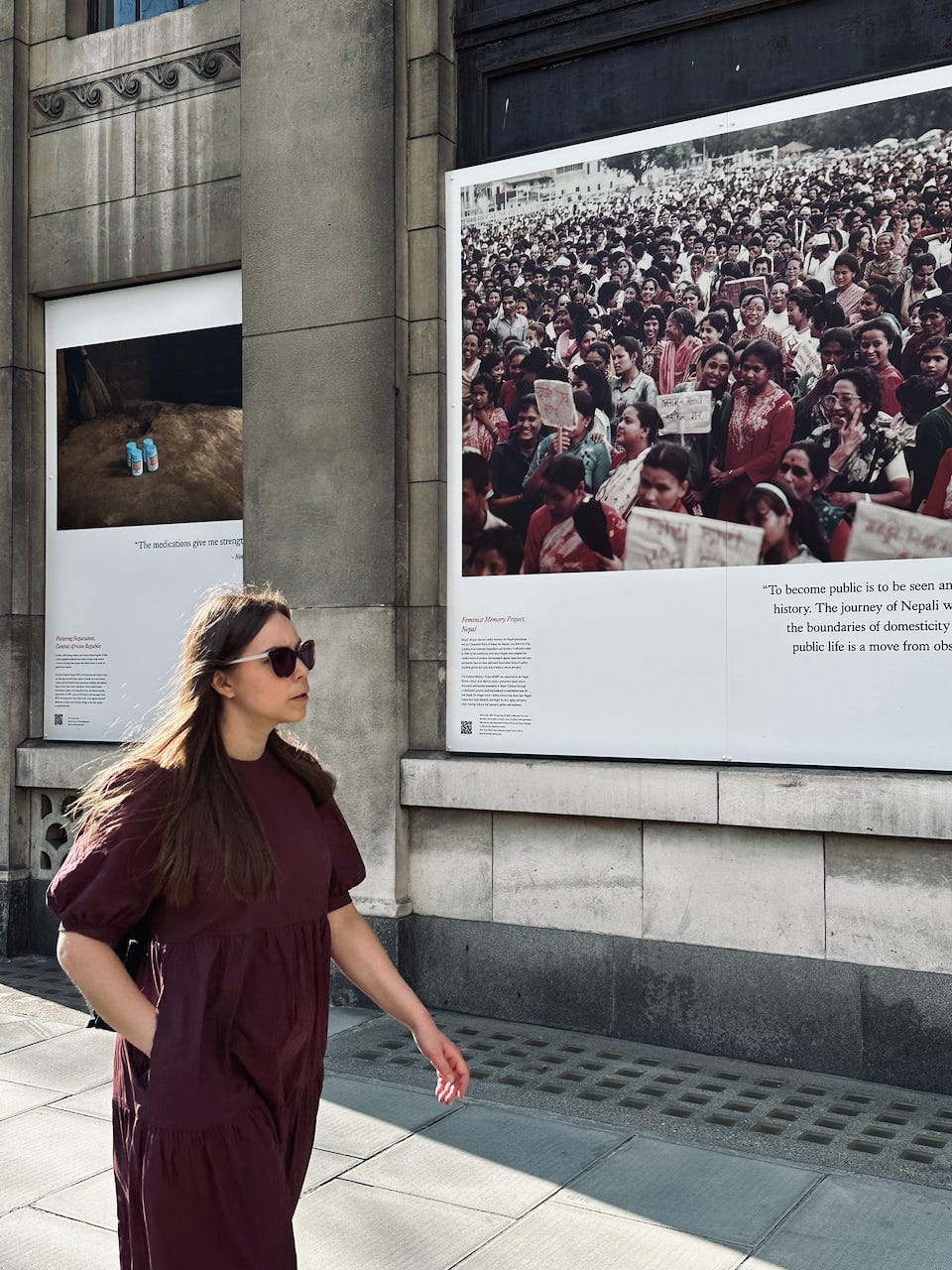
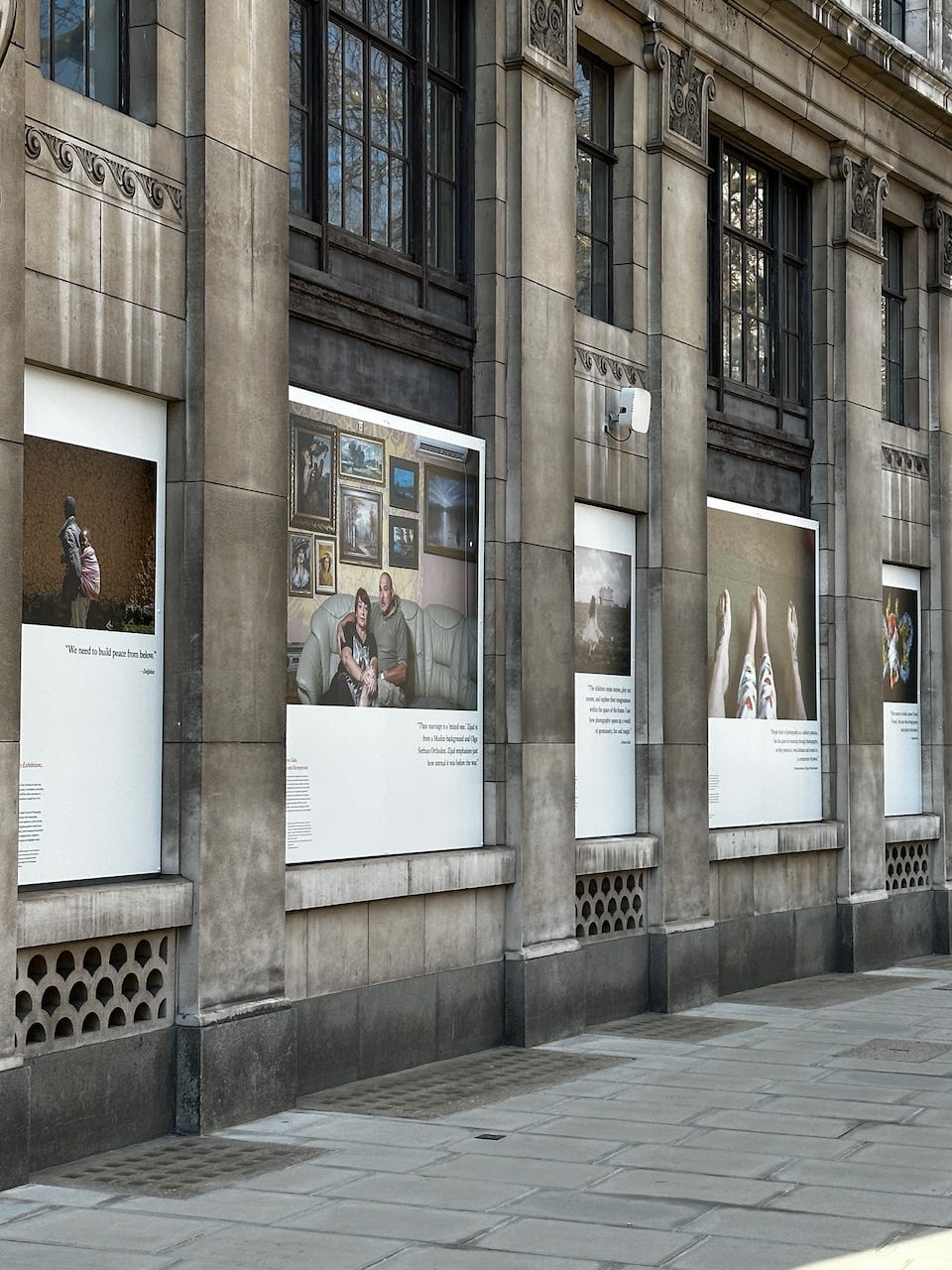
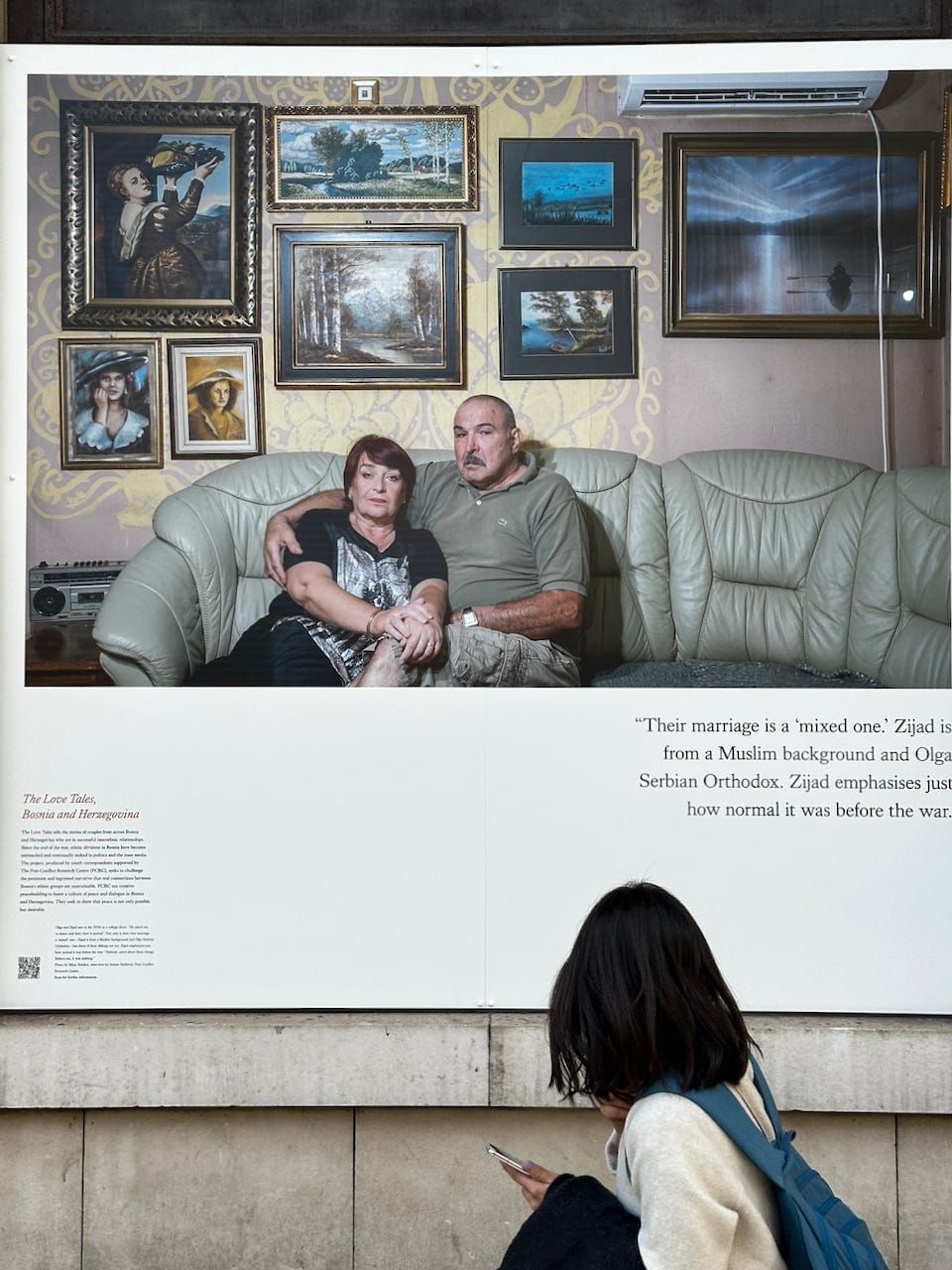
Jon Nicholls - Imaging Peace Exhibition, The Strand, London
Photography has a lot to answer for. Much of its history has been very murky indeed and it continues to struggle with its identity as an extractive, power-hungry, climate emergency contributing, ethically dubious set of practices. Peace Photography, offers a way to think otherwise about lens-based images.
What does peace look like?

A Google image search would suggest that peace is not particularly photographic. Try searching for ‘war’ and notice the difference. Peace Photography, an umbrella term for a host of complementary projects and practices, is an attempt to show us how peace can be imaged and imagined.
Fundamental to peace photography (and other socially engaged projects) is dialogue and what Fairey elsewhere refers to as a “photography of becoming”.*
Dialogical photography is laden with aspirations; hopes that creating images together, looking at images together and talking about images together will help us to understand, see and co-exist better […] Such projects and approaches value the instability of photographs, their refusal to be pinned down, and their capacity to generate and renew social, cultural and political conversations.
— Tiffany Fairey
The Peace Photography Guide is a detailed, accessible, richly illustrated companion. Beginning with some useful definitions about Peace Photography, its ethos, methods and practices, we are then introduced to a set of project ideas before being shown a range of fascinating projects from around the world.
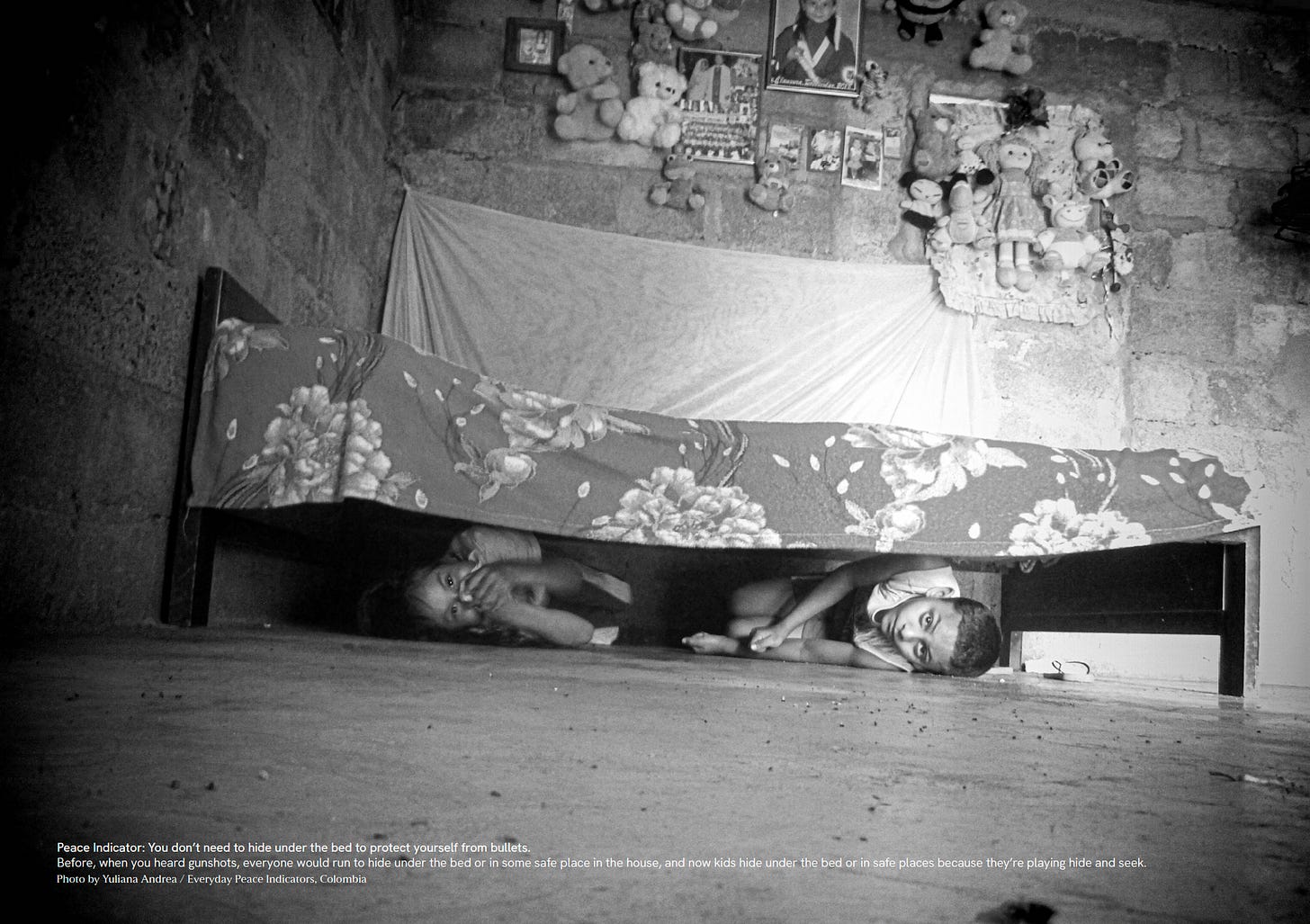
I recognised the brilliant Sirkhane Darkroom project, having bought the book I saw the air fly. Tiffany has visited many of the projects and is particularly connected to those in Latin America, having lived there for nine years. We spent some time looking together at a photograph of a woman harvesting mangoes. Tiffany explained that this was an Everyday Peace Indicator project in which local people imagined a future without reliance on the deadly coca harvest.
Oh! We want to preserve peace and harmony in the community. We must plant cassava, banana, mango and lemon.
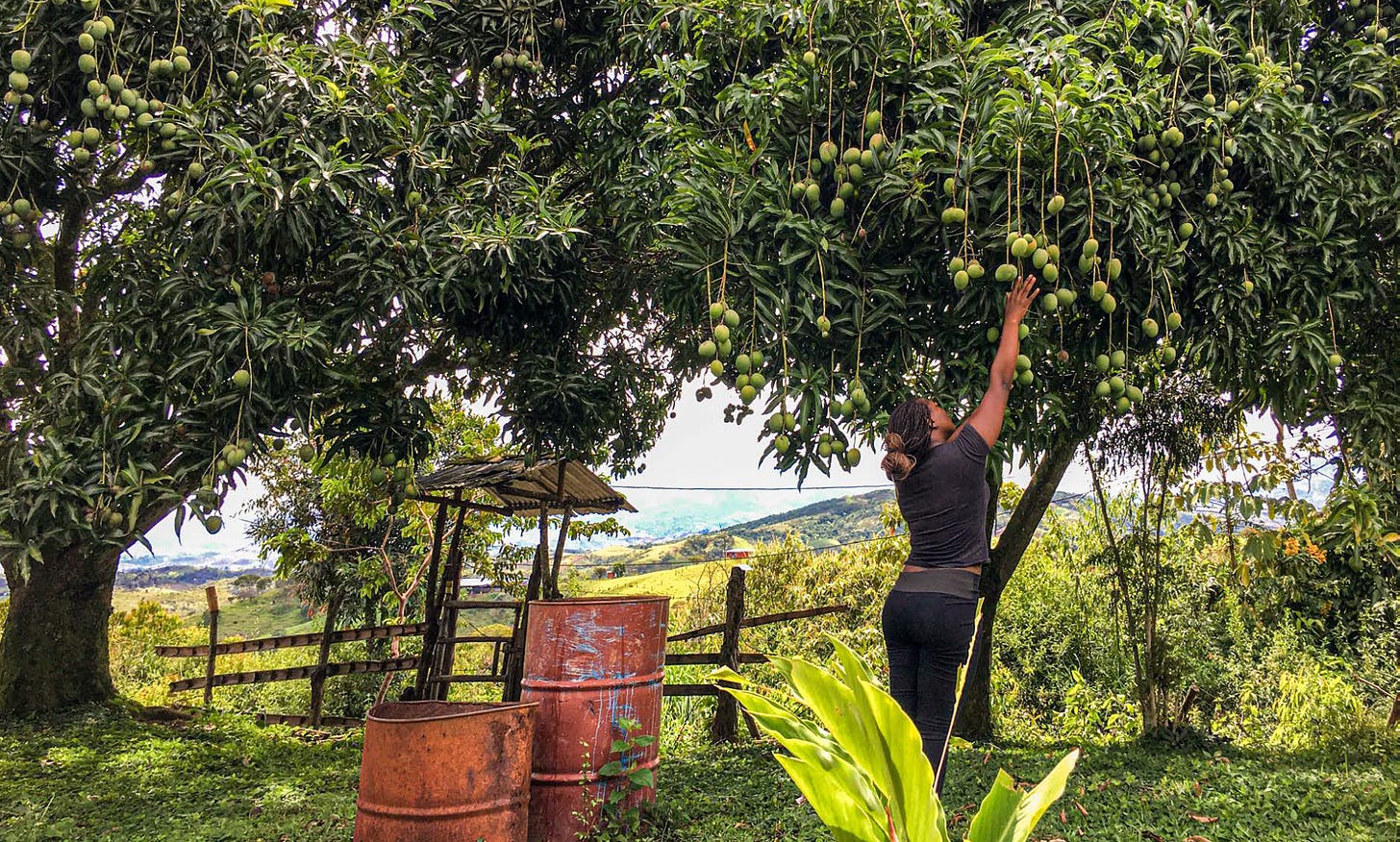
It reminded me of the power of photography to construct new realities. Sometimes, we need to see a vision of the future in order to make it happen and photographs have this rhetorical power, especially when they serve to reinforce a belief or desire.†
As someone interested in ethics and photography, I found the introductory sections illuminating. I particularly appreciated the acknowledgement that things often go wrong and much can be learned from mistakes and challenges. Issues related to security, consent, facilitation, funding, sustainability, spaces and equipment are thoughtfully explored with plenty of practical suggestions for how to minimise potential harm. The authors are clearly aware of the many pitfalls inherent in socially engaged, community photography practice and these are tackled head on.‡
The guide is beautifully designed, carefully laid out and visually rich. I was struck by the quality of the project photographs throughout.§ I appreciated the rationale provided in response to the question Why Photography?
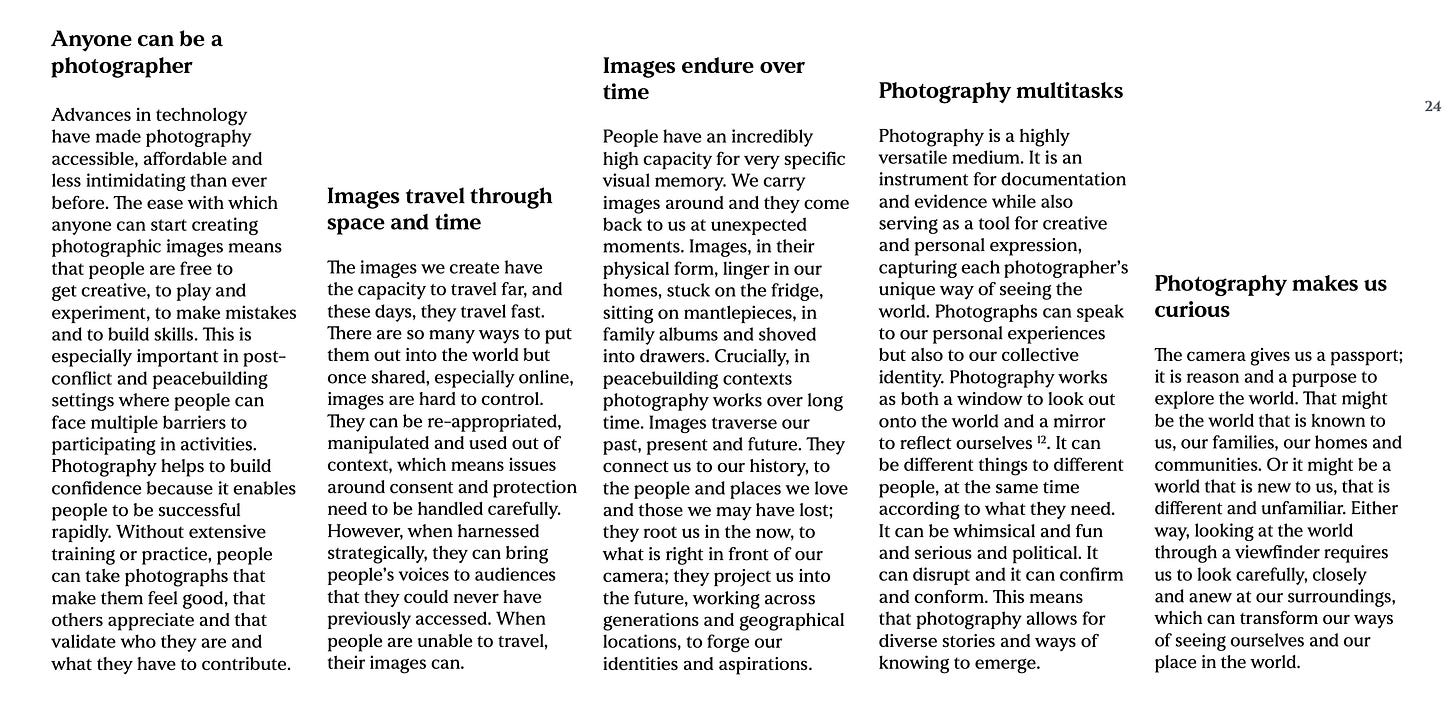
This is echoed by a similar list of photographic practices a little later on:
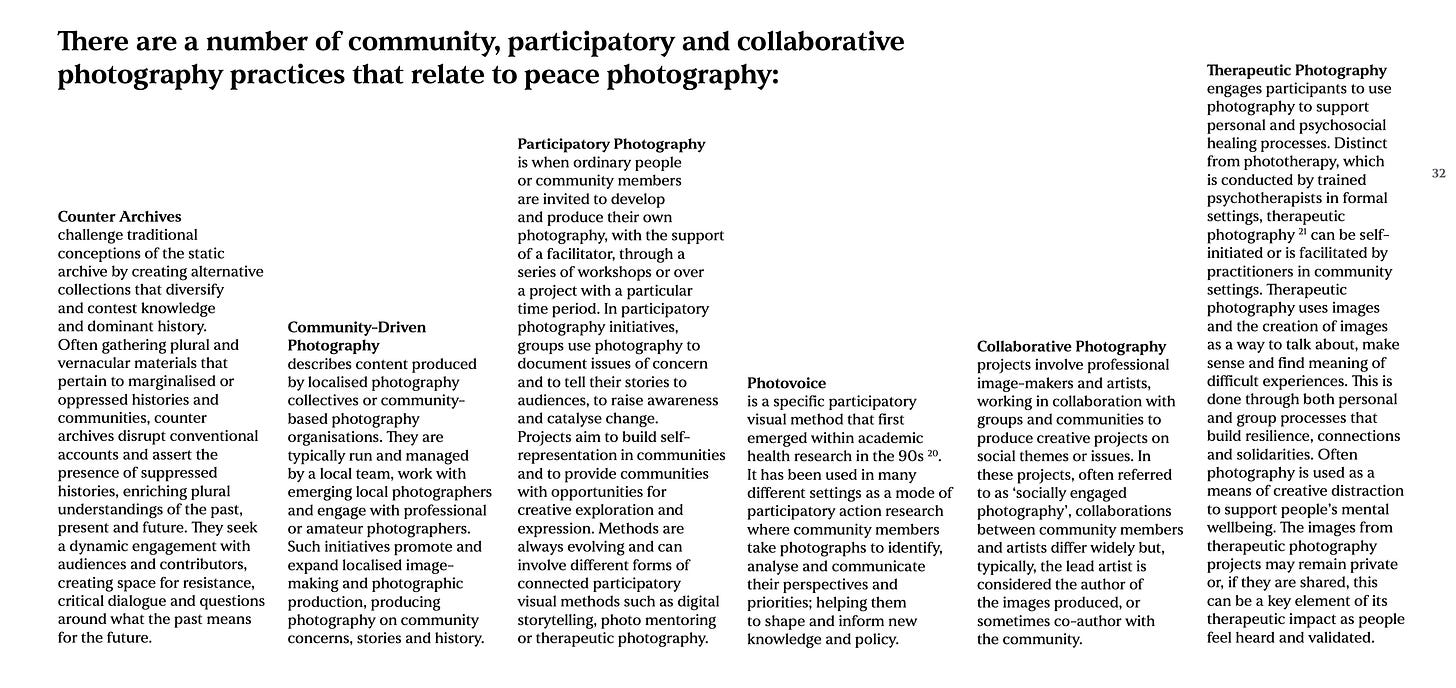
Peace Photography is clearly a complex and multi-layered phenomenon and yet the authors have done a brilliant job of synthesising the information and communicating it succinctly and clearly. The guide is peppered with pull quotes which can be read as a parallel text. My favourite is:
The big thing with any of this is tea, coffee and scones. We’ve spent a lot of money on scones.
— Mervyn Smith, Belfast Exposed Community Engagement Officer
What comes through loud and clear is the emphasis on dialogue and process. Many of the testimonies are very moving:
Seeing all the people looking at the photos has made such an impact on me. They look, they remember what has happened to them, they remember the war, but they do it with tranquillity and confidence that the future is going to be better […] This (project) confirms the magic of this village; we needed that
— Doña Carmen on seeing the Everyday Peace Indicators exhibition in San José de Urama, Colombia
What struck me most forcefully, in reading the guide, viewing the exhibition and talking to Tiffany, was the integrity and care contributed by all participants in the Peace Photography process.‖ Tiffany herself has invested huge amounts of knowledge, experience and time in shaping a resource that gives voice to Peace Photography practitioners. She trained as a visual sociologist, was the co-founder of PhotoVoice and has over 20 years of experience as a researcher, practitioner and educator specialising in participatory visual media and community arts. The work has been funded, in part, by a 3-year Leverhulme Fellowship.
When I met her recently on a gloriously sunny afternoon opposite King’s College, the site of the Imaging Peace exhibition, she spoke with infectious enthusiasm about the process of publishing the guide, curating and installing the show, running workshops and spreading the word. A massive undertaking! She was keen to know what I thought about it all and very happy to receive constructive criticism. To be honest, I had nothing but admiration for the project and I am delighted to help, in some small way, by sharing it with you.
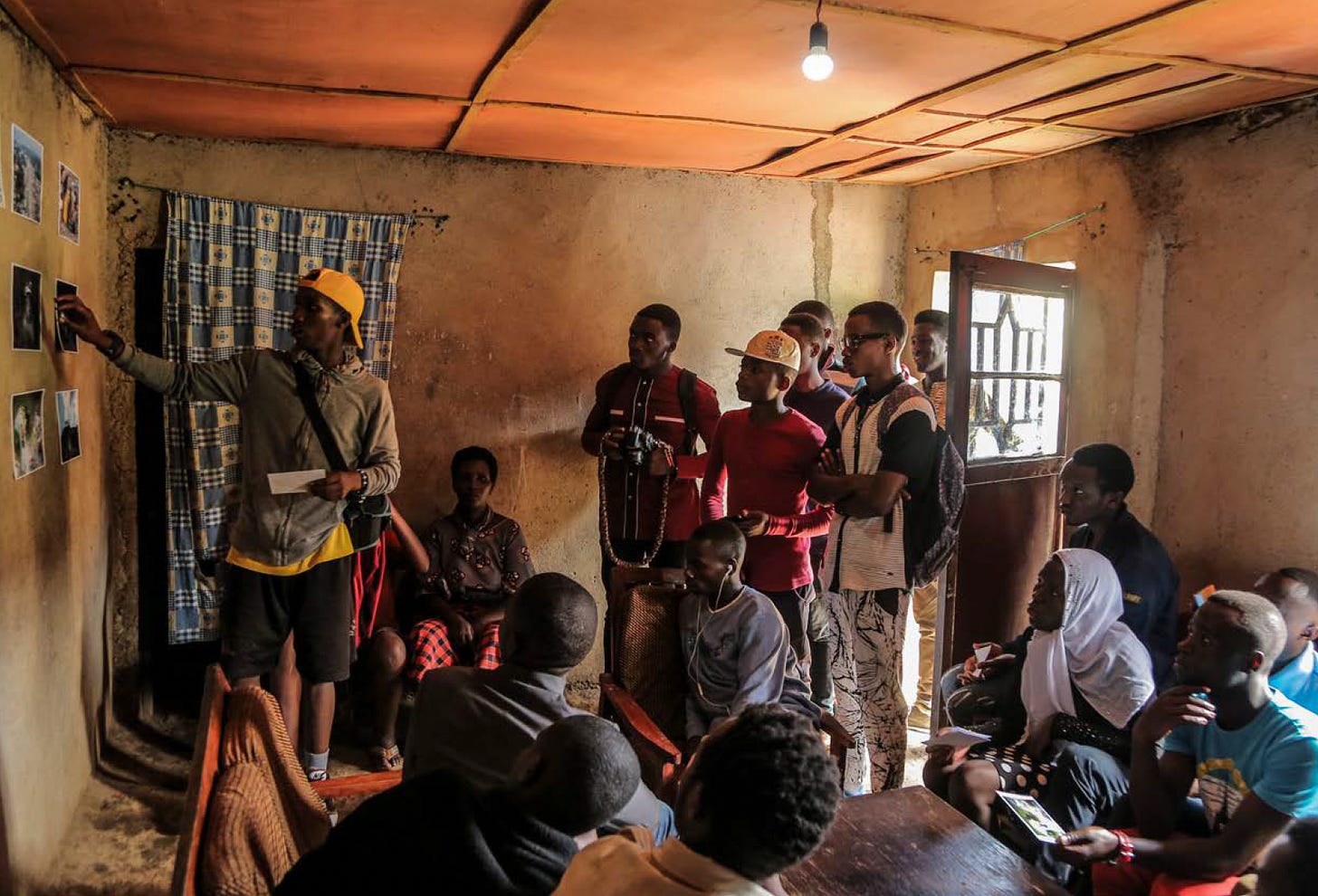
My view is that this is a fantastic new resource for photography teachers. I can see plenty of uses for it in the classroom. For example:
- Using one or two of the many activities listed in the guide (Part 3 pp. 61-99) These practical, open-ended and inspiring activities are very much in the tradition of Susan Meiselas’ ‘Eyes Open’, Fulford and Halpern’s ‘The Photographer’s Playbook’ and Joel Meyerowitz’ ‘Seeing Things’. They have inviting titles like Changing The Story, Image Spectrum, Impossible Photos and Photos That Makes Us Smile. Here are a couple of my personal favourites:
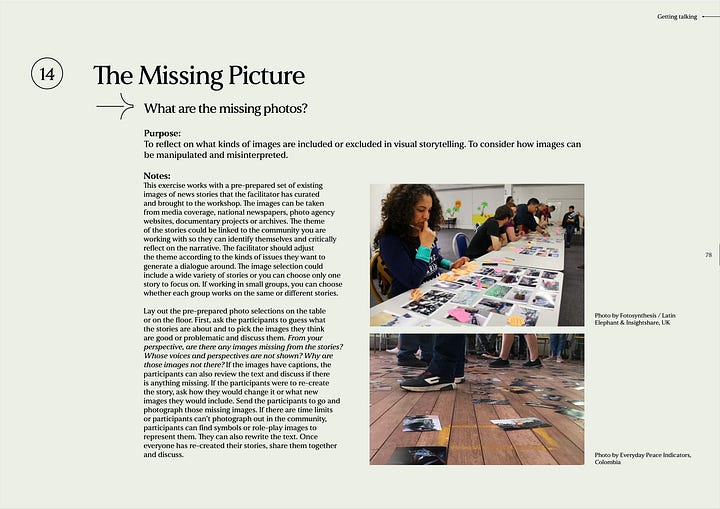
- Asking students to consider the visual clichés associated with peace and war, reflecting on the role of the war photographer and speculating about why we don’t currently know much about the genre of Peace Photography.
- Experimenting with new ways to promote dialogue and the exchange of images between students (and staff). How might various oracy strategies support discussion and debate? How might a greater focus on visual literacy also lead to a greater sense of community and belonging, a classroom ethos and a feeling that this is the way we do things here? For example, why not try a game of Photo Ping Pong?
- Re-considering the importance of process and collaboration in the way students work.
- Exploring the questions What is Peace Photography and how do you do it?
- Inviting the whole school community to contribute to a collaborative exhibition and/or zine containing images of peace. Why not try an inter-school or regional collaboration? Check out the fantastic #YourTurn Photo project, for example.
- Investigating the positive and negative impacts of photography made in response to conflict and war. What is the role of photography in shaping our understanding of violence? How can photographers and photography help to imagine alternatives to conflict?
I certainly intend to share the guide with my A-level students. I’m hoping some of them will find it helpful for their personal investigations. The usefulness of the ideas and approaches it contains extend far beyond the genre of Peace Photography, informing young people about photography’s purposes and ethics more broadly. In a world riven by existential threats and international conflict, where war, hatred and suspicion are constantly in the news, there seems no better time for educators to give Peace Photography serious consideration.
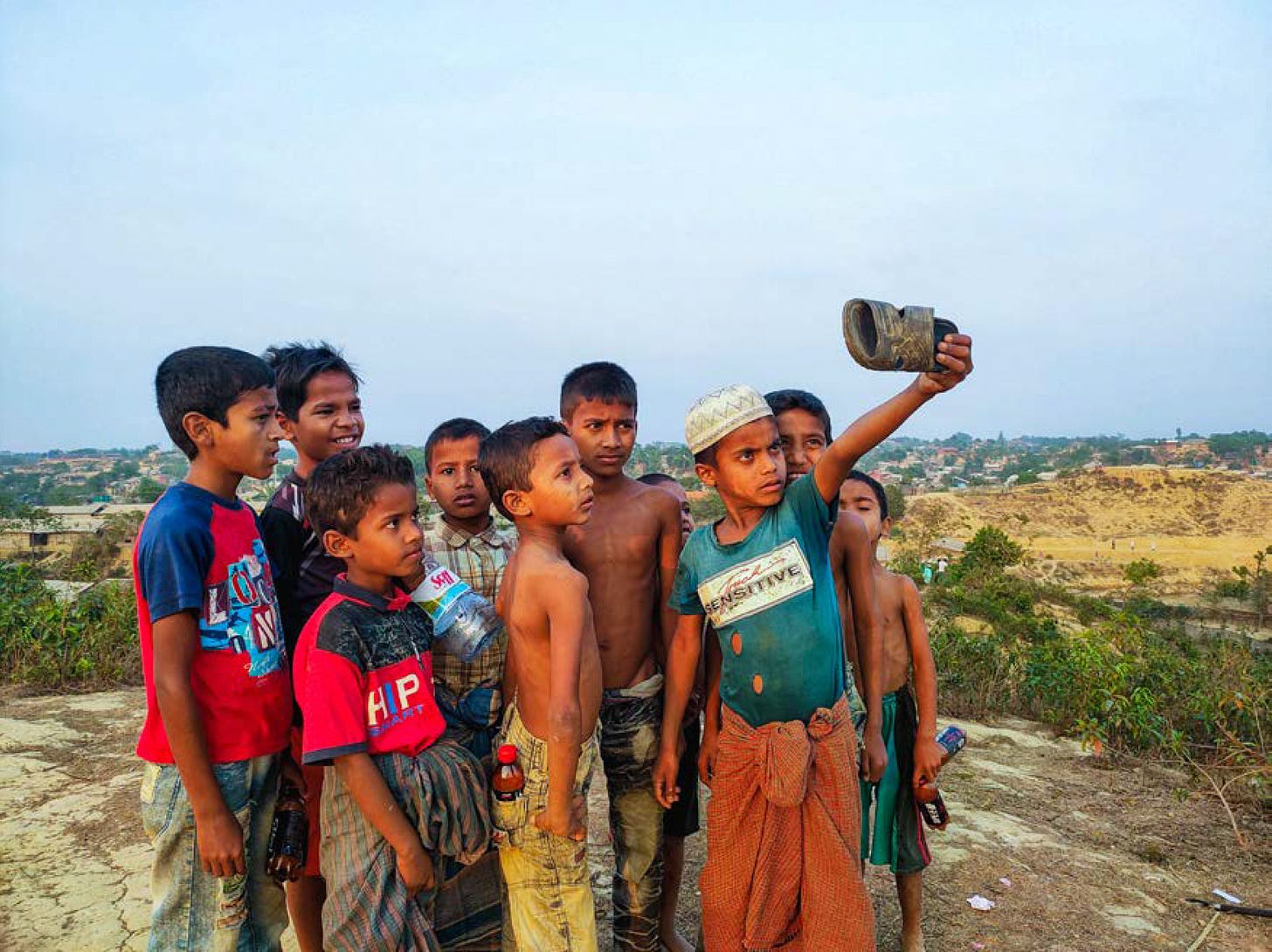
My thanks to Tiffany (and Ingrid) for sharing the Guide and for spending time talking to me about this amazing work. If you are in London, I urge you to go and see the exhibition opposite King’s at the foot of Bush House on The Strand. You can download the free guide here.
If you and/or your students want to take part, why not consider submitting your photographs of peace to Instagram (@kings_imagingpeace | #ImagingPeace) and see them displayed for the public in the exhibition? See this submission guide for more detailed information.
After all, the world could do with a few more photographers imaging and imagining peace!
Thanks for reading PhotoPedagogy! Subscribe for free to receive new posts.
If you are interested in the possibility of a Peace Photography collaboration, do get in touch. Either leave a comment here or email me at my school address.
Thanks for reading PhotoPedagogy! Subscribe for free to receive new posts.
These posts will always be free but, if you enjoy reading them, you can support my analogue photography habit, and that of my students, by contributing to the film fund. Thanks to those of you who have already done so. All donations of whatever size are very gratefully received.
* Fairey, T., & Orton, L. (2019). Photography as Dialogue. Photography and Culture, 12(3), 299–305.
† Visual Rhetoric and the Power of Imagery
‡ https://www.photopedagogy.com/representing-homelessness
§ By Diego Echeverry
‖ The guide includes details of projects from the USA, Northern Ireland, Mexico, Columbia, Nepal, Turkey, Kenya, Bosnia and Herzegovina, Iraq, Western Papua, Central African Republic, Cyprus, Bangladesh, Palestine/Israel, Peru, Spain, Rwanda and Guatemala.The guide includes details of projects from the USA, Northern Ireland, Mexico, Columbia, Nepal, Turkey, Kenya, Bosnia and Herzegovina, Iraq, Western Papua, Central African Republic, Cyprus, Bangladesh, Palestine/Israel, Peru, Spain, Rwanda and Guatemala.