Research for Young Photographers
Preparing for a Photography Personal Investigation.

In a recent post I wrote about Italo Calvino’s story The Adventure of a Photographer and how it might help students reflect on the relationship between inquisitive questions and a photographic enquiry. These “I wonder if…?” questions really help young photographers avoid visual clichés and help them construct investigations that have the potential to be both personal and meaningful.
I ended the post as follows:
My final request of the class was to reflect on their own interests - the things they cared about or were bothered by - and to devise a question that could form the basis of their own adventure in photography - their Personal Investigations.
I’m looking forward to seeing what they come up with over the next couple of weeks.
The students have been thinking hard, for just over a week, and have devised a few questions. Here are some examples:
What is the relationship between film (cinema) and photography?
How can I make portraits which are respectful and empathic? What is ethical portraiture?
What is the relationship between light and time in photography?
How might my portraits of others also represent me?
How can I explore the poetics of photographing the city at night as a young, female photographer?
Why do photographers use long shutter speeds?
How can I use photography to explore family life?
How much chance am I willing to tolerate in my photography?
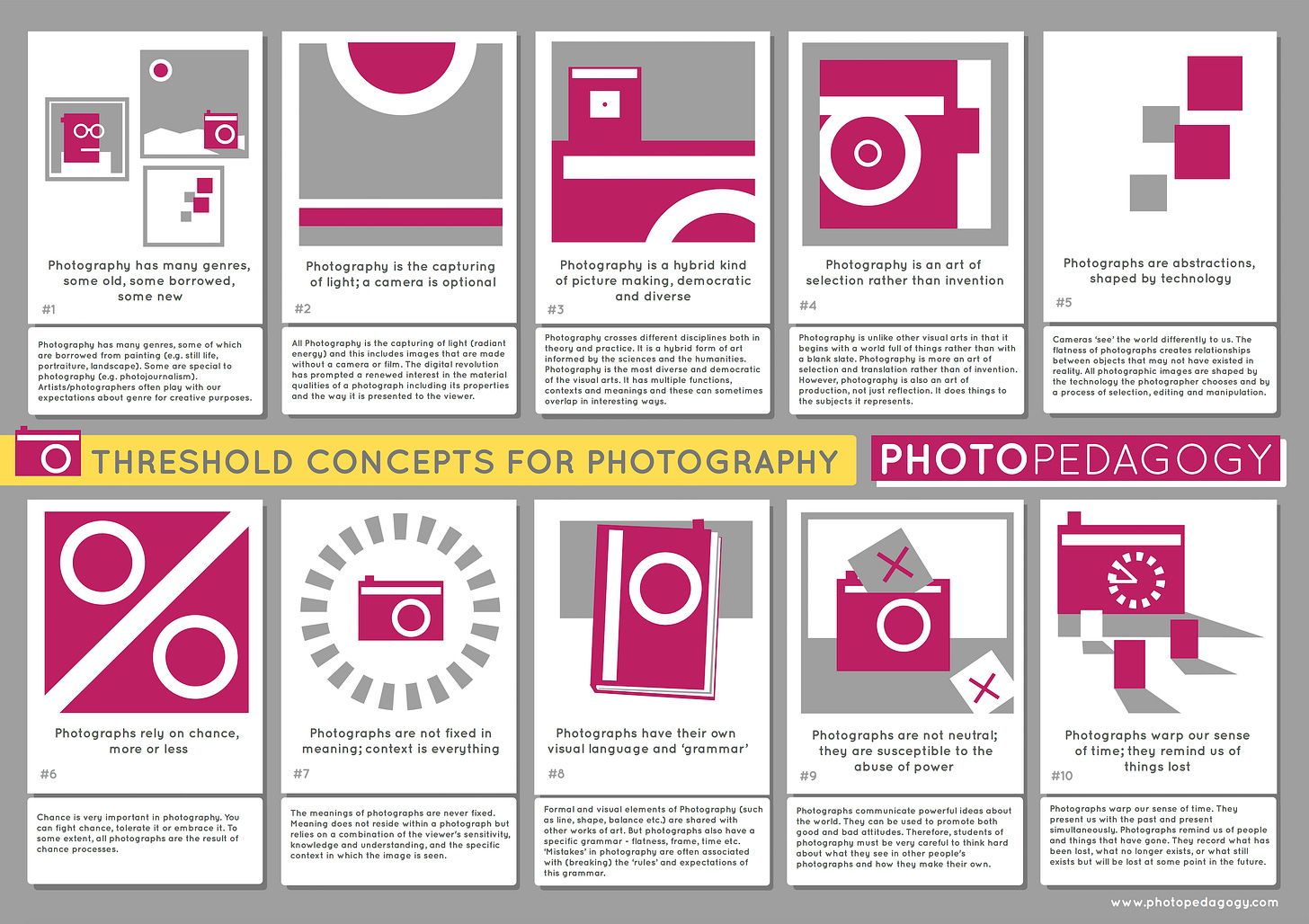
These strike me as really exciting starting points. I’ve no doubt that some of them will be modified over time, especially in response to many practical experiments, but each of them is sufficiently open and provocative to enable a genuine investigation. Many of them also engage with Threshold Concepts in photography - genre, light, democracy, chance, power, abstraction, technology, time. I think of these concepts as invitations to rummage about in the indeterminate, open-ended, complex and multivalent practices and histories of photography.*
I also asked the class to think of supplementary questions. Here are a couple of examples:
Main Research Question:
What is the relationship between film (cinema) and photography?
Additional questions:Are there any film makers who have made photographs and/or photographers who have made films?Are there films about photography?Can films be made with photographs?What is meant by the term ‘cinematic’ when describing still photographs?What words and phrases do films (cinema) and photography have in common? E.g. framing, focus, point of view etc.What is the difference between an individual photograph and a freeze frame or film still?Why do filmmakers often employ a ‘stills’ photographer?How do films and photographs tell stories?
And another:
Main Research Question:
How can I explore the poetics of photographing the city at night as a young, female photographer?
Additional questions:Which photographers have made projects featuring urban settings in low light?In what ways does artificial lighting affect the atmosphere or mood of a photograph?How can I portray the city as a safe environment for a young woman?Is it possible to capture aspects of people's lives by photographing fragments of the city?What makes photographing at night so intriguing for me?
The course requires students to do two main things:
- Write about their understanding of photography (in 1-3000 words)
- Create a personal and meaningful body of work
These two strands should, of course, be interlinked, informing each other.
Increasingly, I’m wondering whether students need more help with their research and whether this might better support their making.
It raises some interesting questions about the relationship between knowledge and habits of mind. This debate is often characterised (lazily, in my view) as conservatives vs progressives, as those who support a ‘knowledge-rich’ curriculum vs those who champion skills and attributes. As I’ve commented elsewhere (here and here), this is a false dichotomy since no-one is advocating for an ignorance-rich curriculum. Students need to have sufficient knowledge to move beyond their tacit understanding, the stuff they can get at home or on the Internet.† But they also need to strengthen their inquisitiveness, for example, through deliberate practice. After all, the ability to ask interesting questions is a habit of mind that can be enhanced. And good questions can lead to greater knowledge. Teachers have a role in pointing at things that are beyond students’ day-to-day experiences, calling to them as individuals. “Look at this. Read this. Think about this. I believe it will interest you.”
Crucially, this process is educational and ethical. It’s not simply a strategy for producing grades. It begins with a dialogue between two individuals, one which takes personhood into account.
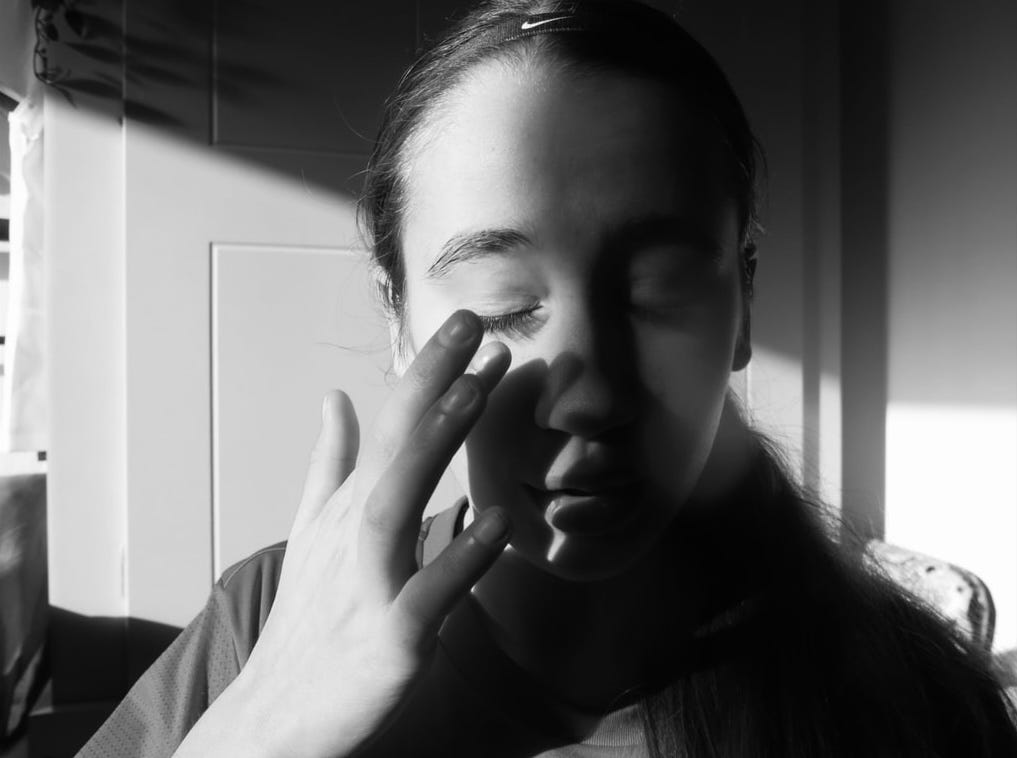
For the last couple of years, I have developed my own personal investigations, alongside the students. They share their work online so I also have an A-level website. It’s helped me to see things from their point of view and, frankly, given me a useful structure for my own picture-making. Since I’m always looking at their work, hopefully providing them with helpful feedback, it seems only fair that they can look at mine. I try to share my thinking, reading, looking and making, using the affordances of the A-level course structure. It’s not what I would ordinarily do, if I wasn’t pretending to do an A-level, and I can’t pretend I don’t know what I know, but I hope it’s supportive.‡
The A-level course is fairly open and flexible but there are assessment objectives and students need to provide clear evidence that they have met them. The first of these is about research, ideas and critical understanding:
An exceptional ability to develop ideas through sustained investigations informed by contextual and other sources. Demonstrates exceptional analytical and critical understanding. Demonstrates fluent use of appropriate specialist vocabulary.
In my experience, this is the part of the course that some students find most challenging. They don’t tend to choose A-level photography because they love research or writing. Those that do are the exception. Getting the balance right between making photographs and researching photography is tricky.
We began the whole process of developing personal investigations by carrying out a series of mini experiments, using the 13 Ways Resource on the PhotoPedagogy website which, in turn, are influenced by some of the assignments in the excellent Photographer’s Playbook. The students chose two or three of these starting points as prompts for mini enquiries. This was an attempt to encourage them to work at the edges of their comfort zones, to take a few risks and begin to challenge their tacit understanding of photography.
Having messed about in the sandpit, now it’s time to climb the steps to the top of the slide, identifying a relatively coherent focus for their investigations; choosing a direction.§
I’m thinking hard about how best to support them. Part of this involves making my own research and idea-generation process a bit more visible and encouraging them to establish more secure foundations for their enquiries.
I’m really keen that this emphasis on research doesn’t squash students’ enthusiasm for making photographs. As George Slade wisely commented on a recent post on Substack:
I think the importance of Szarkowski’s experience as a maker can't be overstated in this specific context and in his critical perspective overall. It's also important to realise that picture-making always came first, and theory second.
A photography A-level should foreground the making of photographs. And making photographs is, of course, a kind of practical research. I’m hoping a slightly more formal approach to research planning will support both making and critical reflection.
Time will tell.
Thanks for reading PhotoPedagogy! Subscribe for free to receive new posts.
These posts will always be free but, if you enjoy reading them, you can support my analogue photography habit, and that of my students, by contributing to the film fund. Thanks to those of you who have already done so. All donations of whatever size are very gratefully received.
* The Threshold Concepts are phrased as provocative propositions on the PhotoPedagogy website:
† Providing access to this ‘powerful’ knowledge is surely one of the reasons why we have (and continue to need) schools and teachers.
‡ Incidentally, I try to do the same with my GCSE photography class.
§ Apologies for the dodgy analogy.