Six Memos for the Future of Photography
#3: Exactitude
This post is part of a short series responding to Italo Calvino’s Six Memos for the Next Millennium.
My friend and neighbour Philip Smith is a painter. He works in series, using systems, and a while ago he asked me for a set of numbers. I generated them randomly, using the constraints he gave me (rows, columns, a range) and sent them back. I’ve just been down the road to see the result, the first painting in a new series and mine to keep, in exchange for some photographs of his work for his website.
The whole of the previous day I had been worrying away at this post and found a dead end. I walked down to Philip’s house thinking about where I might have got stuck.
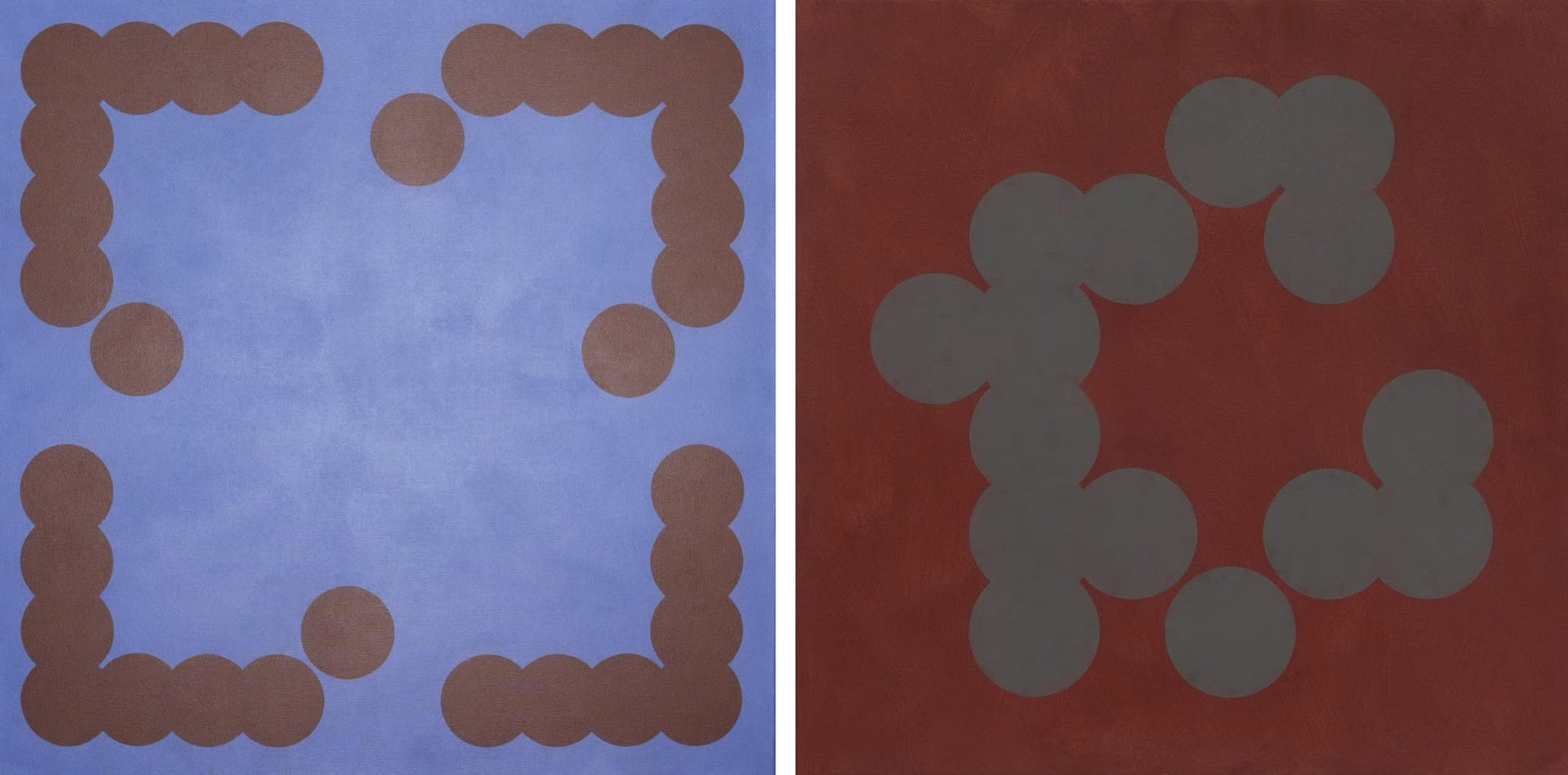
The painting surprised me. Not a canvas, like his other recent systems paintings. He’d removed the centre of a square of wood so that the painting was around the edges, in what looked like a frame but was actually a remainder. What was left when the middle had been taken away. The panel has several layers, so it sits proud of the wall, closer to a relief than a picture. There are overlapping circles in colours the numbers had chosen, against a flat ground. My arbitrary numbers, the algorithm, plus Philip’s control and precision, had produced something I found beautiful. I stood there feeling that the work was exactly right, and unable to say why, precisely.
Calvino’s third memo is Esattezza, and the English “exactitude” makes it sound fussy which I don’t think he meant. Esatto in Italian is an everyday word, the one you use for a sum that adds up or a time that’s correct. Calvino summarises the value as a well-defined design, a clear and incisive image and a language precise in its choice of words. It’s not pedantry. It’s closer to rightness, to the fit between a thing and its purpose. The French refer to this as the mot juste. Not precision as measurement. Precision as fittingness.
It’s a quality you reach by looking again, not by getting it right first time.
Calvino refers to two very different writers at the end of his essay. Ponge and Leonardo. Francis Ponge published the drafts of his poems in sequence because he prized the series of attempts rather than the finished line. Leonardo filled his notebooks with a gnarled, spiky language, worrying at a description over and over in search of something more subtle and precise. He tried three times to write about a sea monster he’d imagined rising from the deep because its force required a particular combination of words. The exactitude, the fittingness, was in the search for the right ones.
I want to follow that thought through some photographs that I love. They are held together by instinct rather than argument. They rhyme at odd angles. It’s mostly about construction, return and the strange afterlife of pictures.
Built to be believed
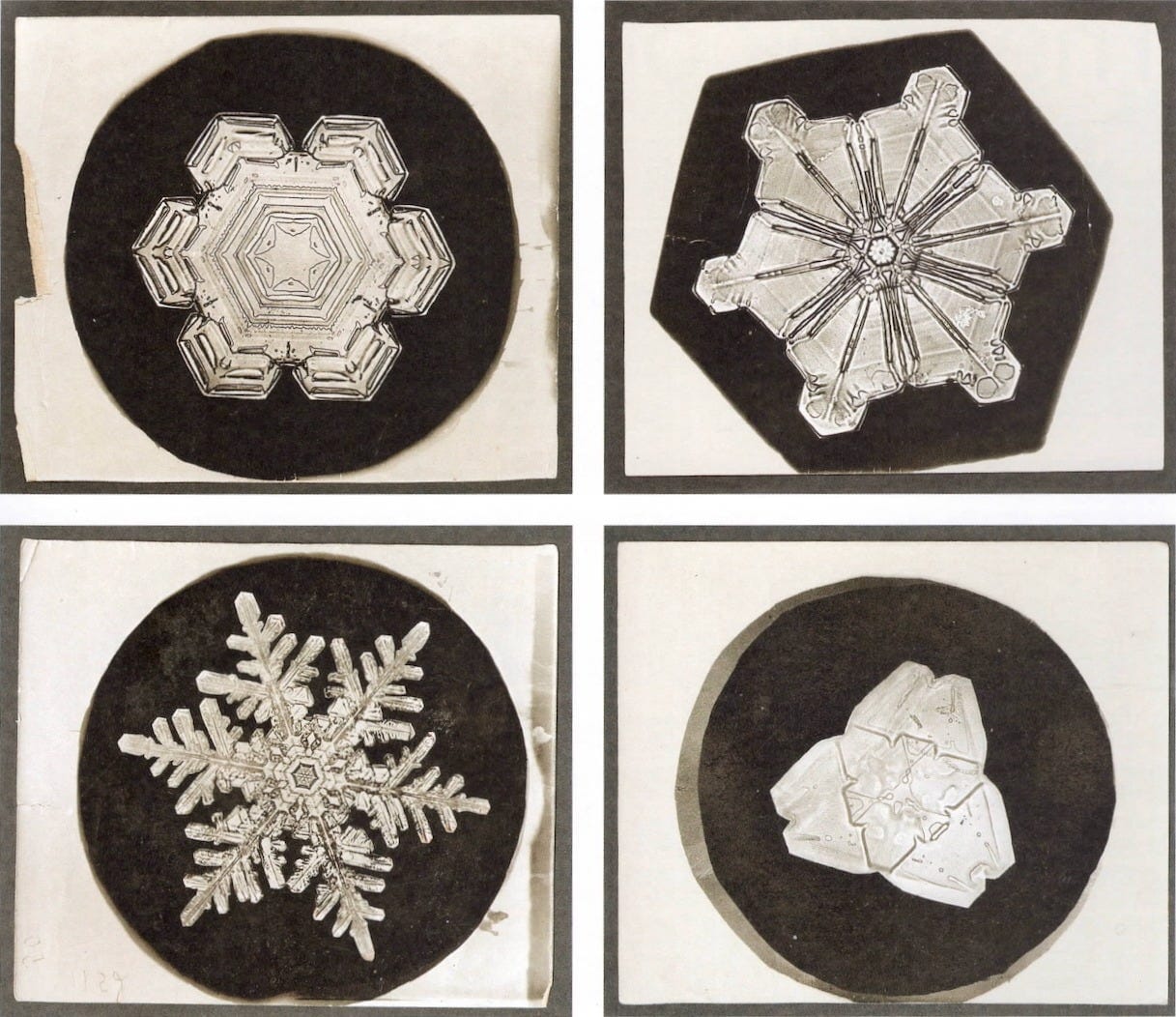
Wilson Bentley famously photographed snowflakes. From the 1880s until his death he caught them on a black board, then transferred each one to a slide, photographing it through a microscope before it could melt, thousands of times over a lifetime, no two alike. The examples above show each crystal on a circle of black. The exactitude is constructed. The isolation, the darkness, the enlargement, all of it built to make the thing legible, built slowly, one melting specimen at a time.
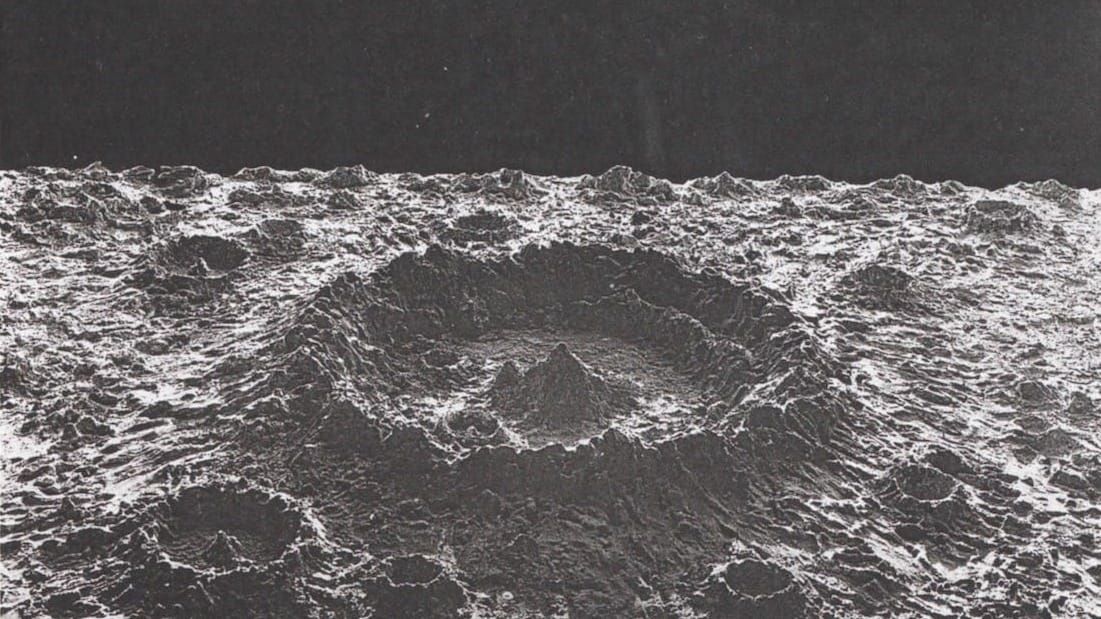
James Nasmyth went further and built the Moon. In 1874, before a telescope could photograph the lunar surface in the detail he wanted, he modelled craters in plaster from his own observations, lit them in raking sunlight and photographed the models. He published them in a book called The Moon: Considered as a Planet, a World, and a Satellite, and the plates are convincing. The one illustrated below, a “Normal Lunar Crater,” reads as a photograph of the real surface seen from just above the rim. It’s a fiction, made carefully, in the service of a truth. You’d think you were looking at the Moon unless you were told otherwise.
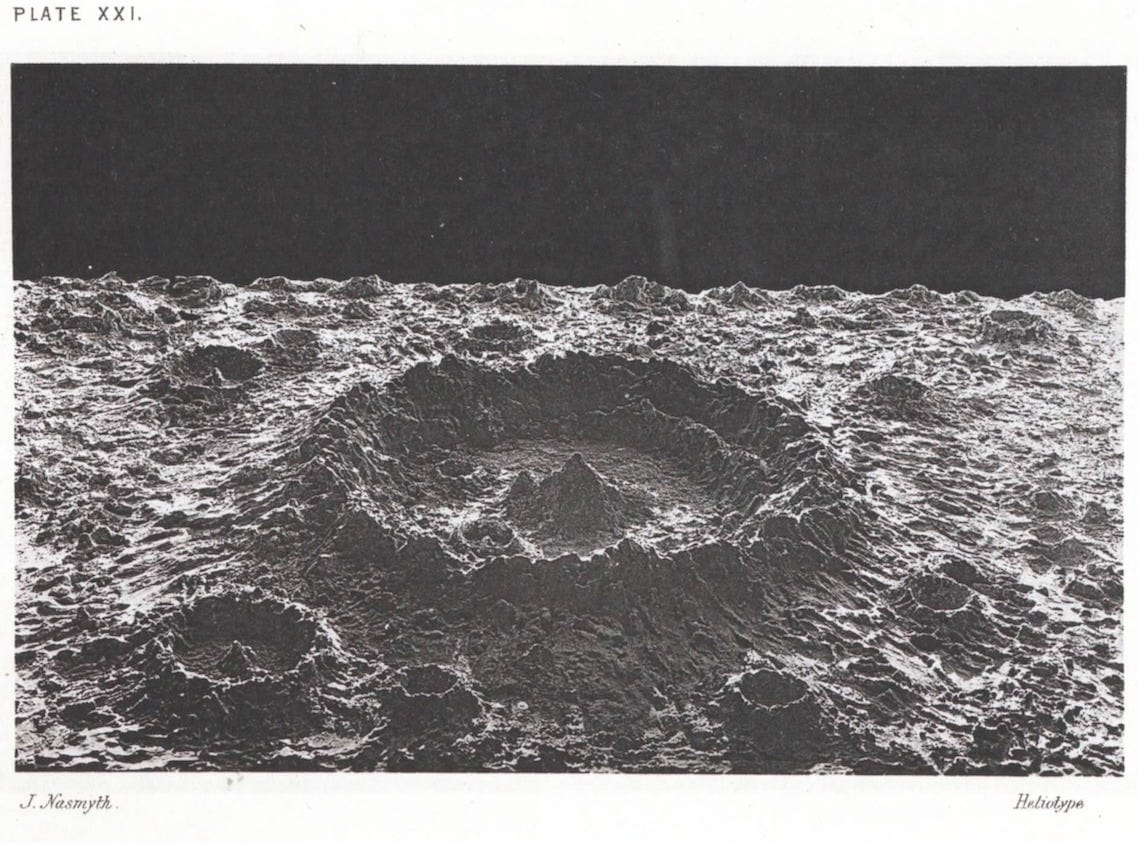
A few years ago I included both these examples of exactitude in a resource for the Royal Photographic Society. We often think of the scientific photograph as the coldest, most literal, most exact kind of image. And yet much of it is imagination and modelling and patience, closer to Leonardo worrying at his monster than to a hunter waiting for the world to compose itself. The cult of the caught instant, the much misunderstood ‘decisive moment’, came later, with small cameras and roll film. The older tradition was always slow, always constructing. It treated the picture as one step in a long study rather than a moment to be seized.
Fittingness, in Bentley and Nasmyth, is a thing made. The black ground. The plaster crater. Built to be believed.
A placeless place
Dafna Talmor makes what she calls Constructed Landscapes. She photographs landscapes on medium format colour film, often while visiting family, who are scattered across several countries, since her own heritage is mixed and her meaningful places are not in one geography. On their own she finds these single frames inadequate. A photograph of a landscape cannot hold the experience of being in one, the turning of the head, the immersion, the different densities of light, the sense of continuity just beyond your field of view. This is an old problem. Gustave Le Gray, in the 1850s, printed his seascapes from two negatives, one for the sea and one for the sky, because a single exposure couldn’t resolve both. Talmor takes the difficulty further. She cuts her negatives and splices them, combines them physically, and prints the composite. The landscape in the final image never existed anywhere. Sometimes the joins are soft. Sometimes they declare themselves, pale flag-like shapes where the film was cut, the seam left showing.
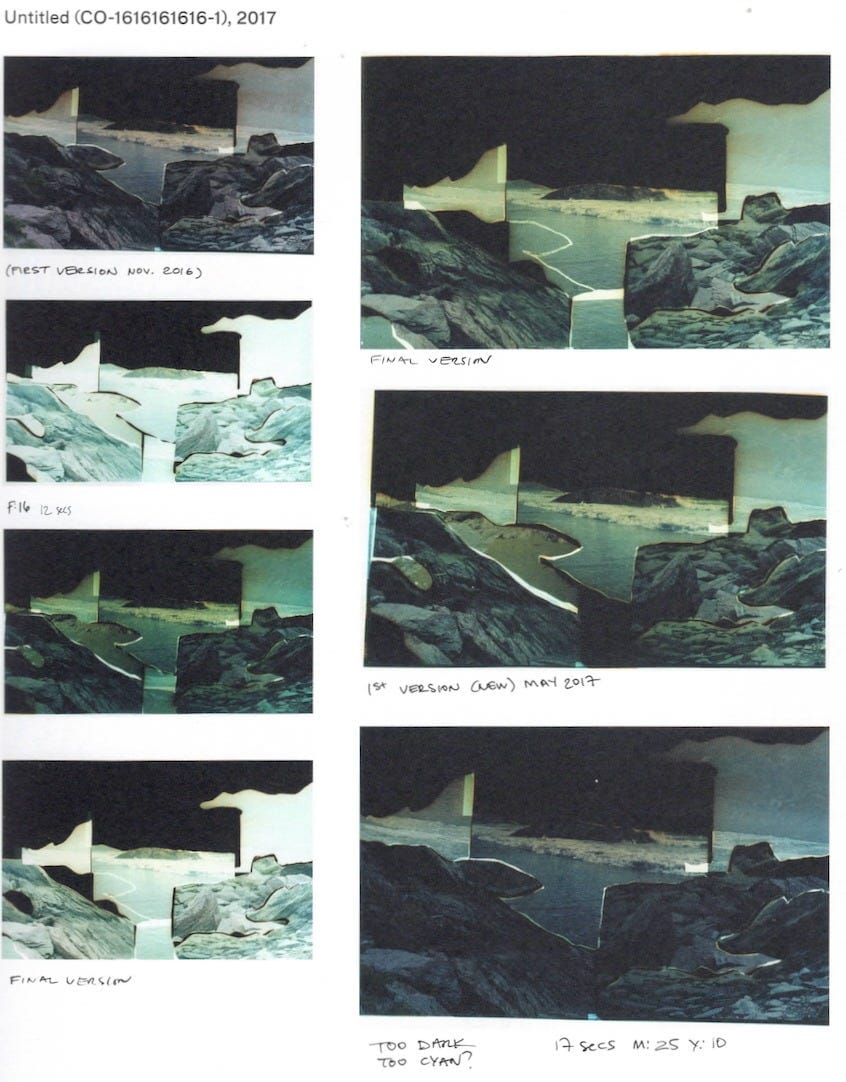
The pictures are not documents of a particular location. They’re about her relationship to places that mean something to her, blended across the distances between the people she loves. They are placeless places, landscapes you can’t see all at once and certainly the one we are all inside now, the warming world too large and too dispersed to picture. Timothy Morton calls that kind of thing a hyperobject, something real and everywhere and impossible to grasp in a single view. Talmor’s cut landscapes are more honest about that than a straight photograph would be because they reveal their madeness.
The back section of her book presents various versions of each composite, the same constructed landscape worked over and over across months, the seams shifting, notes in the margin, “too dark, too cyan,” a first version from November, a new first version the following May, the darkroom timings noted beside them. It is Ponge’s sequence of approximations, made visible. It’s the looking again that is the work. And the negatives she shoots are made partly to be kept, archived, used later. The delay is hard-wired into the process.
Another look
Recently, I’ve been exploring the FSA archive, particularly the work of Gordon Parks and Dorothea Lange. The Farm Security Administration sent photographers across Depression-era America and gathered around 175,000 pictures, now digitised and free to download, which I have had students edit into zines. Roy Stryker, who ran it, shaped what the photographers looked for and killed the negatives he didn’t want by punching a hole through them, around a hundred thousand of them. The archive we have is not the archive that was made. It was edited, in part, with a hole punch. As Lange herself commented:
The FSA file is usable in many different ways. There are a hundred different complete exhibits in that file.
— Dorothea Lange, quoted by Sam Contis in Day Sleeper
Sam Contis recently plundered Dorothea Lange’s archive at the Oakland Museum California, to make a book called Day Sleeper. “The images here are Lange’s;” Contis reminds us, “the selection and the relationships between them are mine.” It’s a great example of the photograph going on doing work long after its author has gone and the purposes it was made for have lapsed. The images were loose enough, indeterminate enough, to be read again.
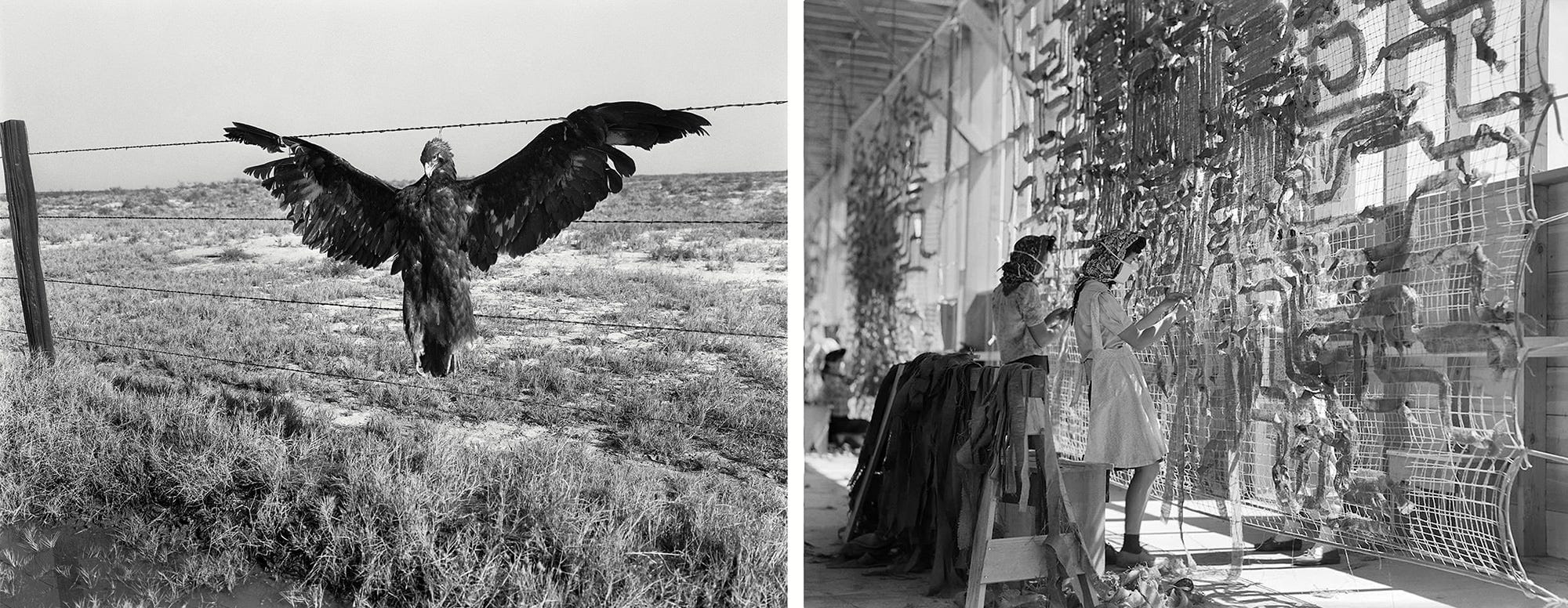
I’m interested here in a particular pair. First, a Lange photograph of an eagle killed by a rancher and spread against a barbed-wire fence, wings forced open, every feather made legible, a warning pinned to the wire for other predators to read. Then, over the page, two women in headscarves and masks weaving an enormous camouflage net, a fabric built to convince an enemy’s eye that there’s nothing to see, just a landscape. One bird made hideously exact. One surface made to defeat exactness, to fake an empty field. The net is Nasmyth’s double. Both are constructions made to be believed, both pass themselves off as unremarkable nature. The plaster fabricates a Moon that isn’t there. The net fabricates the absence of the machinery of war. Two exact fictions, a century and an ocean apart.
Towards the end of her life, she had begun to move away from thinking in terms of individual images, and was experimenting with ‘photographic statements’ — ways of grouping images so as to express ‘relationships, equivalents, progressions, contradictions, positives and negatives etc. etc.’
— Sam Contis quoting Dorothea Lange
There’s the judgement you make with the camera at your face. It’s instantaneous, forward-facing. Is this right, now? And there’s another kind that’s slower and turned backwards, made with the material already gathered. Collecting, sorting, placing one thing beside another, waiting until the time is right, not forcing the thing to close. Both are judgements about fittingness. The second is the one that’s harder to teach and maybe impossible to measure, because it looks like doing nothing. It’s the long game, and it’s more of a disposition than a skill. The patience to stay with something over time, to let it sit until it tells you what it is.
Returning
For over twenty years, Gregory Halpern has photographed in and around Buffalo, New York, his home town, returning repeatedly. Last year, he published King, Queen, Knave, a book of these images. It’s a strange set of pictures, half-mythical, a Buffalo that is both the actual place and a dream of it. Smashed eggs on a pavement. An angel pencilled on a wall. Lone figures in the suburban edge-lands. And a white deer that reappears throughout the book, glimpsed through red grass, the token of the return that comes back to remind you that you’re in it for the long haul even as the city keeps shifting.
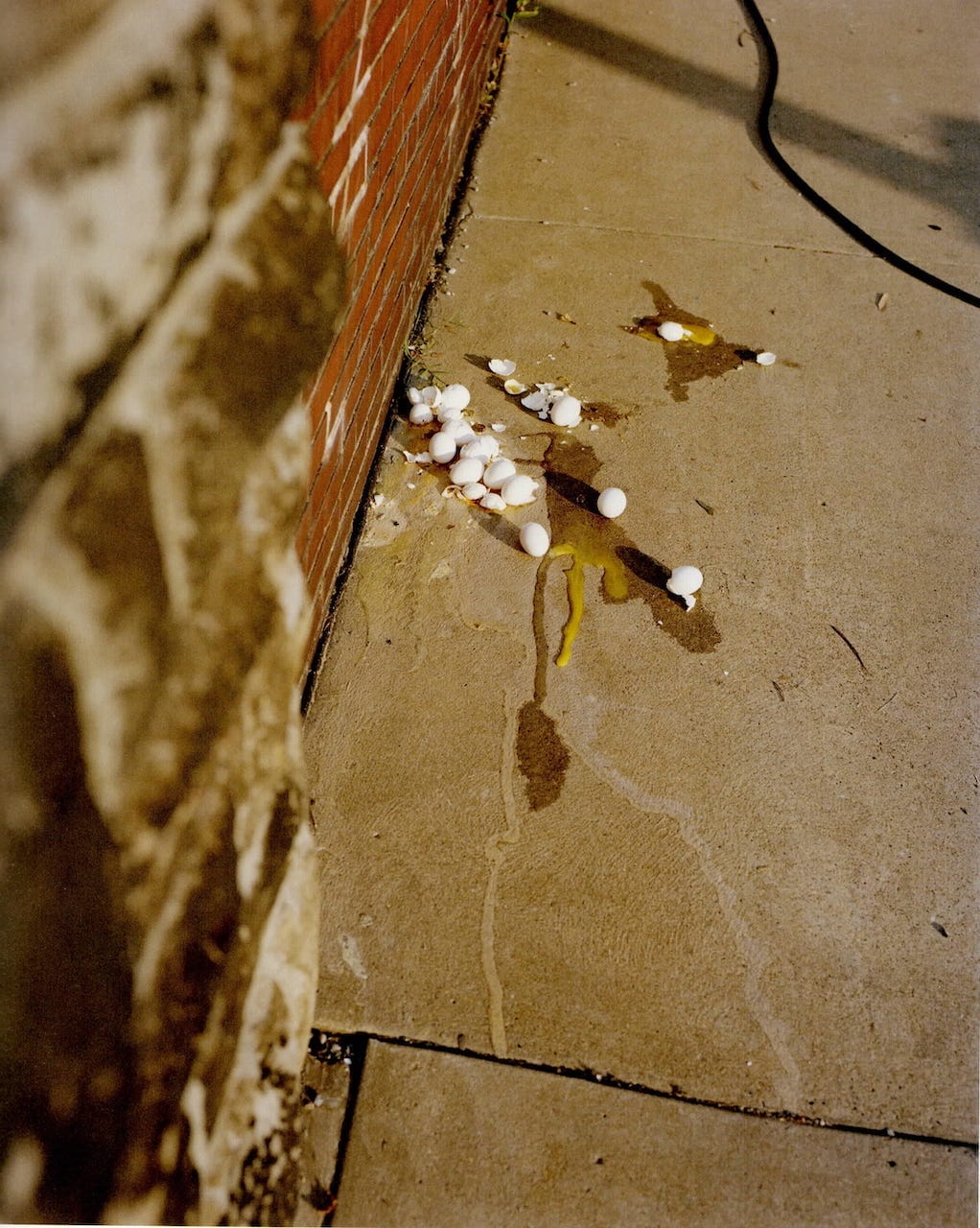
I love the broken eggs. At first glance it looks like a spoiled breakfast, whites and a broken yolk bled across the concrete. But the book has been rhyming the tiny with the vast all the way through and, by the time you reach them, the eggs read as planets, a scatter of small worlds, cracked and dispersing their contents, a universe collapsing on a Buffalo pavement. And what about that serpentine form top right? Arthur Siegel called photography a poor man’s Rorschach, and here’s the proof. You look at broken eggs and, primed by the return, see a cosmos, and the image is loose enough to hold both.
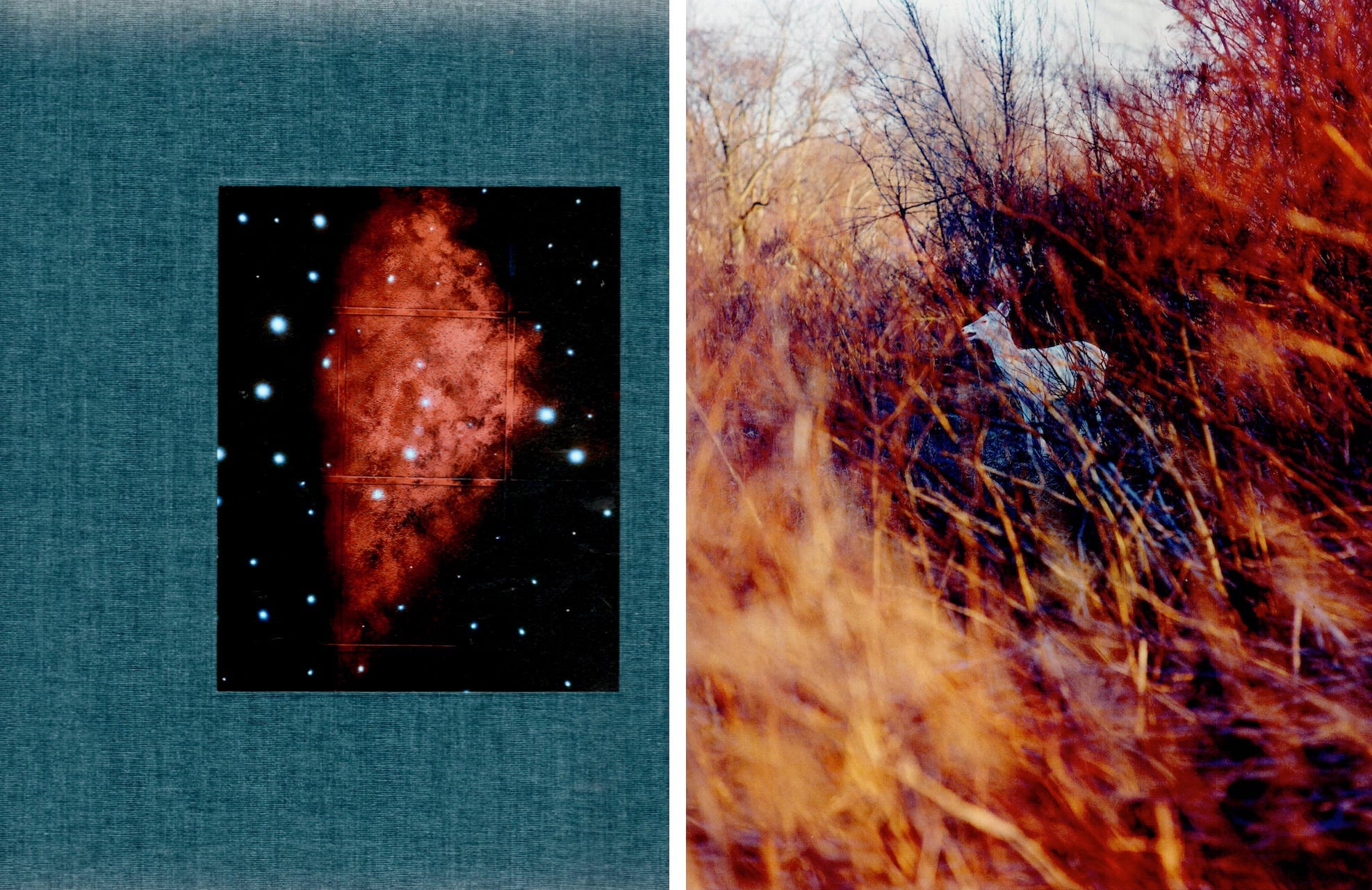
Then there’s the cover, which is also the penultimate image in the book. A galaxy, stars and a red nebula, set into the panels of a suspended commercial ceiling, the ordinary white grid you find above a strip light. The infinite, tiled into an office system. It is Bentley’s snowflake at the other end of the scale, the crystalline order holding a cosmos, except that here the order is a suspended ceiling and the cosmos has been fitted into it, domesticated and modular. Calvino spent the whole of his exactitude lecture torn between the crystal and the flame, the fixed perfect form and the thing that will not hold still. Halpern’s ceiling is both.
Coming into view
The final image is of birds thrown across the night sky. Crows I think, taking flight against bare, flashlit branches. Fukase’s ravens are somewhere behind them, though the gesture has reversed. His birds were crowded by grief, made symbolic of his loss. Halpern’s do the opposite. They decentre the looker, make the human frame small against a too-full world. This is the camera’s odd democracy, its generosity, the thing Lee Friedlander made a virtue of, its refusal to rank, its rendering of everything at once with the same attention. It leaves you with far more than you can gather and a little overwhelmed.
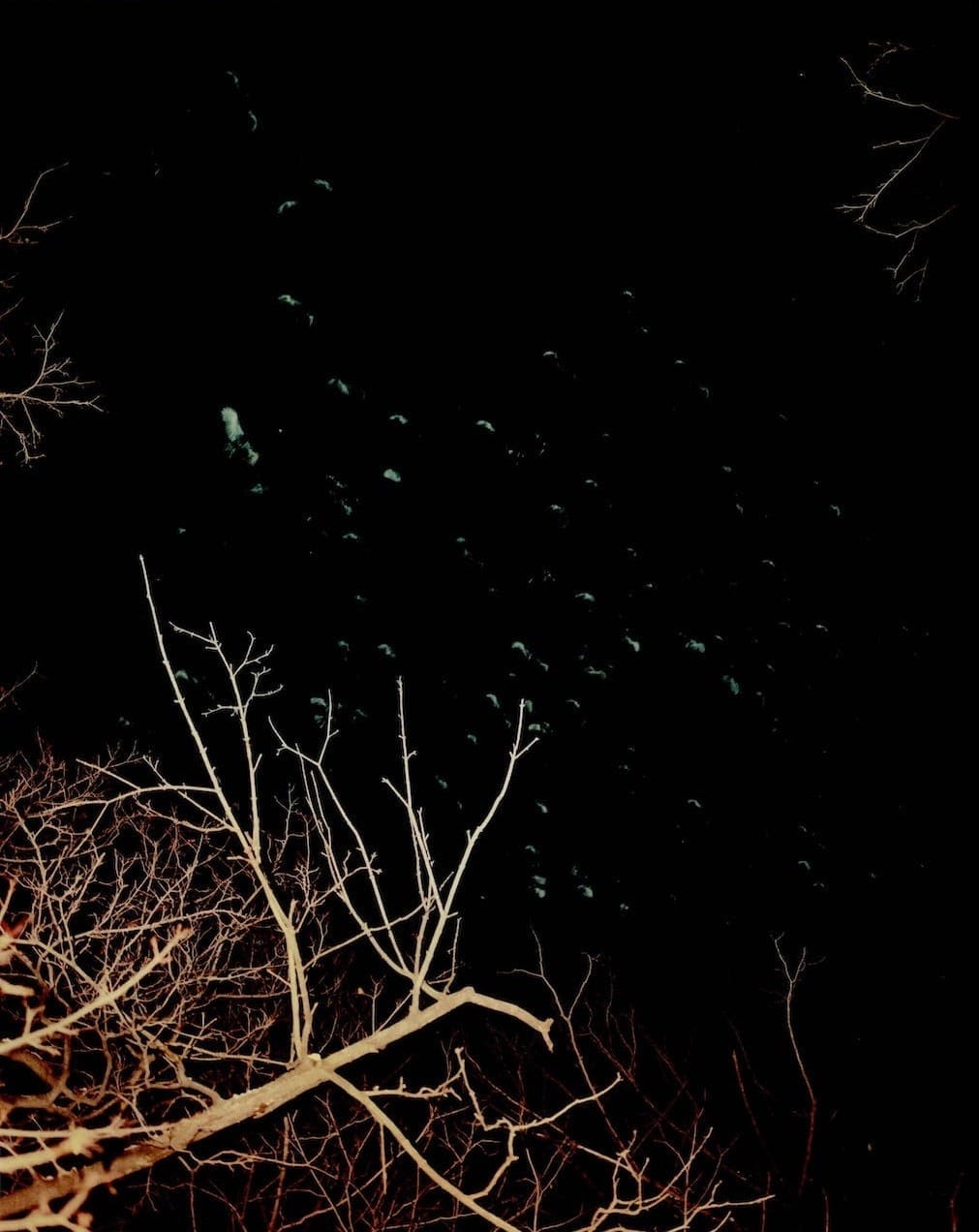
The birds are also Leonardo’s sea monster. Almost visible, almost gathered into a shape, and then not, exceeding the frame like the creature exceeded the three sentences he struggled to finish. The camera is precise about every bird and cannot make them cohere. Precision meets the uncontainable and records, exactly, its own limit.
I think this is a quality worth passing on. A quest for fittingness. The patience to stay with something until it is nearly right and to leave it there, just short of closed, where something is still coming slowly into view.
Thanks for reading PhotoPedagogy! Subscribe for free to receive new posts.
These posts will always be free but, if you enjoy reading them, you can support my analogue photography habit, and that of my students, by contributing to the film fund. Thanks to those of you who have already done so. All donations of whatever size are very gratefully received.