Six Memos for the Future of Photography
#1: Lightness

This post is part of a short series responding to Italo Calvino’s Six Memos for the Next Millennium.
I visited the exhibition of Japanese women photographers at TPG in the middle of a heatwave, once with Neil Scott and then again with my wife. I usually go back a few times to an exhibition I like.
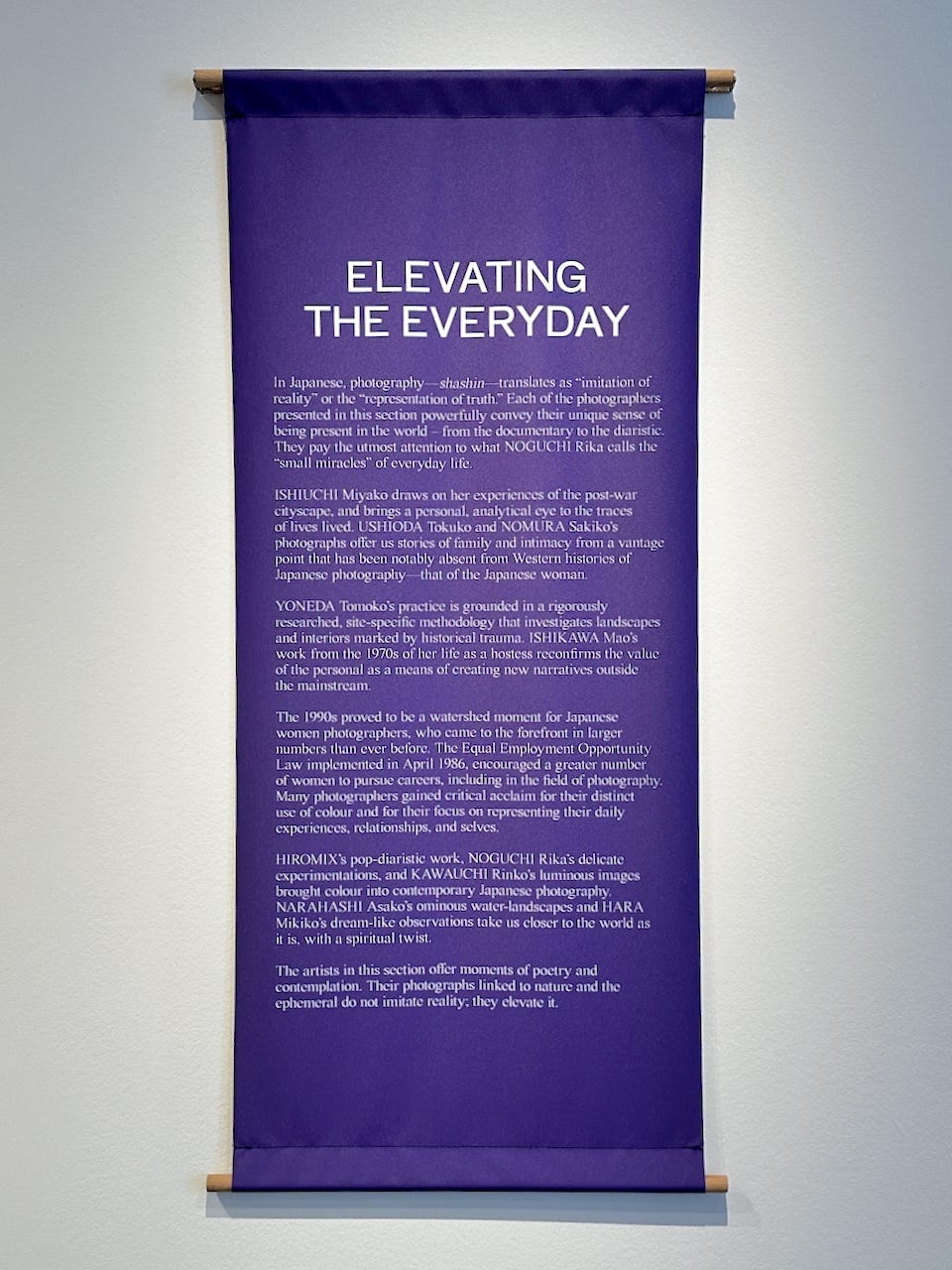
Each of the rooms has a title printed on a long banner of purple cloth hung from a wooden pole. The one that I was most excited to see again was “Elevating the Everyday.” The text explains that the Japanese word for photography, shashin, can be read as something close to “imitation of reality” or “representation of truth”, and that the photographers gathered under this heading attend to what one of them calls the small miracles of ordinary life. Their photographs, it says, do not imitate reality. They elevate it. This is close to being the reason I like to make photographs and also the reason why I like to teach photography.
Earlier in the day, the always interesting Graham Hooper had emailed me with some ‘alternative’ Threshold Concepts for Photography.* We batted a few messages back and forth and then he reminded me of Italo Calvino’s list of six memos.
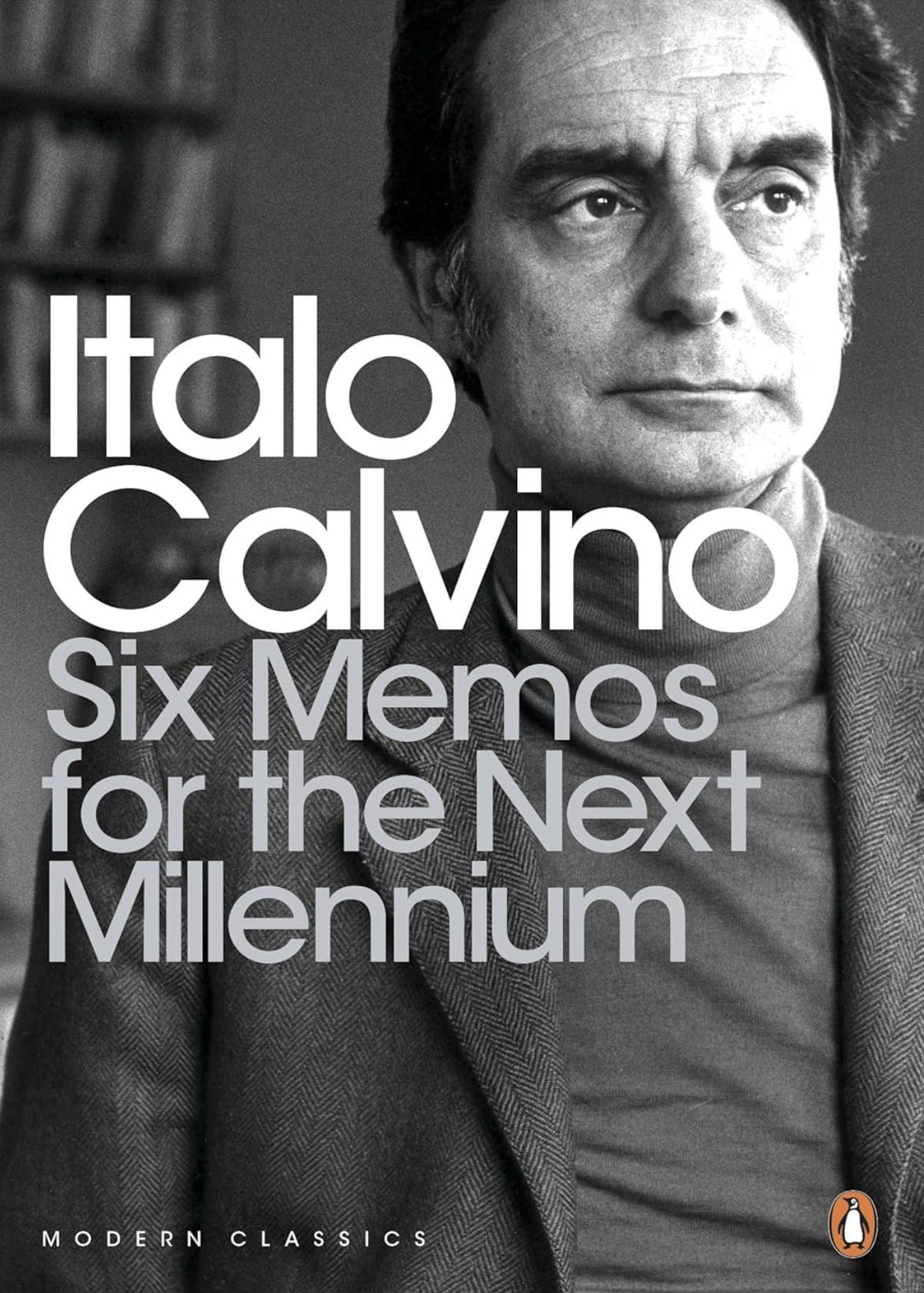
The book is Six Memos for the Next Millennium, the Charles Eliot Norton lectures Calvino was preparing when he died in 1985. He finished five of the six, on lightness, quickness, exactitude, visibility and multiplicity. The sixth, which he meant to write once he reached Cambridge and never did, was to be called consistency. I’m a big fan of Calvino’s writing and Graham’s email left me wondering what it might mean to take his qualities, values he wanted literature to carry into the new millennium, and apply them to photography instead. I could try to add the missing sixth. I realise there’s something absurdly impertinent about this. I’m not claiming any special authority. I’m not a photography expert. I’m a semi-retired photography teacher who only works two days a week. But I’ve got more time on my hands to think about stuff like this and it’s fun. So, please, take this series of posts with a large pinch of silver halide.
I should say at the outset that I can’t see the future any better than Calvino could. He had no appetite for that kind of forecasting. What he did instead was go the long way round, through old stories and images, trusting that a quality worth keeping would show itself in the past as clearly as in whatever was coming. For this post, and maybe some of the others too, I’ll do something similar. I’ll place photographs next to one another and try to draw a line between them.
Lightness first, then.
The picture that doesn’t exist (yet)
Think about what happens between the shutter and the developing bath. The exposure is over. The light has done its thing but there’s nothing on the film. Yet. A few crystals of silver have been altered, too faint to see, and the picture waits inside. Photographers call this ghost the latent image and it’s the lightest thing in photography, lighter than the negative and the print, because it hasn’t yet become visible.
What does that do to the photographer? You could be photographing a christening or a catastrophe and yet walk away with the same weightlessness in your hands. A roll shot at a funeral or a fairground rattle alike in the canister and will lie in a drawer for a year with equal indifference. Whatever gravity the pictures have is all potential. You carry a grave cargo and feel only the ordinary lightness of a small machine.
This lightness is the medium’s founding condition and it points to all three of the senses Calvino gave the word. There is the lightness of what a photograph is physically, a skin of silver on paper. A gram of nothing. There is lightness as a way of working, which for Calvino meant the subtraction of weight and which photography performs by lifting a piece of the heavy world and handing it back to you as a shadow. And there is lightness as something missing; the weight that had to be removed for the image to float free at all. That last one is the one that interests me most.
The mother under the cloth
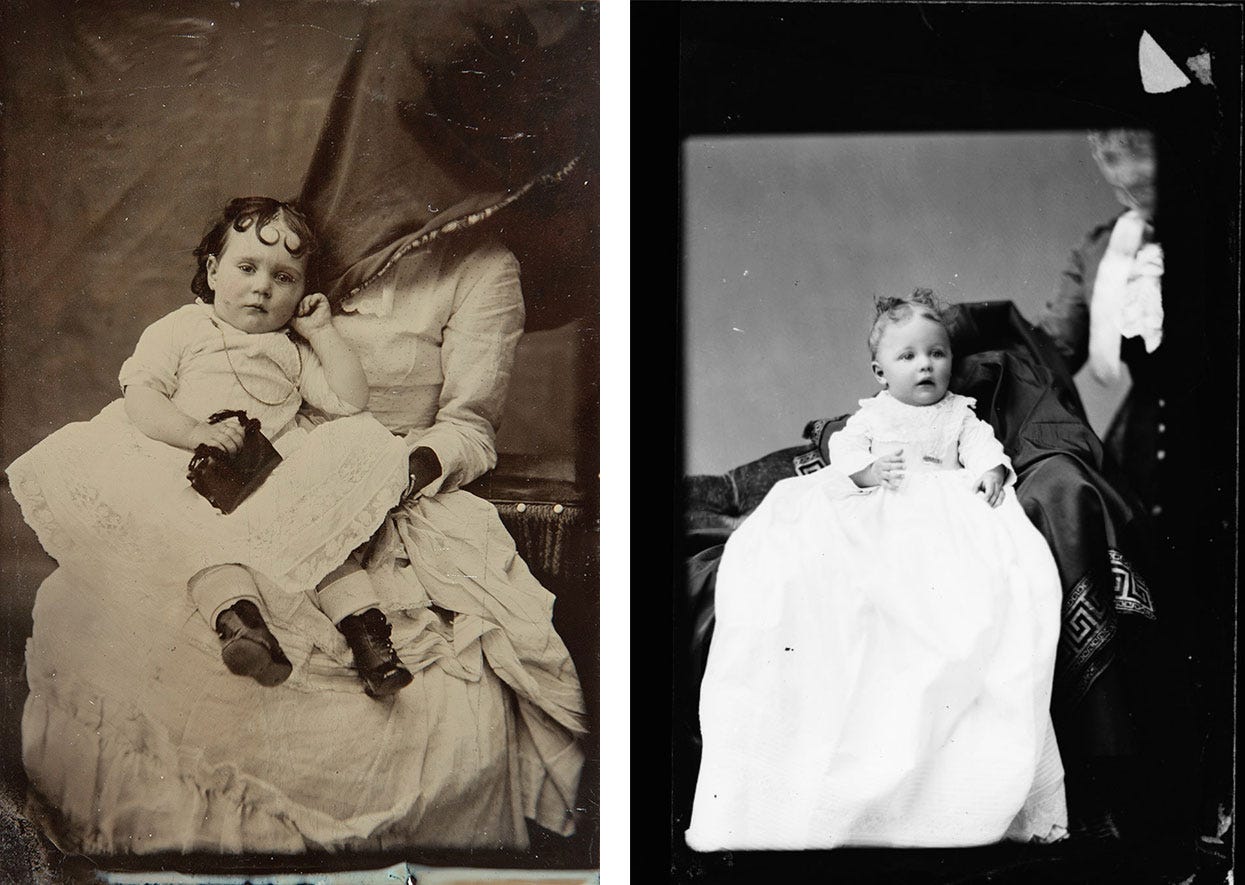
There’s a kind of eerie nineteenth-century photograph, named only recently, in which a small child sits looking out at us with the wide unfocused patience of the very young. And behind the child, holding it upright, there is a person who has been made to vanish. A child won’t sit still for long, so somebody had to steady it and that was almost always the mother. To keep her out of the picture she was draped in a cloth, or set behind the backdrop with only her arms reaching through, or scratched out of the negative afterwards. What survives is the presentable child and, behind it, a shrouded mass, a pair of hands arriving from nowhere. Collectors have taken to calling them hidden mother photographs. Linda Fregni Nagler’s book gathered a thousand or so of them at which point the thing we weren’t supposed to notice became the only thing we could see.
The mother is the weight. She’s the gravity in the picture, the labour that holds the soft body vertical against its own wish to slump. She’s been subtracted so the child can float free. Lightness by removal. Except that here the thing removed is the one doing all the work.
I’d been thinking about these pictures as curiosities until I read something that mentioned, in passing, who was often standing behind the camera. By the 1860s photography had become one of the few trades thought respectable for a middle-class woman and in a single decade the number of female professional photographers quadrupled. They learned, like everyone, to keep a baby still using whatever worked. Some hung a caged bird or kept a monkey in the studio to catch the child’s eye. Others reached for the chemistry. One trade magazine of the period recommended a dose of opium, which would, “effectually prevent the sitters from being conscious of themselves, or of the camera, or of anything else.”
There’s more weight, folded inside the lightness. The buoyant, weightless likeness of the floating child, bought at the price of a narcotised infant and an erased woman. Calvino, reading Kundera, put it better than I can.† Everything we choose for its lightness, he says, soon reveals its true and unbearable weight. He meant it as a truth about living but it turns out to be a fairly precise description of a photograph.
The dress on the lightbox
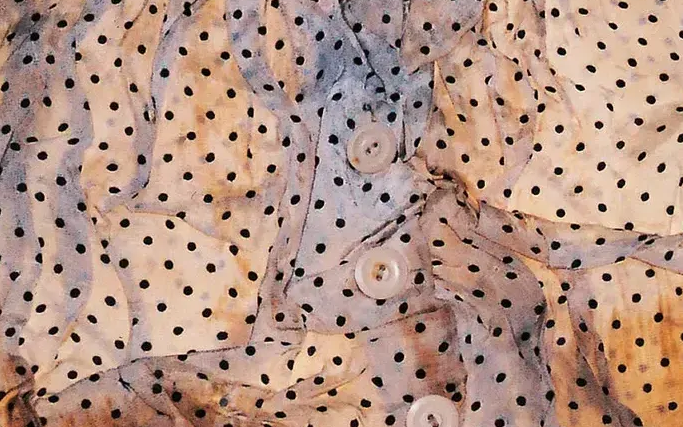
A hundred and thirty years on, in the room with the purple banner, we encounter Ishiuchi Miyako’s laid out clothes on a lightbox. These include her mother’s things, a slip, a shoe, a girdle, a lipstick worn down to the shape of a mouth. The mother is gone and present in the one form left available, as the hollow the cloth still keeps. The gesture is the hidden mother’s, turned the other way about. There a living mother was covered so a child could be seen. Here a dead mother is uncovered and brought up into the light so that she can be seen at last. Cloth in both, a mother in both.
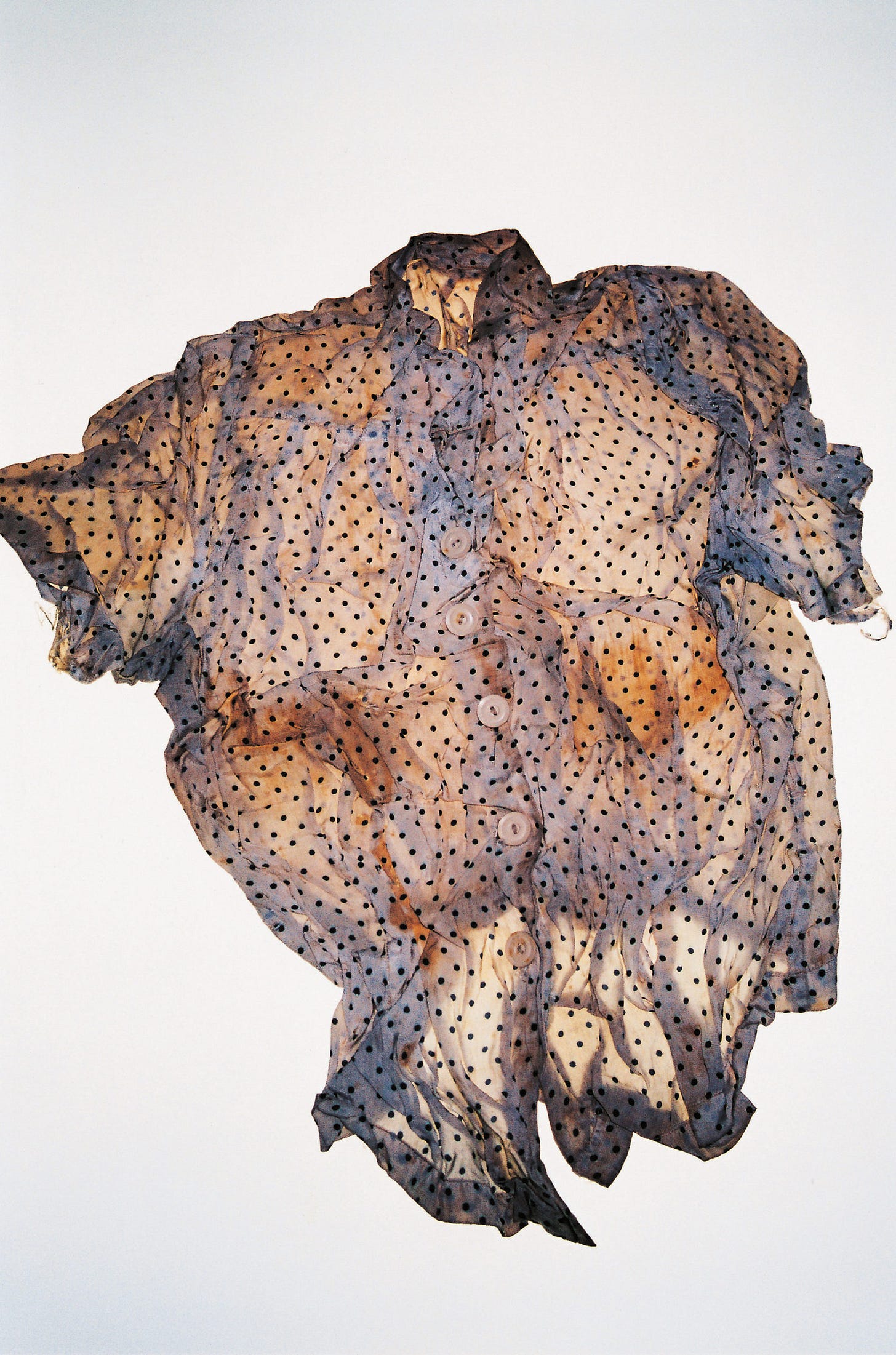
Ishiuchi used a similar method for Hiroshima and the garments of strangers killed by the bomb. She says she approached that subject from the position of not understanding.
I’m an outsider, from elsewhere, so I can’t truly approach things from the same angle, or fully comprehend the sadness and pain of atomic bomb victims. So I started from the standpoint ‘I don’t understand’. I have only spoken to one actual atomic bomb victim, but I have a dialogue with those possessions that have been left behind. Those possessions don’t speak, but I am still having a dialogue with those silent relics. When I spread them out under natural light, I think that the missing girl who owned them might come home, might wear this dress. So when I photograph, I try to show them looking smart, looking beautiful. Well, the owner won’t come back, but that’s the image I have in my mind when I take the photographs.
— Ishiuchi Miyako
I walked in ready to distrust the loveliness of these pictures. Their surfaces are so persuasive, so luminous. But the artist’s own words took my objection away. The beauty is not a cosmetic laid over the absence. It’s hospitality extended towards the absence, a place set for a guest who cannot arrive, and made beautiful anyway because the alternative is to give up on her ever coming. The photograph is put to no use at all. It documents nothing, since she disclaims the knowledge a document would need. It consoles no one, the owner not being available for consolation. And that uselessness is exactly its refusal to be spent. The lightest thing photography owns, the luminous trace with no body left in it, turns out to be a form of waiting.
It’s no surprise, then, to learn that Ishiuchi trained as a textile artist.
I studied textiles at college, so I am more alert to the details of textiles and cloth than most people.
— Ishiuchi Miyako
Cloth everywhere: the drape over the hidden mother, the slip on Ishiuchi’s lightbox and the wall text itself, floating as a purple textile rather than stuck to the wall. The exhibition chooses to speak about these women through the material that runs through so much of their work, and through the folding and laundering and mending that sits under it. The cloth holds the argument up the way the draped woman held the baby up, structural and meant not to be noticed. The banner is the show’s own hidden mother.
Unbearable lightness
The luminous trace is never as weightless as it looks. Silver is a heavy metal, dug and smelted. The photographic industry was built on coal and the image it hands us so lightly is made by relocating an enormous weight somewhere the picture will never show, into the mine, the tannery and the warming air. Ishiuchi’s lightbox runs on an electricity that is, in Japan especially, partly nuclear, which is to say that the light summoning her dead is a tamed cousin of the light that killed them. The same mastery of matter gives us the reactor and the weapon, the lightbox and the flash that printed human shadows onto stone. I may come back to all of this. For now I only want to leave it here, felt rather than excavated.
It was still thirty degrees when I emerged from the air conditioned gallery. The whole visit happened in a heatwave and the warming we have made is felt, in the end, as an excess of light. Lightness as energy, which builds things and unmakes them with the same indifference. The lightness was almost literally unbearable.
I went home in the heat and thought about going back for another look.
Thanks for reading PhotoPedagogy! Subscribe for free to receive new posts.
These posts will always be free but, if you enjoy reading them, you can support my analogue photography habit, and that of my students, by contributing to the film fund. Thanks to those of you who have already done so. All donations of whatever size are very gratefully received.
* (Alternative) Threshold Concepts for Photography
- Photographs (cameras) record light, and its absence, in machine-like ways, without the awareness of or any thought for subject, audience or meaning.
- Photography has developed alongside the dissolution of genre as a meaningful term - combining and converging traditional subject matter to a point where the very notion of genre has become an increasing distraction.
- Photography began as a pastime for the overwhelmingly privileged white males, and utilised to display wealth and status, and has become a mainstay of the capitalist art-world, bought and traded by collectors and galleries, though it has always been and remains open to playful transgression and powerful subversion by the underdog.
- Photography is as much the result of invention and discovery as it is selection and abstraction, just as exploration, investigation and experiment are almost synonymous, or should be.
- Photographs are all abstract but in being so are inherently depictive, as technology, alongside (to differing degrees) the human body, the brain/mind/soul and the eye/sensor work together to form images.
- Photographs involve luck and skill, like a good board game, but skill and knowledge, consciousness and perception usually play the bigger role, at least at the start.
- Photographs can have meaning(s), though they are essentially always fluid and at times arguable, inviting questions as much as providing answers.
- Photography shares its visual language with all the other visual arts, though with some exceptions, such as focus and framing, which is unique to lens-based media.
- Photographs are neutral, but have meaning bestowed upon them. To misquote Shakespeare, “Some photographs are born great, some achieve greatness, and some have greatness thrust upon them”.
- Photographs can solidify or dissolve our sense of time as they can the idea of space, alluding to what is lost, but also, luckily or not, what might remain.
- Thresholds suggest a binary mode of thinking and action - you’re over it or not - akin to digital (on/off) whereas contemporary progressive outlooks feel more analogue, preferring to view the world as shifting scales and crossovers built on degrees and network.
- Photography teaching for the most part still appears to involve having learners draw and label diagrams of enlargers or SLRs, discussing ‘The Rule of Thirds’ and leading lines, copying the work of others and spending hours of Photoshop…
And the actual concepts themselves:
- Light : shade
- Beginnings : endings
- Power : freedom
- Process : product
- Depiction : abstraction
- Luck : skill
- Questions : answers
- Language : silence
- Meaning : nonsense
- Solid : liquid
- Binary : analogue
- Teaching : learning
Good, aren’t they? And don’t ask me about No. 12. I’ve no idea.
† Whenever humanity seems condemned to heaviness, I think I should fly like Perseus into a different space. I don’t mean escaping into dreams or into the irrational. I mean that I have to change my approach, look at the world from a different perspective, with a different logic and with fresh methods of cognition and verification.
— Italo Calvino, Six Memos for the Next Millennium