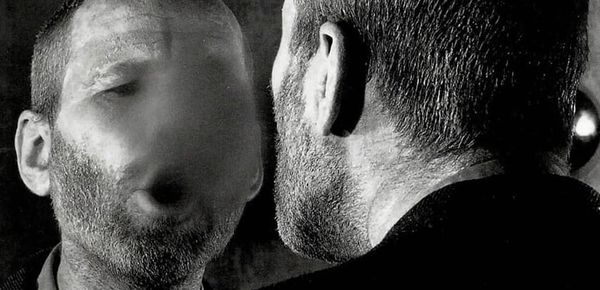
Threshold Concepts for Photography
Opening the Door to Troublesome Knowledge.


As promised, this post deals with Threshold Concepts in the photography classroom. It’s a HUGE subject so, rather than exercising your patience with a lengthy A-Z tour, I’ll attempt to take you on a small detour (a dérive if you like).
Many of you will already be familiar with Threshold Concepts. The PhotoPedagogy website has most of the information you might need if this is the first time you’ve encountered them.

Suffice to say, in 2015, Chris Francis and I, plus a small group of interested colleagues, decided to have a go at compiling a list of foundational concepts for photography. We were keen to raise the status of the subject, addressing a perceived lack of knowledge (“Anyone can take a photograph, can’t they?”) and support colleagues in their attempts to design meaningful programmes of study. Thanks to everyone’s input, we published a set of ten statements, featuring Chris’ wonderful graphics, and began working on related web-based resources.*
Over the years, lots of people have let us know how useful they have been and we are really grateful for all the positive feedback.
A key question remains. How do I incorporate the Threshold Concepts into my teaching?
It’s all very well having the poster on your classroom wall or a TC graphic signposted in a presentation, but how do students make use of these troublesome ideas?† To be honest, we’ve struggled with this too.‡ As I’ve often remarked, Threshold Concepts are a Threshold Concept!
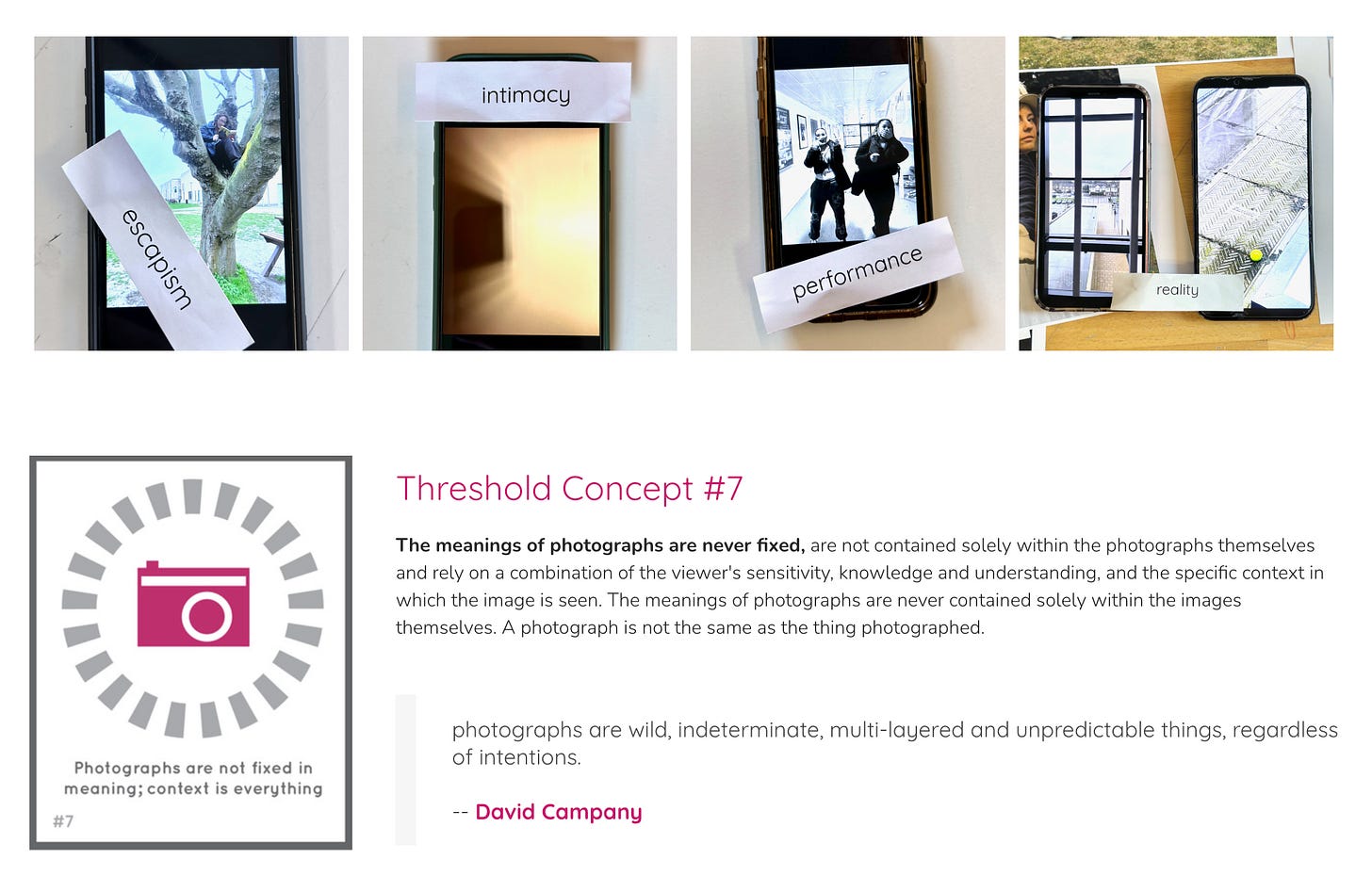
We’ve tried lots of strategies over the years, some more successful than others. We’ve attached key TCs to specific resources, made massive A0 posters for our classrooms, and encouraged students to refer to them in their writing. This year, however, I’ve decided to try something a bit different. Rather than making reference to the TCs as they come up, either through whole class or individual discussions, or linked to a particular project, I’m foregrounding them for my Year 12 photographers as they design their Personal Investigations.§ In other words, each student will begin making a body of work informed by one or more of the concepts.
How does this work?
Here’s what I’ve done so far:
- Students have set up a dedicated Photo Theory page on their websites.5
- Having explored some big ideas already, students have added Threshold Concepts for Photography as a new item on these pages. They were tasked with selecting one for closer study, related to their interests.‖
- I asked them to respond to the following prompts:
- What is a Threshold Concept?
- Analyse your chosen TC graphic. What do you see?
- Identify one useful quotation (from the relevant resource)
- Identify two useful photographers (from the resource) for further research
- Summarise the key points (from the resource) in your own words
- Explain how this concept relates to your investigation
Asking students to analyse the image associated with a specific TC is always a really fruitful activity. For example, what do you see when you look at the graphic for TC#10 (below)? What does it suggest about the relationship between photography, time and memory?

Do you see a church and gravestones? A ticking clock? Is the church a camera? Is it 08:51 in the morning or 20:51 in the evening? Do the gravestones look a bit like photographs? In what ways are gravestones and photographs similar? Etc.
Next, how does the summary statement (proposition) further develop your thinking?
Photographs warp our sense of time; they remind us of things lost
How do you feel about the use of the word ‘warp’ in this context? What has been lost and how do photographs work as memento mori?¶
In today’s lesson we explored another pair of images in our ongoing Photo Ping Pong activity.

This time, I asked the students to look carefully at both images (as usual), following the same protocol as previously, but also thinking about the Threshold Concepts. Which concept seemed most fitting as a way of thinking about both images? How could the TCs help us unpick the issues, themes and ideas embedded in both images?
The students selected various TCs. For example:
- TC#2 could help us reflect on the different light sources (artificial and natural), the relationship between positive and negative, the projection of shadows etc.
- TC#4 could help us think about what’s missing in both images, the tightness of the framing, what’s been excluded (as well as what’s included) etc.
- TC#7 could help us think about what happens when you place one image next to another and, crucially, how the captions change the potential meanings of both images
I think this discussion has been one of our most productive so far. I hope the students could see just how useful the Threshold Concepts could be for them, over time.
In a couple of weeks, they will have a Making Day. Instead of a mock exam, we prefer to give our students a day off timetable to make images in a location of their choosing. This year, we are tasking them with choosing or devising an activity that responds explicitly to one or more of the Threshold Concepts. The idea of the Making Day is quite simple:
- Students decide where they want to go and how they want to make their images, informed by their chosen Threshold Concept(s) and emerging Personal Investigation focus.
- They book any necessary equipment, spaces and support (students may choose to stay in school and use the studio and/or darkroom, for example).
- They spend the day making their images. Collage, montage and moving image work are also possible.
- In subsequent lessons, they edit, post-process and sequence their images to best express their mini project idea.
- Finally, they create an online gallery of their final sequence of images which we critique together.
We will share with them lots of examples of photographers’ web galleries and those made by previous students, some extremely innovative. They will practise using the tools available to them to curate their online exhibitions.

The end result will hopefully be a touchstone, important preparation for the end of Component 1 of the course, when we also ask them to share a body of work in the form of an online gallery.
I’m really hoping that the Making Day is a further opportunity for students to put some meat on the bones of their chosen Threshold Concepts. The risk in all this is that theory and practice remain separate, that they don’t cohere into something like a praxis. Time will tell.
In my experience, the students who develop increasing levels of intentionality in their work are ultimately more successful but also, crucially, find photography a rewarding and life-affirming activity, something that can sustain them for longer than the two years of an A-level course.
Education (as distinct from training or instruction) is existential.** Threshold Concepts are one way of coaxing students (using what might be referred to as positive coercion) into an encounter with troublesome knowledge, to risk not knowing, to sometimes invite unknowing, to stay in a liminal zone for a long time, to be persistent.††
Teachers can be helpful in at least two ways:
- They can point to new ideas, encourage students to cross a conceptual threshold and have a good rummage around
- They can help sustain students’ experience of liminality, through encouragement and by modelling persistence
I have no idea whether this renewed focus on Threshold Concepts for Photography will help my students develop their own ideas and sustain their investigations. The beautiful risk of education.
Thanks for reading PhotoPedagogy! Subscribe for free to receive new posts.
These posts will always be free but, if you enjoy reading them, you can support my analogue photography habit, and that of my students, by contributing to the film fund. Thanks to those of you who have already done so. All donations of whatever size are very gratefully received.
* We are aware that the Threshold Concept statements are phrased as propositions. Since a TC is an invitation to engage with “troublesome knowledge” we felt that the language was important. A proposition invites thought and debate, we hope. However, there are concepts lurking behind each of these propositions. For example, TC#2 proposes that all photographs really have in common is that they are made with some form of ambient energy. Related concepts might then include: exposure, aperture, tone, colour …etc. But we also want to encourage students to question tacit assumptions e.g. that photographs require a camera.
† Threshold Concepts are troublesome in several ways. They may challenge students’ tacit understanding, they may require the acquisition of powerful knowledge (complex, domain specific and sophisticated) and they may use high level or technical language. Consequently, they are not meant to be understood immediately. They might induce a liminal state, a period of confusion and loss of secure learner identity. The job of teachers is to support and encourage students to enter this liminal zone, sustaining them as they rummage about in the jumble sale of ideas.
‡ I work in the photography department at Thomas Tallis School in south east London.
§ My colleague is attempting something similar with her GCSE photography class.
‖ All of our students create websites (ePortfolios) instead of sketchbooks. We find them to be much more flexible and user friendly. I may return to this strategy in a future post in a bit more detail (if anyone’s interested…!?)
¶ We have considered Szarkowski’s Mirrors & Windows, Barthes’ Studium & Punctum (plus the terms denotation and connotation) and Italo Calvino’s story The Adventures of a Photographer. I have a few more big ideas up my sleeve for the remainder of the course.
**
“All photographs are memento mori. To take a photograph is to participate in another person’s (or thing’s) mortality, vulnerability, mutability. Precisely by slicing out this moment and freezing it, all photographs testify to time’s relentless melt.”
— Susan Sontag, ‘On Photography’ (1977)
“Put simply, what is at stake in the idea of subjectification is our freedom as human beings and, more specifically, our freedom to act or to refrain from action. This is not about freedom as a theoretical construct or complicated philosophical concept, but concerns the much more mundane experience that in many — perhaps even all — situations we encounter in our lives, we always have a possibility to say yes or to say no, to stay or to walk away, to go with the flow or to resist — and encountering this possibility in one's own life, particularly encountering it for the first time, is a very significant experience. Freedom viewed in this way is fundamentally an existential matter; it is about how we exist, how we lead our own lives, which of course no one else can do for us. Put differently, freedom is a first-person matter. It is about how I exist as the subject of my own life, not as the object of what other people want from me.”
— Gert Biesta, ‘Risking Ourselves in Education: Qualification, Socialisation, and Subjectification Revisited’, (2020)