What Exactly is a PhotoPedaogy?
Reflections on teaching, photography and photography teaching, with Graham Hooper.

You’d be amazed by the number of different spellings of photopedagogy folks attempt when searching for the website. It’s not the most straightforward neologism to say or spell.
When Chris (Artpedagogy) and I embarked on a plan to create a website about teaching photography (just over 10 years ago) we thought it might be useful to ask colleagues if they could describe their photopedagogy. What was their classroom ethos? What did they emphasise in their courses and what did they avoid? How did they motivate their students? How did they utilise the various materials and techniques available to them? How did they orchestrate space, time and humour? etc.
One of our most thoughtful contributors is Graham Hooper, who has been teaching A-level photography for over 20 years at Peter Symonds College, Winchester. He has written two pieces about his photopedagogy for the Articles section of the website, the second quite recently. Graham has developed a very particular approach to teaching photography which has struck a chord with many visitors to the site. He apparently still receives regular emails about them. Since he recently submitted a further list of his photopedagogical strategies, I thought it might be useful to share all 24 here, with some commentary from me (in italics). I hope he doesn’t object to my responses.* I’ve tried to imagine the kind of friendly conversation I might have with Graham about his ideas, the questions they raise for me, over a cup of tea in the staffroom.
Thanks again to Graham for his generous and provocative views about our wonderful subject. I hope you find them as wise, entertaining and thought-provoking as I do.
1. What I don’t teach
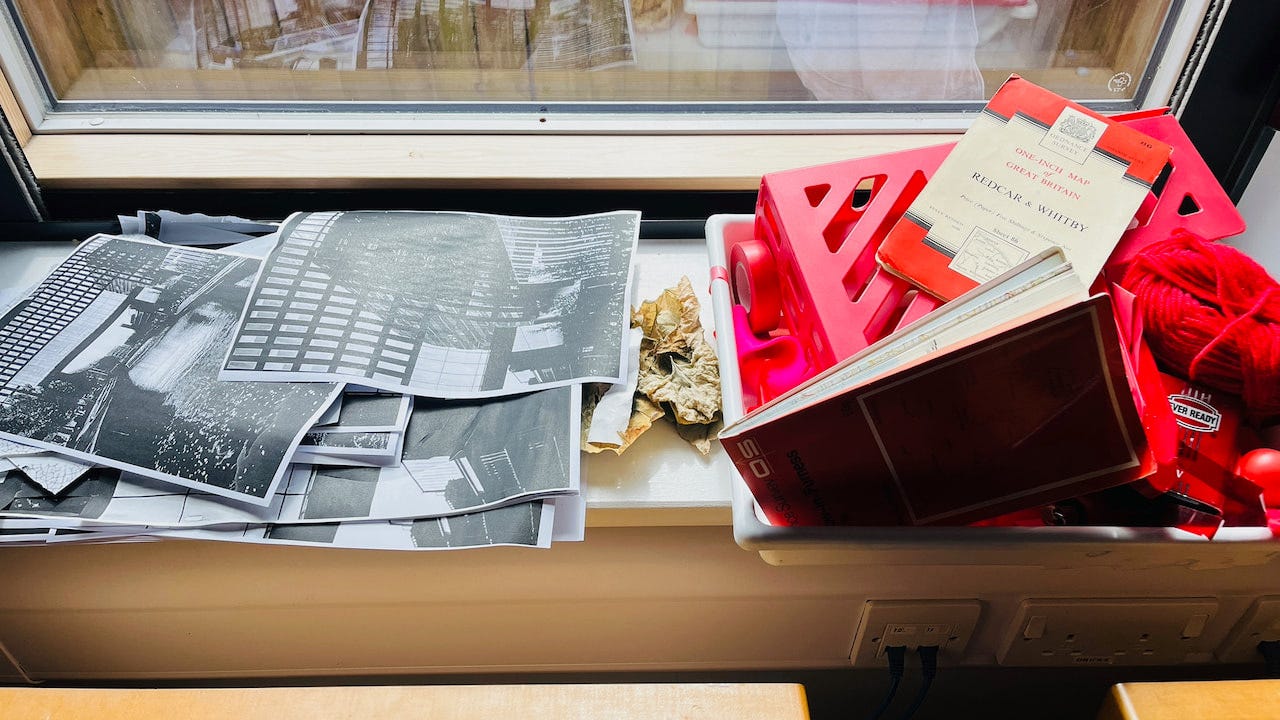
I don’t teach Photoshop at all (though of course my students are freely permitted to use it). Nor do I expect my students to draw a cut-away diagram of an SLR camera, make a pinhole camera, or make photograms. I used to do all that, but I don’t anymore. I did it because other people did. It felt like what you should do, and I thought it made a difference. I’m more confident now, and I’ve changed my mind.
2. Using my time carefully
I also decided sometime ago that I wanted to spend my lesson time with students doing the things they can’t do elsewhere. I minimise time on screens, and time on their own. I maximise looking, talking, thinking and sharing. I want my lessons to be entertaining, profound and useful. I am trying to create an environment that is genuinely experiential, immersive and utterly captivating. And if that sounds naff or pretentious I’m sorry, but I assure you it’s the truth.
3. No themes, titles, starting point or topics
The approach I use is one that takes longer (perhaps), but I do believe it makes for better photographers that are independent and individual - in their choice of subject matter, if nothing else. It means they’re more likely to commit, engage and fully involve themselves in their work. Some schools and colleges might insist that students run with Fossils and seed pods as their opener, I just couldn’t do that. Even Identity or Nature as (so called) starting points seem so immense as to be overwhelming, and as a result, this can be more of a barrier than an inspiration. Of course, my students do have to deal with ‘starting points’ when it comes to their controlled assignment, but that’s for later.
Graham’s ethos comes through strongly in these opening points: open, experimental, inquisitive, authentic, exciting. His confidence to leave aside some of the conventional materials and techniques makes room for a more student-centred (or perhaps, more accurately, photographic-image-centred approach). There is no mention of success criteria or lesson objectives here, although I’m fairly certain that quality and excellence are important. But how do students discover camera-less photography if there’s no opportunity to be taught it? Does Graham have a darkroom at his college? I love the simple but powerful statement “I’ve changed my mind.” Me too, about a lot of things.
4. Take photographs
I encourage each and every student to use their camera to discover what it is they’re interested in looking at. It’s important that the interest is visual rather than just conceptual, I think. It might be both, but to my mind, photographs are visual first and foremost. So the first lesson on a new academic year begins with the normal introduction - fire procedures, directions to the nearest toilet...but is quickly followed by a simple invitation: Take 35 photographs to show in the following lesson. Fast and fun, but no nonsense.
I suggest that they avoid people, at the start at least. I want to avoid pictures of their mates in the smokers area (until they’ve had time to investigate portraiture in depth, if that’s an area they wish to pursue). I’m not keen on pictures of dogs, cobwebs, flowers or raindrops on leaves either. I’m trying to use my experience to help them avoid some of the traps and pitfalls, so as to save them time and heartache. That’s something I can offer them.
5. Thirty-five
It’s 35 because it roughly equates to the number of exposures on a roll of film; makes for a neat contact sheet printed on A4 (5 x 7), and stops them taking 4 or 400 - which is either too few or too many to reflect any degree of authentic and deep scrutiny of the subject. They can print-to-PDF and convert-to-jpeg as pairs, groups of 4, 9, or as a ‘contact sheet’ (of 35!).
6. Questions not answers
For some that’s almost enough instruction to begin. They might be really into bikes and take lots of close up shots of the machine parts - that’s great, I’m happy with that. Then we can start to discuss intentions, successes, developments, refinements. For others the question of subject matter can be resolved by looking through photography books in the library; seeing what other students go away and explore; going to an art gallery; or just going about their daily lives with a different perspective, looking for triggers and springboards that might be the seed of a first group of recordings. But they have to do this. It can be long and drawn out, it might involve a number of false starts, but they’ve got to do it. And by themselves too.
These points extend Graham’s commitment to photography as discovery. The risks are clear. Students may begin by making very conventional photographs, leaning on pictures they already know or success criteria they have absorbed from the cultural ether. How does Graham go about unpicking these easy solutions whilst still encouraging personal discovery? How do students acquire powerful knowledge (Threshold Concepts?) about photography, the knowledge they can’t get by themselves at home? The stuff for which you need a teacher? If only there was a video of Graham working his magic in the classroom…!
7. Skills
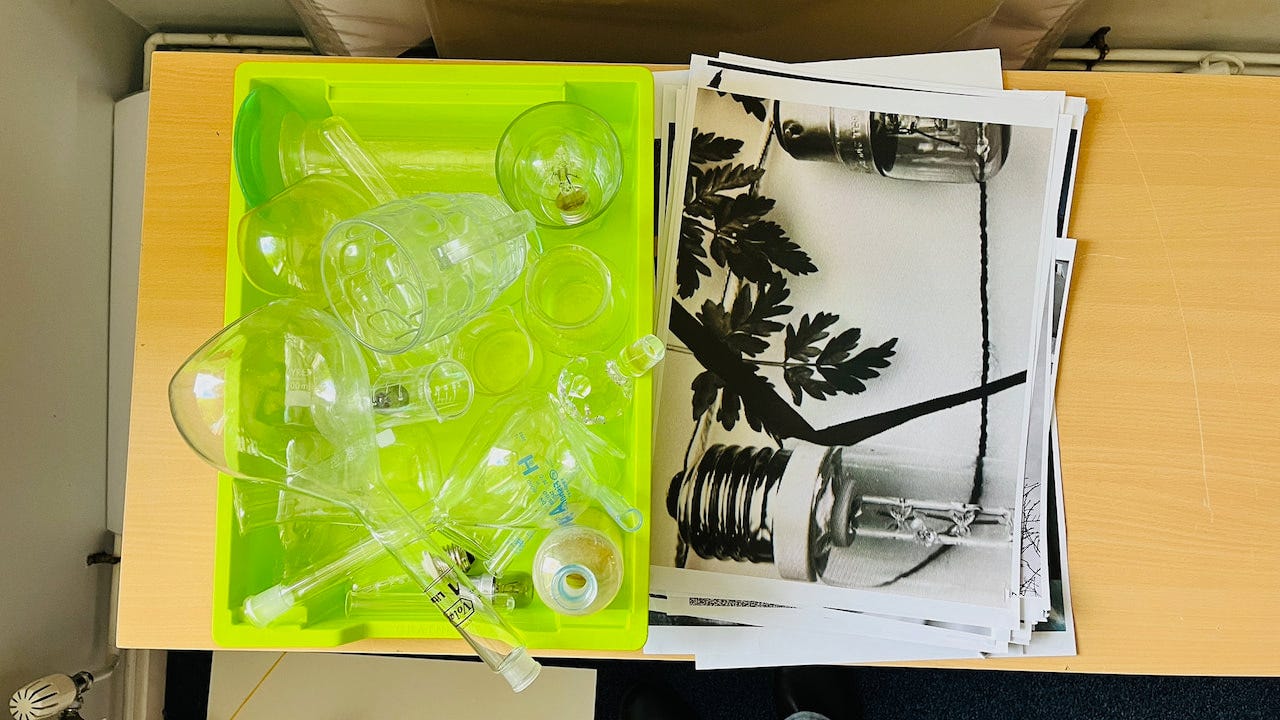
My attitude to Photoshop and cameras is contentious, I know. It shocks some of my counterparts, I get that. Firstly, I don’t think Photoshop makes any difference to anything - I think it’s closer to painting actually, and I love painting, but Photoshop doesn’t interest me at all. I try to get students to consider their recording in a way that avoids the need for cropping even. I don’t like manipulation. Don’t get me wrong, I’m not a luddite or even a purist, far from it (honest!) it’s just that’s not what we’re doing here. Students use Irfanview (free online, ugly but effective), Picasa, Pixlr - whatever they like, I don’t really care - to alter contrast, crop if necessary, convert to black and white, all the things you can do in a darkroom really. It’s enough. This isn’t a degree course.
8. Art
Following on from that I think it’s important to remember, and remind the students, that this is an Art course, and at A level. It’s not GCSE anymore, but it’s not graduate either. And it’s not a vocational course - I’m not training them to be professional photographers for fashion shoots or weddings. It might help; probably won’t do any harm, but that’s not the aim. Some students drop out when they realise this, for others it comes as a pleasant relief. These are not IT lessons, there’s no sit-down written exam, there’s no text book or essays … for better or for worse.
9. Equipment
Similarly, I make absolutely no distinction between iPhone imagery and photographs made on a DSLR. Students are never without their phones, they fit in a pocket, are quick and easy to use, and they can upload directly to the college servers instantly. I’m convinced the likes of Lytro and Photosynth are going to make any notion of technical knowledge obsolete in the near future. Teaching depth of field might make me feel clever and useful but I’m not convinced it’s the best use of our time together.
Graham is clearly concerned to clear away potential barriers in the discipline of photography education, to make space for experiments. His attitude reminds me a little of Josef Albers who famously said, “Good teaching is more a giving of right questions than a giving of right answers” and “I have always tried to develop discovery and invention which, in my opinion, are the criteria of creativeness.” Graham is less interested in the techniques, processes and tools of photography, than in the images that can be made. However, Albers was also obsessed with the “How”, not the “What”. Aren’t the meanings of photographic images partly shaped by the materials, processes and techniques from which they are made? If focus, for example, is a core concept in photography, how do Graham’s students develop a relationship to it? Is it possible to sidestep technical knowledge entirely or is Graham suggesting that photography teachers should be wary of fetishising the technology to make room for more ‘art’?
10. The assessment objectives
I should mention here that I centre my work absolutely on meeting the assessment objectives, at every point. Succeeding and achieving on the course and making good art isn’t mutually exclusive. I want both to happen. That’s really important - every lesson, all lesson, at every stage. I talk about responses, development, refinement. I use those words and phrases because that’s the language of the course specification, and that’s okay. A good specification with any luck has come out of an understanding of the natural art-making process. Structured correctly, the assessment criteria should be met as a by-product of the process. Relax.
11. Central strategies
The 5 hours are essentially a group critique. I can easily look at images that they’ve taken over the past week, uploaded and projected on the whiteboard. We can gather round. We can ask questions. It can be laugh-out-loud funny or profound, sad or strange. But they have to account for their time. They see how others have involved themselves in their own lines of enquiry. We talk about shutter speeds and apertures certainly - if and when it’s relevant - and we might talk about function and context, or sometimes, even, farmland and faces. They share solutions, enquire into reference points, and offer resources. It is open, positive, constructive, intense but very enjoyable and deeply satisfying. Like being at art college all over again. Importantly it’s a meaningful and authentic experience for me too. I don’t know what will be said or shown. The adventure is real, for everyone there.
12. Writing
I minimise the amount of writing students do. I found that such a relief. Language, as referred to in the specification, doesn’t need to be written. It can (and is) visual. It has it’s own vocabulary and grammar. The assessment objects talk about recording, for instance, in visual “and/or other forms”. I use annotations, and headings. These provide signposting and easy navigation, for us, them, and a moderator later on. Most of what they write, when left to their own devices, doesn’t add anything to the pictures anyway necessarily. We’re better off without it.
Ah yes, shutter speeds and apertures when “relevant”. The phrase “Like being at art college” is significant. Earlier on, Graham reminds us that A-levels aren’t “GCSE anymore”, but they’re “not graduate either.” It seems like there might be a sweet spot between the somewhat formulaic approach at GCSE and the pseudo-professional standards of degree level art making. I love the idea that teacher and students are all engaged in a collaborative “adventure”. Marvellous. I’m less sure about the approach to writing. I used to be an English teacher and I like to think that words and pictures have equal authority. It’s true that many students who choose A-level photography don’t relish the idea of the written component of the course. My feeling is that they need help with this and so should have some opportunities to practice their writing about photographs and photography. Organising one’s thoughts in clear, coherent sentences is a useful activity. It’s hard to think complex thoughts without access to complex linguistic structures. I’m not suggesting that this should dominate the business of picture-making. But I do believe that photographs, as distinct from other types of visual imagery, often depend on words for their meanings. This is a feature of the history of the medium. Most photographs are not made for primarily artistic purposes - advertising imagery, the family snapshot, the photojournalistic document etc. A-level photography might be part of the Art & Design set of specifications, but I don’t think it’s the same as Fine Art. I think it’s important for students to understand the intrinsic, historic and contemporary, relationship between photographs and words.†
13. Entertain
Every lesson needs to be a party. If they’re not entertained (funny hats, surprise bubble blowing - use the aircon vent, it works perfectly - old wooden bird calls…) they’ll not want to come, or at least arrive on time, and frankly if they’re not entertained nor will I be. The first five minutes is a funny story, amazing fact, music video with commentary. They’ll want to boot up a PC, update their neighbour and take off their coat anyway. But the rest of the session needs to be an entertainment too, ideally.
Hmm. Not sure about this one. Never really fancied myself as a Red Coat. However, I do think humour is crucial. Schools can be a serious place and a little levity helps to lighten the load.
14. See every student, every lesson
So three times a week I check in with all of them, face to face. Some of them will need 30 seconds, just to confirm they are continuing with the problem you gave them to solve last time you spoke, others might need 30 minutes. That said, I aim to make every interaction as short as possible. I just give the single biggest, simplest thing they can do to improve (develop and refine, to use the language of the specification) not a list of everything they could do - it’s overwhelming and would take all day. They can come back later if and when they’ve done that and get the next thing on the list. There’s probably only about 10 in the list (“make the light work harder in your photographs”, “use words in your presentation to signpost how you’re explicitly meeting the assessment criteria”…), and then you still have time to find something good in their work to praise too (“Your language is rich and powerful, and I love reading what you have to say about what you’ve noticed, so thank you”). Happy days.
15. Be a butler
We have the encyclopaedic photographer database that they don’t, built up over years of looking at books and going to exhibitions, so we are best placed to offer them connections to work of others that they can use to discover a) the shortcuts, b) the trapdoors. Save them the time and effort. It’s a gift to yourself and them.
I love the emphasis on one-to-one tutorial support here. The butler metaphor is cool. Passing on what you know, your wisdom and experience, without overwhelming the poor student with a million references. Avoid showing off.
16. Books and magazines
Our department has invested a lot of money over a long period of time in good photography books, and we subscribe to Aperture and The British Journal of Photography. We’re lucky like that I think and have a solid collection of monographs by key practitioners with little writing. There are some big go-tos. If you can dig out a copy of Jonathan Miller’s Nowhere in Particular, you’ll get what I mean. Every page is a project. You’ll have your own maybe. Likewise exhibition catalogues. It also saves them endlessly googling “Cool photographs for projects”. How depressing that is. I don’t use Pinterest, that’s a personal choice, and Colossal is a lot of Photoshop gumpf by the looks of things, no disrespect. I need them to have reference points they can assimilate.
17. No written feedback
They don’t read it anyway. All our projects are presented on Google Slides which has a very useful feature allowing you to record audio feedback (and video, should you wish), up to 30 minutes long. That saves time and fingertips, let me tell you. Use your shutdown marking and feedback weeks to (what, you don’t get them?!…ask your senior leadership team, you NEED those!) blast through them, with time afterwards for them to develop, improve and modify their work.
No, we don’t have shutdown and feedback weeks either!
18. Resources
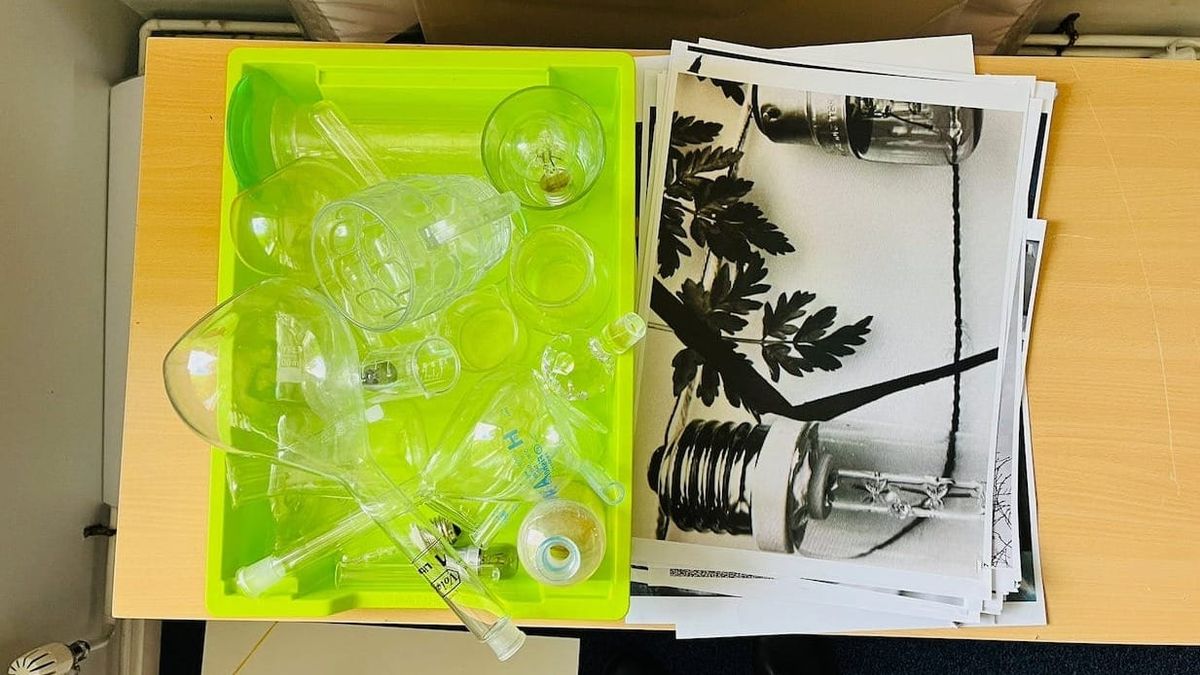
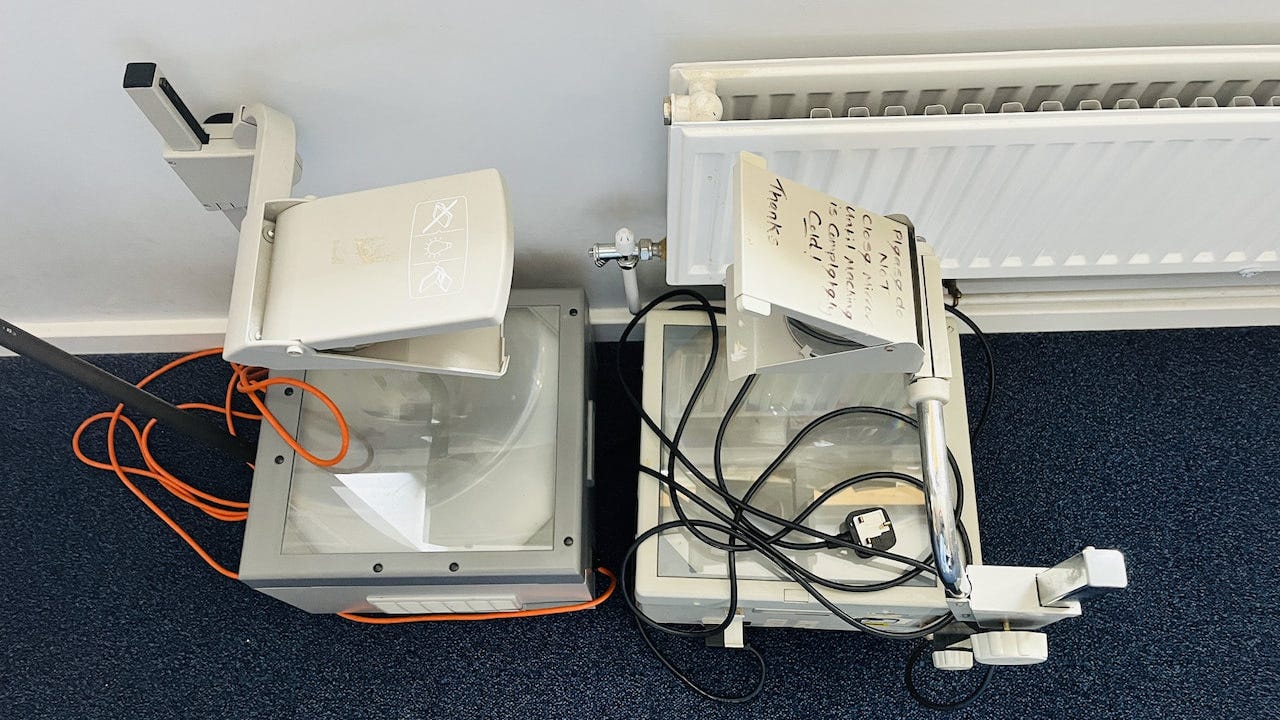
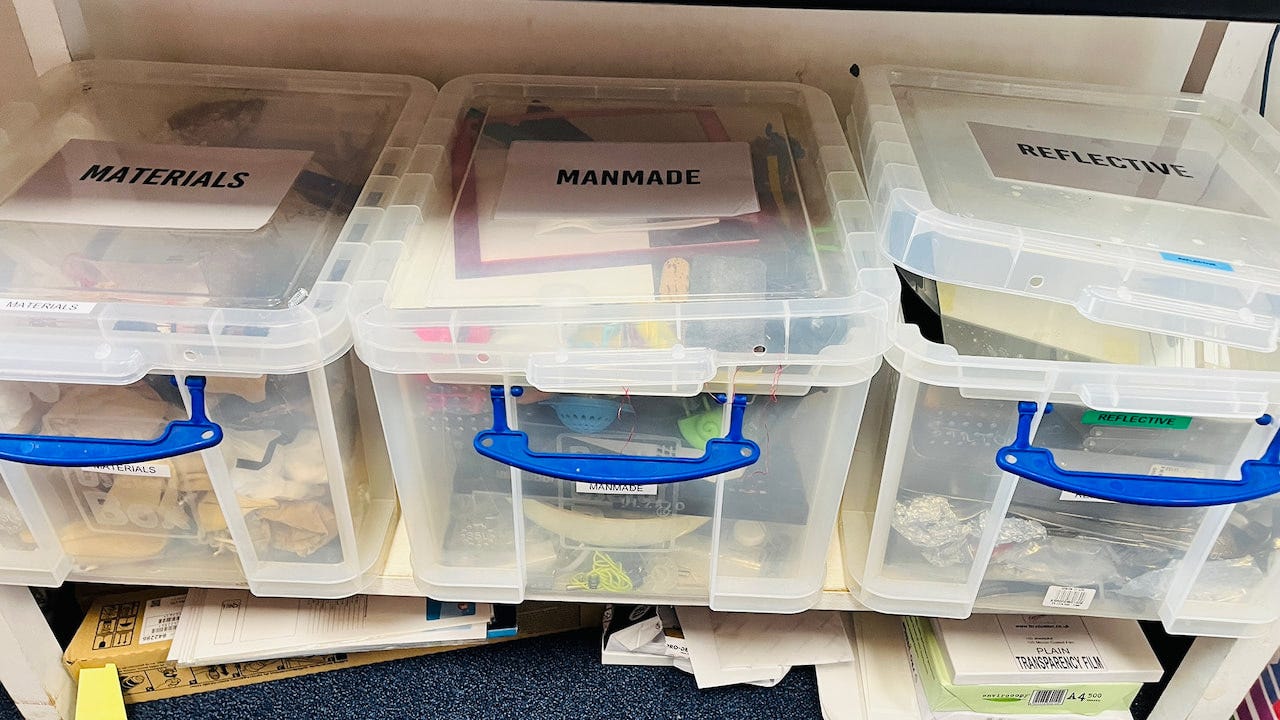
I have a box of shiny objects, lightpads, natural forms on windowsils, a stack of perspex shapes, an overhead projector (remember those, brilliant they were). For those seemingly lacking any visual sensibility (yes, they enrol on the course), I’m amazed at how some string and wire arranged pretty randomly on a lightpad and photographed from directly above in and in high contrast black and white can somehow become attractive to the most hardened ‘non-artist’. “Now go do some more,” I say, “and find me in 20 minutes…I’ve got a nice book that I really think you’ll enjoy looking at” (The Shape of Light Tate exhibition catalogue!)...
Yes, yes, to all these lovely materials and simple, transformational play strategies.
19. Leave work at work
Try this, arrive no sooner than 15 minutes before your first lesson of the day (to use the loo and put the kettle on), and leave as soon as possible after your last lesson. Then get home, walk the dog, go to the gym, watch a film, read the paper, do a crossword. You need your energy when you get back tomorrow. Our job is utterly relentless, we don’t really need reminding. You need to arrive with your best 100%, creativity on demand, your A game, and demand the same of them. They get their pound of flesh.
Then at the end of the day, I stop. There’s always more you can do, better, differently. It doesn’t end. You know that. Stop it. Just an idea.
20. No Powerpoints
Give them the deadlines, give them the assessment criteria, then do photography. The first term I go through Stephen Shore’s The Nature of Photographs. No need for any other images, it’s all in there, high quality printing in their sweaty hands. Plenty of everything, to inspire, conspire, to confound you and them. I have 25 copies. One heavily annotated by me over the decade. Even before you open the book the front cover suggests what’s going to happen; we’re going to hold photography up to scrutiny. We’re going to realise the photograph is not the photographed. It’ll be odd but strangely fun.
A helpful reminder to save your strength and enjoy the quality of Stephen Shore’s observations. I would add John Szarkowski and Jason Fulford to the list, but you’ll have your own gurus. “The photograph is not the photographed.” A-level photography in a nutshell.
21. Displays
Print off work, put it up, look at it, write on it, move it around, put it up around the site, change it around, then do it all again. Life’s better with interesting things to look at. I’m sure the students can help. #blutack
22. Trips
Mmm…they all want one, 80% take the letter home, 60% of them bring it back signed, 40% get their risk assessments done, 20% turn up on the day, and you’ve got half your team out and have prepared cover. Mmm…but for those 5 students it can change their world forever. Mmm…are you near a good gallery or a train station on a direct line to a big city…? Mmm…
23. Accurate, sensitive and comprehensive
I still believe that the most beautiful thing in the world might be a thing seen on its own terms. Observed as if for the first time, with respect and innocence. I think things get more interesting the more you look at them, anything that is. Our job might just be to slow them down enough to realise that their job is simply to notice things, and notice them properly, carefully and honestly.
24. The most important subject in the world
When it comes to open evening, or taster days or welcome days lets all be reminded that the world is the internet (cooking, shopping, holidays, dating…) and the internet is pictures (not etchings either, but photographs), so knowing how and why they behave, or misbehave, and could be made to behave and misbehave is a great skill to have. It’ll help you have fun, know right from wrong, never be bored, and maybe even earn you some money.
Not much to add to these final 4 observations. A brilliant summary of the value of a good photography education. Slowing down, looking carefully, having fun, recognising beauty in the everyday. Thanks Graham!
Do check out Graham’s original articles on the website and another Photopedagogical reflection by Nicole Stager. If you fancy contributing your views about teaching photography (at whatever level), do get in touch. Thanks to everyone who uses the resources on the website and takes the time to to tell us about what they do and don’t like about them.‡
Thanks for reading PhotoPedagogy! Subscribe for free to receive new posts.
These posts will always be free but, if you enjoy reading them, you can support my analogue photography habit, and that of my students, by contributing to the film fund. Thanks to those of you who have already done so. All donations of whatever size are very gratefully received.
* Maybe I should have asked him?
† I’m fairly certain that I have done Graham a disservice here. I don’t mean to suggest that he does not care about writing or the value of a well-turned phrase. I do sometimes feel that visual arts teachers can be a bit afraid of writing and words, even a bit hostile. I get it. Schools don’t tend to value (or even recognise) visual literacy and spend a disproportionate amount of time on words and numbers. I do believe in what Stephen Shore refers to as “a kind of visual thinking without words” and I wrote my school’s Visual Literacy Policy which, ironically, no-one reads.
‡ Actually, we’ve only ever had very positive feedback but we’re not averse to critique. We’re fully aware that the resources are less diverse than they should be and that we have very considerable blind spots.