From the Bookshelf
Luce Lebart — First Times, First Photos

Boats by the beach
I don't have my first photograph, only a vague memory of it. It was taken on holiday in Menorca, in the early 1980s. Some boats and a shoreline, I think. I like to imagine it had something about it, the arrangement of colours and shapes perhaps. I'd just begun my art A-level. It was my first flight in a plane and my first foreign holiday. I think it was also the first time I'd held a camera, my dad's Canon AE-1. I entered the print in a school competition, where it was praised but didn't win. Not surprisingly. It was a pretty conventional image. I didn't pick up a proper camera again until I was twenty-one, when my parents bought me a Nikon EM. If you asked me when I started making photographs I'd probably say then. So which one is the first?
A flag in a river
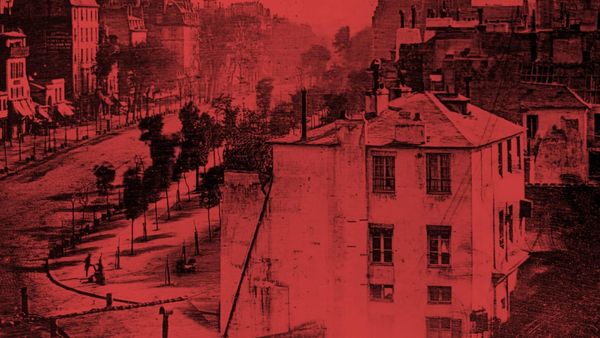
I came across Luce Lebart's First Times / First Photos in a bookshop in Amsterdam and bought it on my return to London. It's the catalogue of an exhibition at the Pavillon Populaire in Montpellier (1 July to 1 November 2026) and Lebart's first show as the venue's artistic director. It's linked to the French Ministry of Culture's Bicentennial of Photography, which runs from September 2026 to September 2027 and takes as its founding date Niépce's view from his window at Le Gras, usually given as 1826 or 1827. The Maison Nicéphore Niépce celebrated the bicentenary two years ago, dating the invention to 1824. Even the birth has two birthdays.
Next spring the plate returns home. It has lived since 1963 in the Harry Ransom Center in Austin, Texas, where Helmut Gernsheim's collection took it after he found it in England in 1952. From late April to June 2027 it will be shown in France, at Chalon-sur-Saône, for the first time since it was made. Then it goes back to Texas.
I've seen it. In 1994–95 I spent a year teaching in Austin on a Fulbright exchange, and one afternoon I went to look at the first photograph. It was a little anticlimactic: a shiny piece of pewter in a case. I tilted my head from side to side, trying to find the window or the roofs. Most people who know the image have never had that experience. What they've seen is a 1952 reproduction that Gernsheim retouched by hand so that it looked the way he thought it should. The textbook first photograph is partly painted. The visitors queuing at Chalon next spring will stand where I stood, looking for rooftops in a mirror.

That was also the year I started taking photography seriously. I traded the Nikon EM for an FG and a couple of lenses. I filled my suitcases with some great second-hand photobooks from the shops on Guadalupe: Eggleston, Goldin, Meatyard. The beginning of my photography education. I shot hundreds of Kodachrome and Fujichrome slides, which then sat mouldering in a loft for thirty years. I scanned them last year. If Müller-Pohle is right that there are many first photographs, that year holds a few of mine.
A national celebration of an origin is a flag planted in a river by the ministry. What interests me is how often Lebart seems to stand on the bank and watch it drift.
The egg and the gift
The exhibition and book open with a photograph from 1923 of a man in a dark suit staring at an egg in an egg cup. It is a demonstration of the Mirœuf, Victor Mendel's aluminium egg cup with a mirror in it, which sent light through the shell so you could check the egg was fresh. A cheap kitchen gadget for seeing inside things. The caption mentions Aristotle and the chicken-and-egg paradox, which runs through the book as a joke about origins: there is always something before the first thing.

What is a "first image"? A proof, a test, a feat, a failure, an event, a memento, or even a catalyst?
Édouard Boubat refuses the premise: "There is no first photo. There are only new photos. The light is new today." The book never quite chooses between Boubat and the patent office.
Then there is the gift. In 1839 the French state bought Daguerre's process and, in Arago's phrase, gave it to the world. Daguerre's agent had taken out an English patent days before, so the gift had a hole in it the shape of Britain. Talbot fenced off his own negative process with patents in turn, and the negative won anyway. On page 98 Lebart writes that France bought the patent to "give it to the world". The quotation marks are significant. The book holds the founding generosity at arm's length.
Fox Talbot is a brief entry and a series of footnotes. He's in the main text on p. 70, presenting his photogenic drawings at the Royal Institution in January 1839, but the footnotes have the last word. He "would eventually abandon his own terminology to adopt the more effective nomenclature of his friend Herschel." His Latticed Window of August 1835, "considered the earliest surviving photographic negative", appears in the introduction as an inset the size of a caption. It is a window too, the rival founding window, printed small and nearly blank, a pale violet rectangle with the lattice barely there.


The same page gives Hercule Florence his due. He wrote "photographie" in his notebooks in Campinas, Brazil, around 1833–34, years before Herschel used the word at the Royal Society. The book has room for the origin that happened an ocean away and went unnoticed.
Particles
For all its playfulness the book is mostly built from two French archives. By my rough count of the picture credits, the Société française de photographie supplies around 47 pages and the patent office, the INPI, around 31. Between 1839 and 1901 the INPI registered 4,022 photographic patents. The "gift to the world" set off a stampede of people trying to own a piece of it.
Lebart's introduction ends with a promise: "All the practices and uses of photography find their place here and receive equal attention." In the chapter of innovations, by my count, about 61 of the 73 captioned entries are by French makers. Léon Gimpel alone has nine, as many as all the clearly non-French makers put together. It's what happens when a book is built from the archives within reach. But equal attention is a claim, and the credits page tells a slightly different story.
The patent pages are the funniest in the book. Edmond Bloch's Edmus of 1889, a camera hidden behind a tie so you could photograph "without anyone noticing". Mattioli's photo-velocipedic stand. A chimney sweep from Millau with a smoke-consuming apparatus. A rotating hedgehog bottle drainer that the caption, not unreasonably, compares to Duchamp. Then the trade names, which read like found poetry: Le Merveilleux, Le Summum, Ze Rapide, Pif Paf Pouf. Swap any of them for a current phone's camera mode and the hyperbole hasn't moved. About a quarter of the patents were filed by foreigners, Eastman and Muybridge among them, who came to Paris to protect what they'd made.
A patent is a particle claim: one name, one date, one object. The book is full of them, and then it keeps letting the word "first" slide into its other meanings. A photograph headed "Thomas Edison at the controls of the first electric streetcar" turns out to be c. 1910. The caption hands the credit to Pirotsky, Siemens and Sprague, and in the picture a motorman in a cap is at the controls while Edison leans out of the next window. A first-class metro car in 1945 is a first in the sense of rank, and the caption turns it into a page on social hierarchy. The first sea bath of the season is a first that comes round every year.

Wet beginnings
The book opens in the sea. Anna Atkins's cyanotypes of British algae, from what is usually called the first photographically illustrated book, come before anything French. Hers, along with the space telescope pictures at the far end, are the only images in the book cut across the gutter or sliced in half by the page edge. A cyanotype is a contact print, so its edge is the paper's edge and the alga is life size. Splitting it turns the object into a picture of the object. It also lets the plant flow across the spread, which puts the sea back into specimens Atkins had pressed and dried before they touched the paper.
Once you notice the water it's everywhere. Niépce's bitumen plate was developed in a bath of lavender oil and white petroleum. Bayard staged himself as a drowned man in 1840, a complaint about being denied priority that the press kit now credits with several firsts, the first staged photograph among them. Niépce de Saint-Victor coated glass with beaten egg white (the egg again). Le Gray made the sea at Sète out of two negatives, one for the water and one for the sky. Louis Boutan's diver at Banyuls holds up a dissecting tray with "underwater photography" written on it, a photograph naming itself under water. Wilson Bentley photographed snowflakes before they melted, more than five thousand of them, and insisted no two were alike, so each one is a first that can't happen again. Léon Gimpel took his autochromes into the ice cave at the Bossons glacier in 1907.
Heraclitus is usually quoted as saying you can't step into the same river twice. The fragment thought closer to his own words says something better: on those who step into the same rivers, different waters flow. The river keeps its name while the water changes. "Photography" is like that. The book steps into the river again and again looking for the source and finds ripples, rings spreading from a stone that has already sunk.
Michelle Henning's A Dirty History of Photography taught me to notice when photography gets its feet wet. Lebart shares her fascination with the chemistry and almost none of her darkness. For most of the book the water is a pleasure.
Boulders
A river with nothing in it can look still. What reveals the current is the rock it has to go round, and the book has a few.
The section called "Firsts both major and minor" has a rhythm I didn't expect. Jack Aeby's colour photograph of the Trinity test, 16 July 1945, faces Citroën's first 2CV. A few pages on, China's first hydrogen bomb faces a boy in rural France with a battered toy truck. Between them come a boy shaving for the first time and a Burgundy family round their first television, both by Janine Niépce, a distant relation of Nicéphore. Les Trente Glorieuses and the nuclear age arrive together. France's "entry into the ranks of nuclear powers" is written up like a confirmation.

The captions don't always stop the music. Trinity is told as a story of photographic luck: an overturned chair for a tripod, four frames of colour film borrowed from a friend, the second "by chance, perfectly exposed". Hiroshima, three weeks later, isn't mentioned. The China caption is more serious and ends on Beijing's declaration, that same day, that it would never be the first to use nuclear weapons. In a book of firsts, a vow never to be first.
France's own bomb, Gerboise Bleue, Reggane, 13 February 1960, never appears as a fireball. It arrives as news: Parisians at the Place de la Bourse reading France-Soir's headline that it had exploded "avec succès". The caption is frank about the secret clauses in the Évian Accords that let testing continue in Algeria until 1967, and about contamination that wasn't publicly acknowledged until the archives were declassified in 2013. On the facing page, dated the same day, African students protest at Karl Marx University in Leipzig. Barry Seydou, from the Mali Federation, says his hometown is about 300 kilometres from the test site: "African peoples have no need for the atomic bomb. We want to live in peace and demand an immediate end to colonial domination in Africa."

He is the first person in the book to speak against a first. The photograph came through the East German state photo service, so the protest was also Cold War publicity. The caption doesn't say so, and doesn't need to. It's the one place where the delight stops, and Lebart lets it stop without comment.
There are smaller rocks too. Albert Kahn's operators made the first colour photographs of Albania, Bosnia, Mongolia and Algiers, French firsts made in other people's countries. One caption says Berber women and mosques "can be seen in relief through these special glasses". A 1916 French tank is "turned... into a piece of visual innovation". Henning would have stopped for a closer look. Lebart moves smartly on.
Not yet
Towards the end of the book, photographers describe their first photograph, a survey agnès b. started in 1992. These are the best pages, because here people look carefully at their own pictures. Elsewhere the captions tend to look past the image to the history of the object in it. The boy shaving on p. 164 holds an electric razor with its flex hanging down, and the caption tells the story of Gillette's safety razor of 1895.
Andreas Müller-Pohle sets out the categories: "there are many 'first photographs': the very first, the first good one, the first truly personal one, and so on." He chose a window photograph from 1977, light and shadow on a wall. The book officially begins at Niépce's window.
I wasn't sure how much of it came from me, or whether it was still a picture made under someone else's influence.
The someone was Ralph Gibson.
Cristina de Middel photographed her neighbour's window across the street in Valencia, again and again. "I stole photographs because I didn't dare ask for them." The camera served her "more as armor than as a pretext for approaching her". Her entry ends in capitals: NOT YET. A first that postpones itself.
Richard Billingham gives one sentence, the shortest entry in the book: "These are the first images I made that point toward the ones that would follow." A first is only a first because of what comes after it. His dad, Ray, is asleep under a blanket. it’s a gentle picture of a man who would later be turned into a spectacle.
Boris Mikhaïlov's real first photograph, a young woman with a cigarette, "remained with the KGB". So did the negatives of Suzi, his first wife, standing naked in a river at dawn, which cost them both their jobs. The print he can show is inscribed "1967/1992", a 1967 negative printed and annotated a quarter of a century later. A first remade after the event, in the mist, in the water again.


Open corners
Lyosha Kritsouk's design is a moodboard of a book. Pictures are pushed to the page edge and the captions are displayed as dense columns at the back of each chapter, in typefaces that argue with one another. The cover sets each word of the title in a different century. FIRST is a heavy nineteenth-century grotesque, PHOTOS a wide display serif off a playbill and Times is blackletter, borrowed from Gutenberg and newspaper mastheads. The Fraktur drop caps carry on inside, at the beginning of each entry. Spector's own wordmark is blackletter too.
The cover is framed by rough black brackets that look like the border you get from a printed negative, the darkroom's sign for the whole frame, uncropped. The corners never meet. Atkins's blue has gone. The cyanotype is printed black on silver cloth, the colours of a daguerreotype plate. I may be reading too much into a cover, but it looks like an English first reissued in French livery.


Downstream
The last chapter before the end is a run of space telescope images of stars being born: Hubble and Webb among them, the Pillars of Creation three times over. Wavelengths no eye could see, given colours by convention so we can read them. One caption admits its picture of the Lynx Arc is "an artistic rendering based on observational data". At the far end of a book about photographic firsts, the origin of everything turns out to be partly drawn.

Before the stars there is a chapter of Libération front pages, and it turns out to be a chapter of lasts. When Cartier-Bresson died in 2004 the paper showed him as a young man in New York in 1935, eye to the viewfinder, under the headline “L’instant décisif”. When Agnès Varda died in 2019 it chose a photograph of her from 1954, the year she made her first film, taken by Édouard Boubat. At the end of a life, the paper goes looking for the beginning.
The exhibition ended with Mishka Henner's Photography Is, a list of definitions gathered from search engines. The book ends somewhere else. Its last image is Joan Fontcuberta's Googlegram of 2005, Niépce's view from the window rebuilt out of thousands of pictures found online. From a distance it is the founding plate. Close up it is everything that came after.

My Menorca picture could, in theory, be somewhere in that mosaic, or one very much like it. Boats on a shoreline taken by a hundred thousand people that summer.
Thanks for reading PhotoPedagogy! Subscribe for free to receive new posts. If you know anyone who would enjoy these ramblings, do please share the site with them.
These posts will always be free but, if you enjoy reading them, you can support my analogue photography habit, and that of my students, by contributing to the film fund. Thanks to those of you who have already done so. All donations of whatever size are very gratefully received.