From the Bookshelf
Michelle Henning — A Dirty History of Photography: Chemistry, Fog and Empire.

► 01
The cover of Michelle Henning's A Dirty History of Photography is a photograph by Wolf Suschitzky, Charing Cross Road (puddle jumper), 1937. A woman leaps over a puddle in the rain. She is cropped at the waist and her legs are a blur. The slick puddle vibrates with ripples, reflecting the city lights but not her. The picture is dark and slippery.
The obvious comparison is with Cartier-Bresson's man behind the Gare Saint-Lazare, five years earlier, whose puddle is still enough to be a mirror. He and his reflection almost close into one sealed figure, reflecting the jumper on the hoardings behind. The picture became the emblem of the (somewhat misunderstood) decisive moment. That phrase was his American publisher's. The French title was Images à la sauvette, which is how street hawkers sell, without a licence and poised to scarper. Cartier-Bresson's own phrase is closer to Suschitzky's grubby movement than the American translation suggests.
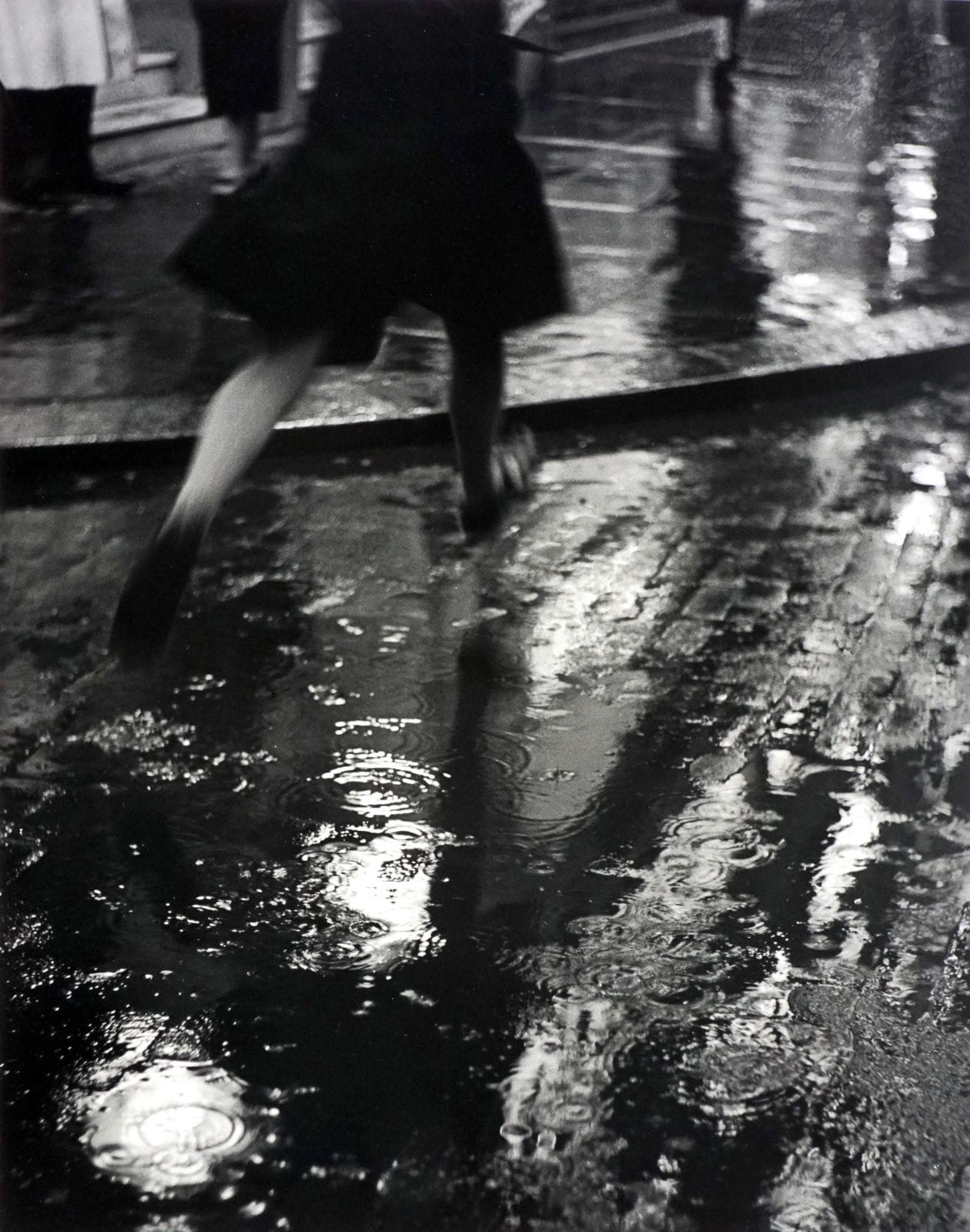
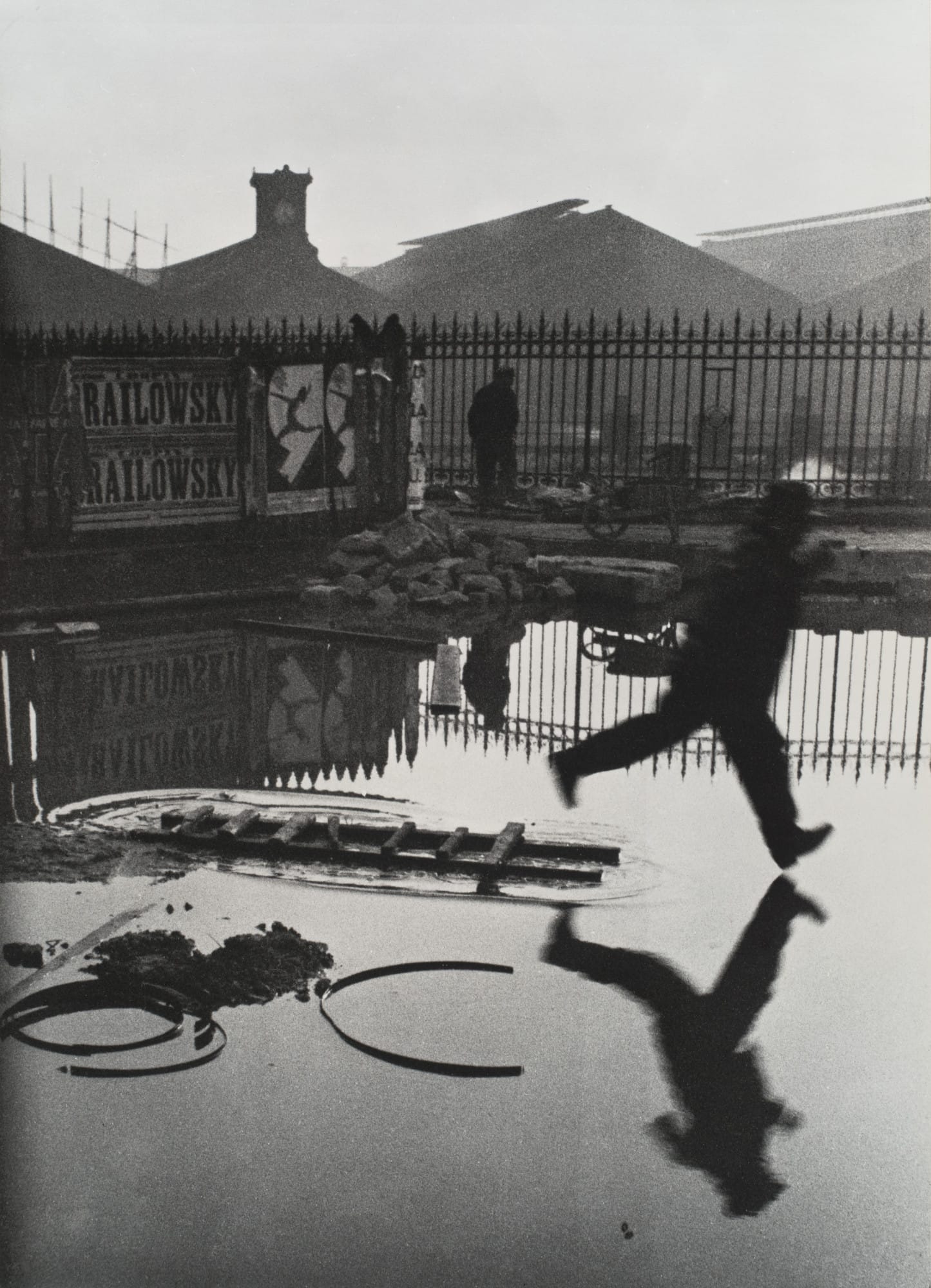
Wolfgang Suschitzky - Puddlejumper, Charing Cross Road, 1937 and Henri Cartier-Bresson - Behind the Gare St. Lazare, 1932
Whoever selected the cover image is providing more than decoration. Suschitzky has almost a whole chapter of his own, "The Pathetic Fallacy", which comes just before "Breathing the Light". Ruskin's phrase named the habit of lending feelings to weather and, decades later, he described a "plague-cloud" over industrial England as a moral blight. He was looking at pollution and feeling it as mood. Henning holds the two readings together and Suschitzky's wet streets are one of the places she does it. As a key image for the book it shows a grainy photograph made in bad weather and still moving.
► 02
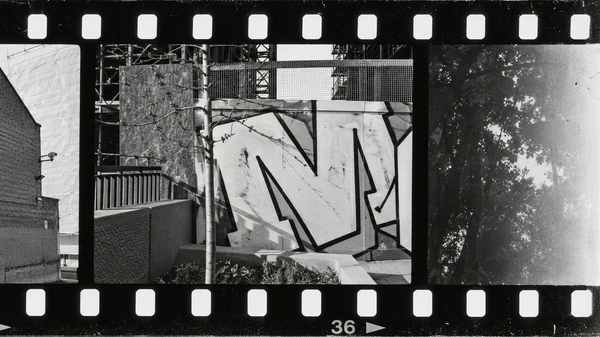
One of my Year 13 students recently asked me to scan a roll of film for her. The classroom scanner was on the blink. I was happy to oblige. Unfortunately, her negatives had partly stuck together in the drying cabinet and some frames were disrupted by ghostly sprocket holes. I cleaned up the worst of them with Lightroom and ChatGPT (for speed) and sent them back to her. In my haste, I forgot to send her the originals.
She was upset, rightly so. She felt I had deceived her by sending pictures that looked strange and a bit too good. What she received were plausible versions of her photographs, a little over-sharpened, with small inventions I, in my haste, hadn’t noticed. I sent the original, damaged scans, apologised, and we had a long chat about it. I argued that technology is neither good nor bad, that what matters is how it's used. That it wasn't as simple as photography = good, AI = bad. Photographs are abstractions. Lots of people hated photography in the early days and it‘s had its own disturbing entanglements with extraction, pollution, colonialism and totalitarianism. Not surprisingly, she wasn't persuaded. She would rather have her damaged images and learn from them than the more obviously fabricated versions. And I realised I’d broken my own rule, using AI for optimisation, like a digital servant, rather than a critical companion, a surface to think against.
I'd started Henning's book weeks earlier and put it down. This conversation sent me back to it. Henning proposes reading photographs diagnostically, for "the marks and blotches of an image" that "speak of the very air that surrounded it." Read that way, my student's negatives are a record of the drying cabinet: its damp, its warmth and two strips of gelatin touching in the wrong air. The software I used enhanced the pictures but removed the air.
► 03
Before Henning’s contents page there‘s a short prose poem about a thing “conceived in a storm and in darkness, born within sight of coal mines, its sibling an internal combustion engine.” It keeps company with "consumptives, diabetics, and addicts," and passes through many hands "before it was tamed and put to work in a factory." Then chapter one opens on a giant creature hiding in a cave. It can't bear light or touch, breathes only purified air, and is changed forever by one exposure.
The cave is the coating room at Harman Technology in Cheshire, which still makes Ilford film. Henning visited in 2018 after months in the archives of Ilford Limited, the largest British maker of photographic materials between the wars. Watching the screens that monitor the coating bed, she "imagined this creature in the cave beyond." Emulsions, she realised, are sensitive "not only to light but to atmosphere, humidity, dust, temperature, and the oils in people's hands." The Frankenstein echo is deliberate. She is "happy to think of photographic materiality as lively if not strictly alive," and less happy with older theories that cast photography as aggressive and predatory. Her creature is shy.
She tried writing it as a conventional academic book and, by her own account, found the long chapters dull. So it became thirty-six short ones, the number of frames on a roll of 35mm film. "Treating the chapters as snapshots," she says, "enables me to shift between different narrative scales and registers." The design plays along, with numbered frames and small arrows at the page edges like the markings on a film rebate. The illustrations mix documentary photographs with Ilford's advertising and packaging and the film labels alone are an education: Matt Hyper-chromatic, Aerial Infrared, Oscillograph Type M. It’s printed on thin, slightly shiny coated paper, the least foggy surface the chemical industry makes, which I didn't love.
The range of reference is close to encyclopaedic, from Davy's laughing gas to Benjamin, Ruskin and Hervé Guibert's smoky lover. It is rigorous and readable at once and, in places, close to poetry. Henning, a professor in Liverpool, also works as an artist, and you can feel the maker in it.
► 04
Atmosphere is the book's long thread and it gathers slowly. London became the city of fog in the 1840s, just as the photographic "mania" took hold. "If the throats and lungs of city dwellers register it," Henning writes, "so do photographic materials." Sulphurous air fogged plates and the industry responded with sealed rooms, filtered air and air-conditioning. In 1930 and 1931 Kodak's British subsidiary even tried to bottle the London fog to analyse it.
Out of this she builds a way of reading, holding the two senses of atmosphere together, the meteorological and the affective. She traces the word to the Greek atmos, vapour or breath, and sphaira, globe. Atmosphere is ambient and vague, all-enveloping and at the same time peripheral: "we feel it or sense it while we face something else." The idea accrues across the frames. Air is chemical, then meteorological, then industrial and imperial, the smoke over Ilford's works and the humidity of the tropics. By the end, atmosphere means the whole set of conditions a photograph is made in. A photograph can show them as matter and as mood.
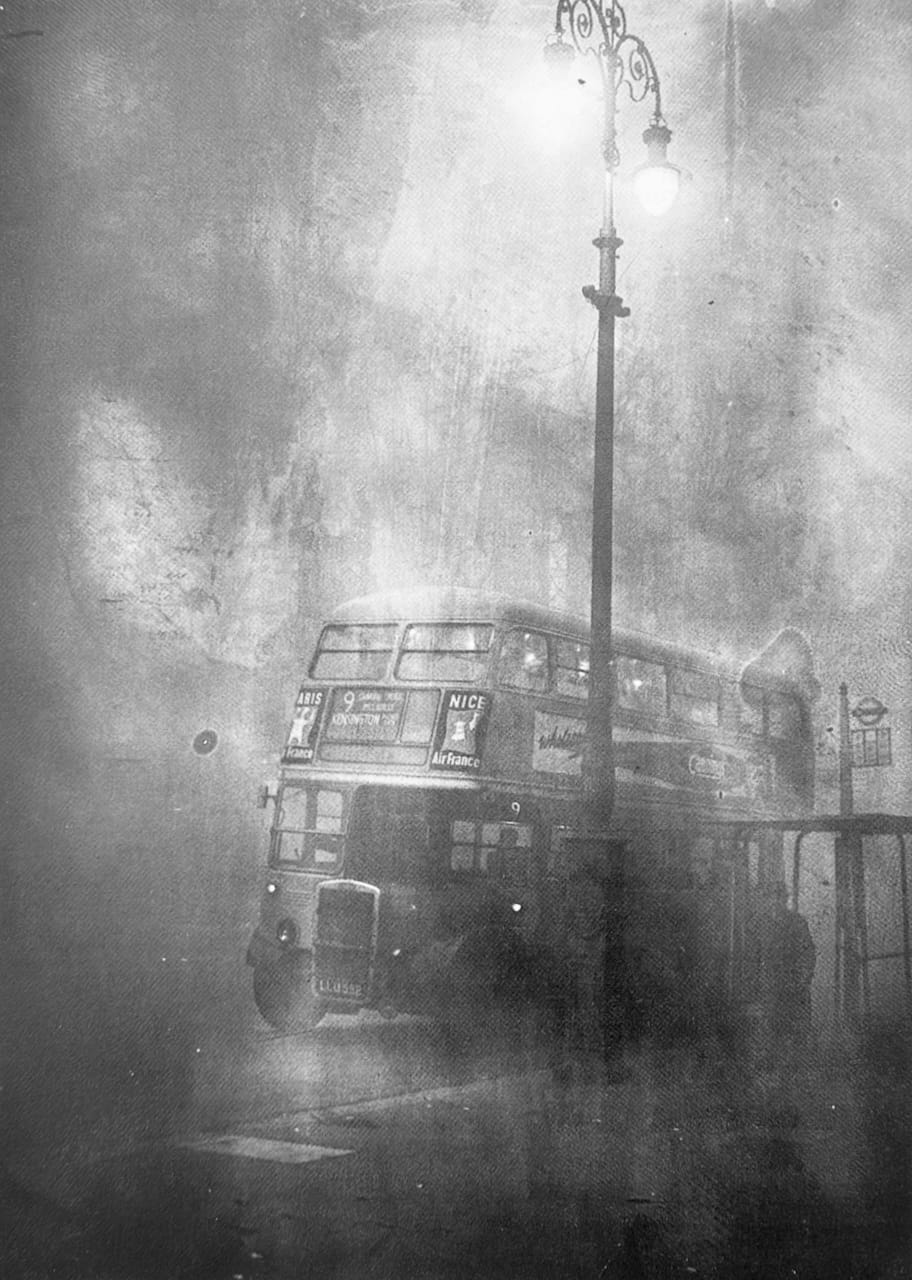
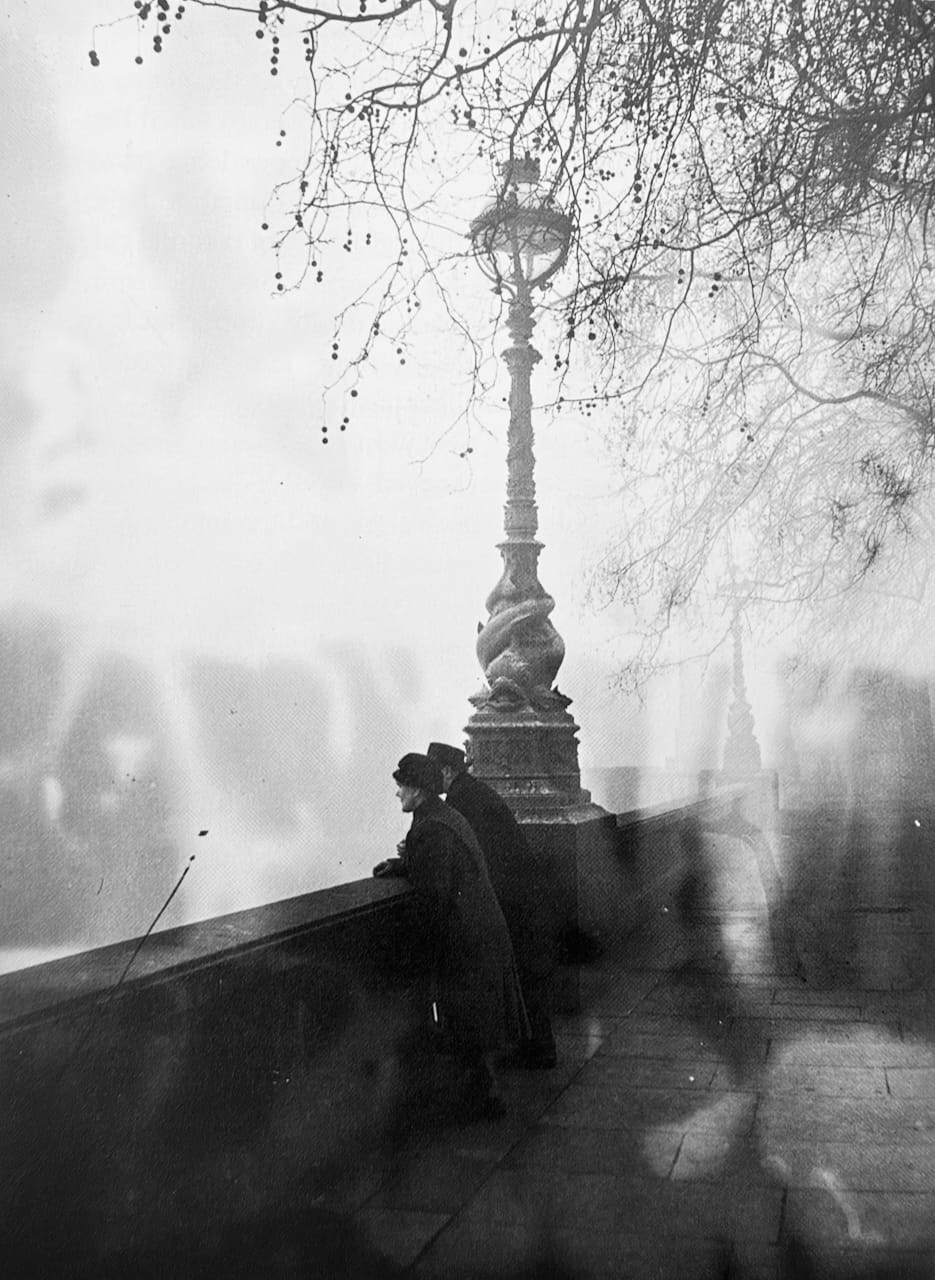
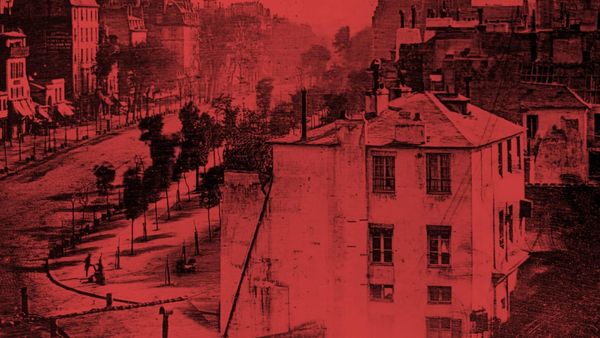
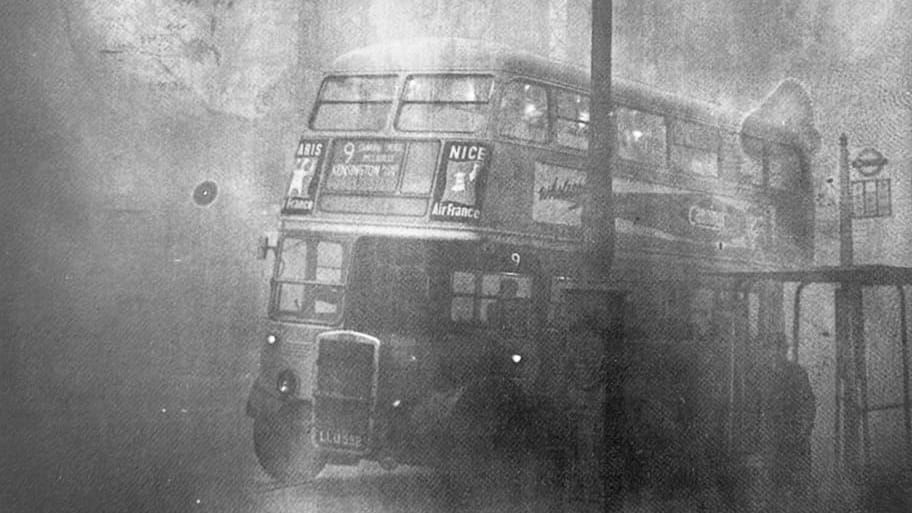
Edward Miller - Fleet Street, December 6, 1832 and Monty Fresco - Embankment at Blackfriars, London, December 5, 1952.
The book makes an atmosphere of its own. Henning says she wanted it "a little hallucinatory, as if nitrous oxide or toxic darkroom chemicals had left their faint traces on these pages," and it works on you that way. I found it connected and congealed after I'd stopped reading, overnight. I woke, after a restless night, with a new sense of the book's own swirling affect. Not a fog exactly. More like a miasma: something you breathe in, that changes you, whose workings are hard to trace.
But the miasma theory of disease was wrong, of course. Cholera came through the water, as John Snow showed in Soho in 1854, a few streets from Suschitzky's puddle. Miasma was the theory that blamed the air for what something else had done. There’s a chapter called "Bad Air". It's a reason to stay awake while the book does its work on you, since some of its connections are stronger than others.
► 05
We talk about photographs in the language of stillness: the frozen moment, the instant, the stopped clock. Theory has mostly agreed. In accounts of indexicality, Henning notes, "film is imagined as a passive recipient of light: it is exposed and it changes, something is done to it, but it does not act itself."
Her response is careful. The new materialists grant things agency, but emulsion doesn't do much. It waits and it registers. So she turns the argument round: "If we are going to grant agency to nonhumans, we need also to grant them passivity, recognizing that the capacity to be acted on is still a capacity." Passivity, she points out, is related to passion and suffering. Photographic materials offer "a model for passive vitality, in the form of sensitivity, receptiveness, an openness to impressions."
That sensitivity was managed. Between the wars the laboratories of Ilford, Kodak and Agfa tuned emulsions, "heightening them in some ways and dulling them in others," so that X-ray film went to hospitals and infrared to the air force. Henning borrows Rancière's "distribution of the sensible" for this. Teachers know all about this.
Latency is the other way out of the frozen instant. Between exposure and development there is a gap, "which could be very brief or last years or even decades," and it "ought to affect our perception of photographic immediacy." The developer that brought Talbot's latent image out came from oak galls, made by wasp larvae and shipped from the Levant, so the image "depended on a relationship between an insect and a tree, on gall pickers and on shipping routes from the Middle East." She follows latency into Proust and into Freud's Moses and Monotheism, where a buried trauma incubates like a disease before it returns. And she asks: "How do we distinguish between something that is present and active but hidden, and something that is present but inactive, if both are imperceptible?" It's a question about chemistry. It's also an educational issue for anyone familiar with debates about "visible learning".
► 06
Photography, Henning says, is a "daughter of coal" and of capitalist imperialism, "dependent for its materials on the extractive practices and trades of empire, a global market in chemicals, and, most of all, on the development of coal tar by-products." Ilford's headquarters sat alongside the chemical works of Howard and Sons. The industry depended on coal while coal smoke spoiled its products.
In "Worldings", drawing on Heidegger and Spivak, she argues that photography coproduces reality, gathering the stuff of the world and making it meaningful. "Except that material was never raw, never just given to us as a resource but always already a world." Someone else's world, often. Silver, gelatin and paper reached London through empire and Ilford's interwar expansion was overseen by a veteran of colonial campaigns in India.
Then war: poison gas, Marinetti, Benjamin's answer to him, Italy in Ethiopia, and Ilford's place in an expanding military-industrial complex. She quotes Esther Leslie: "The chemical industry had it all covered: it produced the bombs and the gases and the photographic materials." These are the darkest frames.
► 07
The school darkroom looks different after reading this book. The drying cabinet is a small weather system. The safelight, the trays and the damp all belong to Henning's history and so does what goes down the sink at the end of a lesson.
Her students are astonished to open a film camera and find nothing inside. "It is empty!" But it isn't. "Like our own lungs, it is filled with air." What a lovely teaching moment. To think atmospherically, she suggests, is to slow down light's passage through that air, "thickening and solidifying the air, making visible what is invisible."
Two of my students are currently working in this territory. One is attempting to grow crystals on darkroom prints, so the image becomes a place where something goes on happening. I pointed her to the Sustainable Darkroom, one of the collectives Henning names. The other is photographing friends and family and wondering whether the pictures might hold the love and care she feels. Hippolyte Baraduc claimed in the 1890s to photograph emotions on plates held near the body; they almost certainly recorded heat and moisture. Henning's materialism is kinder to him than debunking would be. The plate did sense something from the body. He just gave it the wrong name. If love is in my student's pictures, the carrier is probably the conditions, how close she stood and for how long, how easy her sitters were with her and how her choice of framing holds things together. Barthes called it the air of a face.
I recently reviewed Stephen Shore's The Mental Image and struggled to accept its central claim, that the photographer's inner image travels in the print to an attentive viewer. Its cover, Dieter Appelt's mark made by breath on a mirror, seemed to me a more honest version: presence arrives when it has a carrier you can see. Henning gives that carrier a history. My student is asking Shore's question and Henning's book is a better place, in my view, to look for a possible answer.
The book also unsettles a word I use unthinkingly. We tell students the print is 'fixed'. Henning's history suggests otherwise and so, in truth, does any print left long enough on a wall or stuffed in a pocket. Residual fixer yellows the highlights, silver creeps to the surface and mirrors, sulphur in the air browns the shadows. Fixing is a truce with the air and every print, everywhere, is still, imperceptibly, changing. This is also Duncan Wooldridge territory.
Latency belongs in the classroom too. What a lesson exposes may not develop for years and the teacher is rarely there when it does. Schools are built for the instant, the learning objective and the progress check. They want the image in the tray before the bell. Henning's gap between exposure and development, anything from moments to decades, describes most of what I think teaching actually does. Her question about telling the hidden from the inert is one of education's imponderables.
Atmosphere too. Much of what matters in a classroom is peripheral, the mood of a group, the weather of a term. It never appears in a scheme of work. A good deal of the teaching happens there. Schools, like Ilford's factories, spend a lot of energy filtering it out.
It might seem a stretch to bring Henning into education, but education could be considered another technology with a murky history and an uncertain future. It's bound up now with environmental degradation and artificial intelligence, while politicians talk about re-industrialisation. Calling education a technology might sound strange. It never works with a machine's supposed reliability. It's closer to Henning's sense of technology than to the factory's: sensitive, lively and never entirely under control.
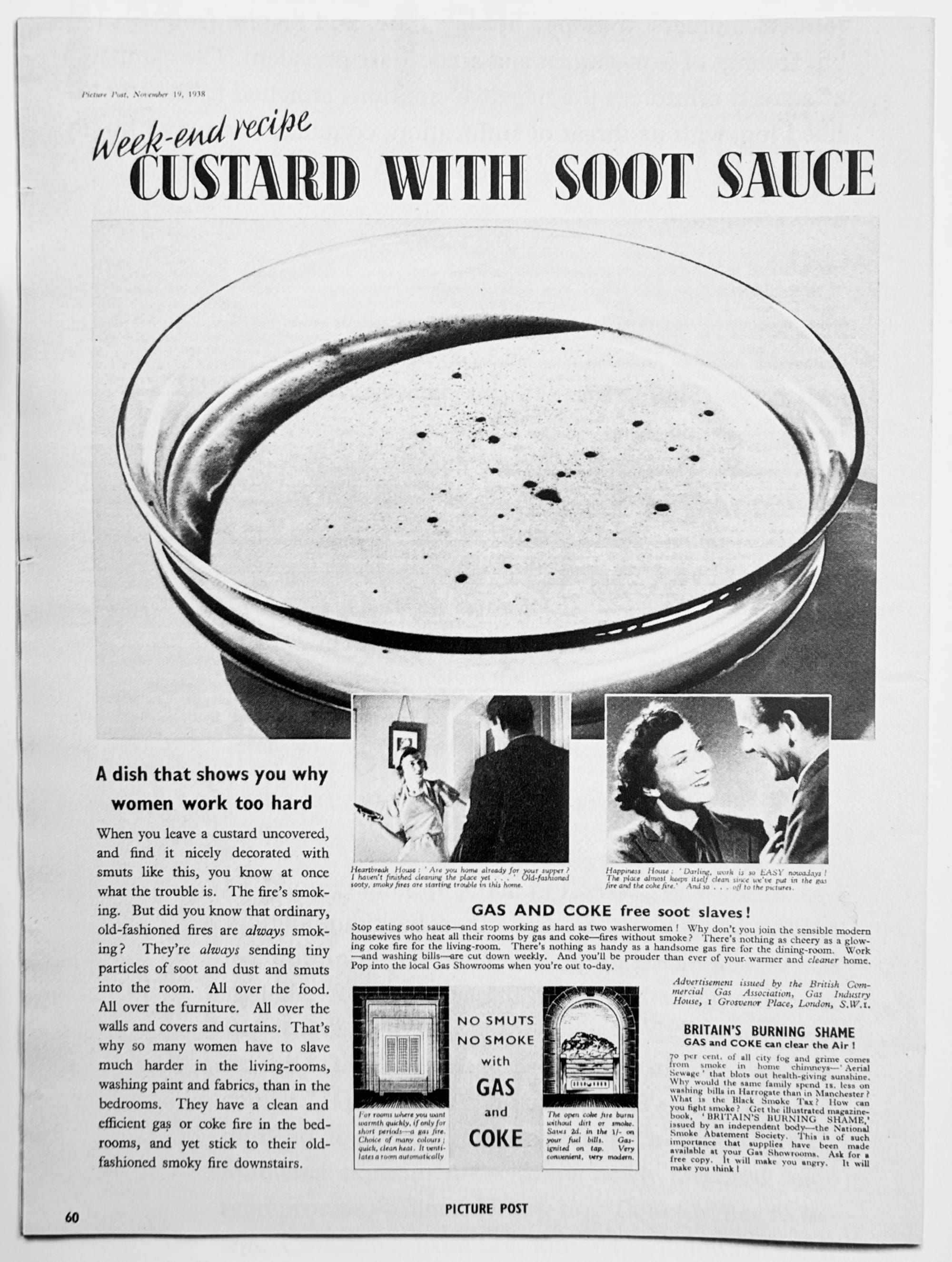
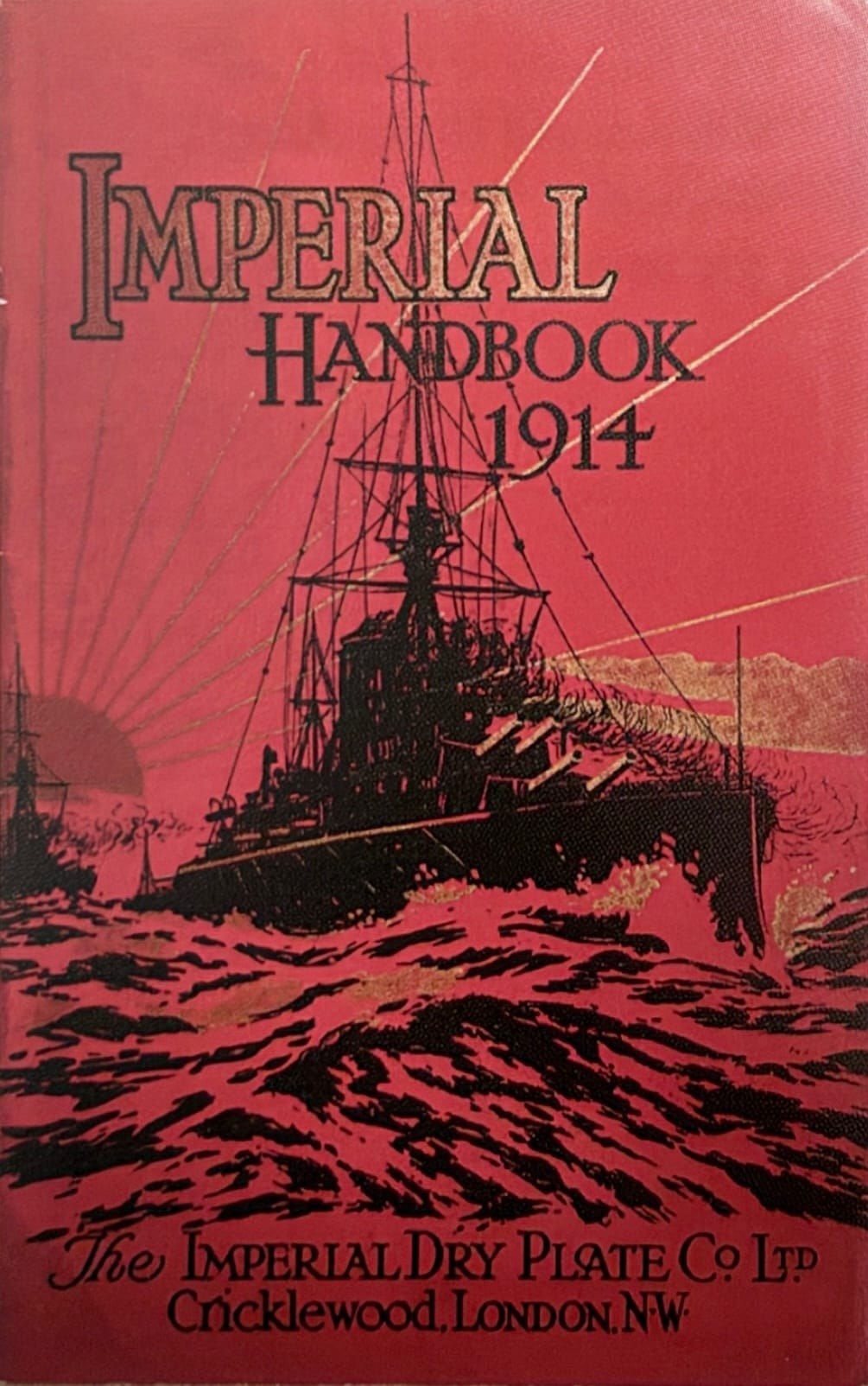
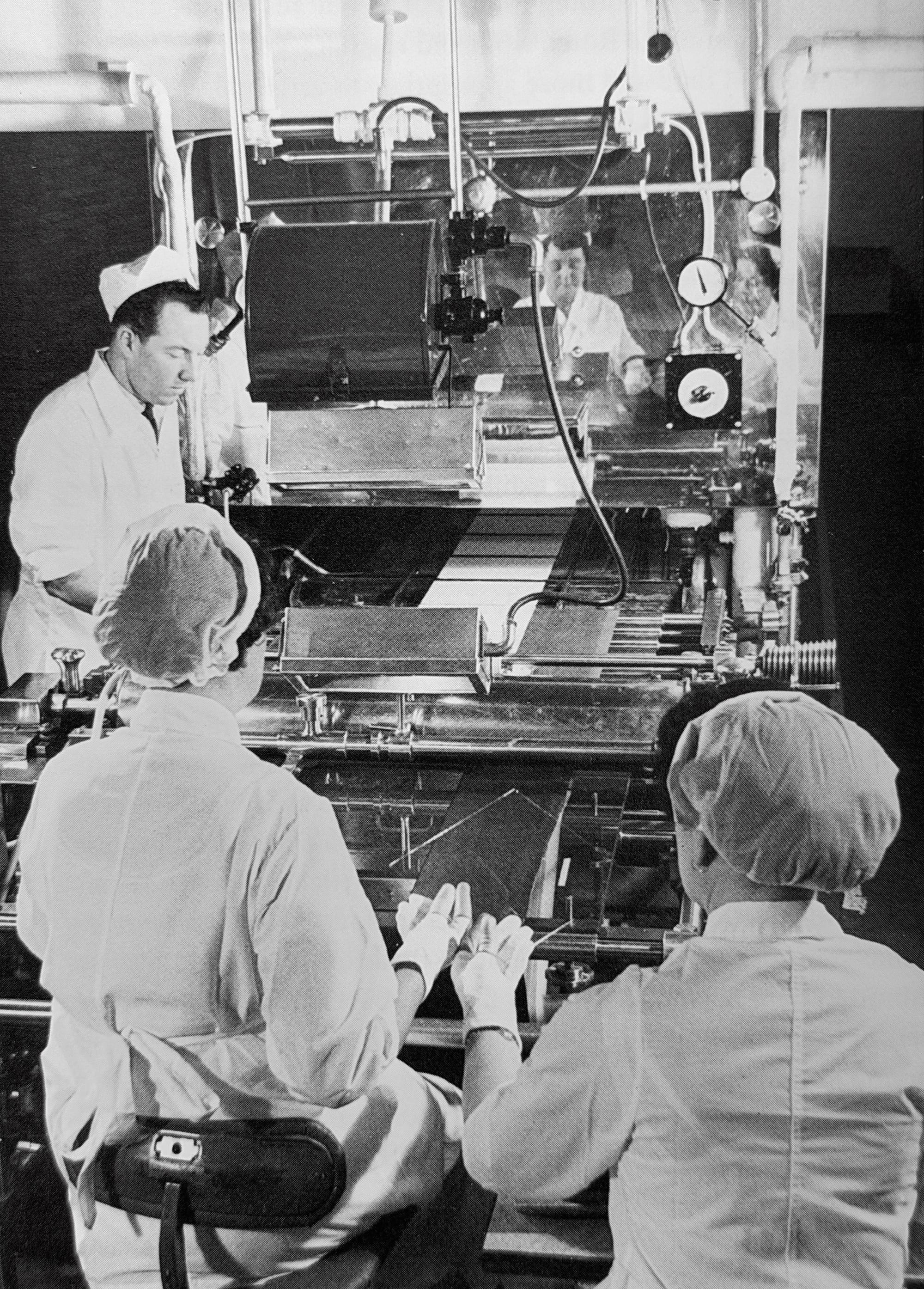
Left to right: Gas Association Advert, Picture Post, 1938, The Imperial Dry Plate Co. Ltd. film label and Maurice Broomfield - The Plate-Coating Section at Ilford, ca. 1960-65
► 08
The book ends with artists and collectives who rework photographic chemistry and revisit its contaminated sites. Henning is clear that their work is "not intended to suggest viable industrial alternatives for photography but rather to resituate photography in life." Then she returns to her opening image. Plato's prisoners are meant to leave the cave for the light. Henning sends her creature back in, imagining these artists "gently returning the creature to its cave and helping it to incubate differently, reinventing its chemistry, and recultivating its atmospheric sensitivities." The purified factory turns out to be the false cave.
Her last sentences are personal. "I rake through photography's dirty history, turning up its residues, and still I remain in awe of its magical and peculiar properties." She is glad Harman survives and she still has Ilford film in her fridge. Earlier she writes that "resignation is not a solution," and that "we have been exposed, and exposures cannot always be stopped."
I wanted a bit more resolution than that, at first. Sometimes the argument stretches thin and the connections feel speculative. A mystery wants a culprit, and this one turns up coal, empire, the chemical industry, the military and the weather.
Not all the dirt is the same, either. Silver down the drain and gelatin from cattle are harms a practice can change. The cyanotype's chemical kinship with hydrogen cyanide, which Lewis Bush made use of in Depravity's Rainbow, is history, and nothing done at the sink alters it. I would have liked Henning to say which is which. A historian is allowed to take a position.
Perhaps she does take one, though. Refuse to cast the creature out; help it incubate differently. She holds it lightly, the way a fixed print holds its image, knowing the air will get at it. The book works rather like a photograph. It accumulates more than it argues and leaves the reader to look after the developing.
The more I've thought about it, the more I wonder whether the apparent looseness is the method. Atmosphere, on Henning's own account, is vague and peripheral. An argument about it may have to work the same way, building up over thirty-six frames until the air in the pictures becomes visible. Some connections hold and some don't. The cumulative effect is impressive.
Meanwhile she’s set to lead a five-year research project on AI-assisted phone cameras as extractive seeing. Fog of a different kind.
Thanks for reading PhotoPedagogy! Subscribe for free to receive new posts.
These posts will always be free but, if you enjoy reading them, you can support my analogue photography habit, and that of my students, by contributing to the film fund. Thanks to those of you who have already done so. All donations of whatever size are very gratefully received.